 Add to Chrome
 Add to Firefox
 Add to Edge
On Hallucinations in Inverse Problems: Fundamental Limits and Provable Assessment Methods
May 13, 2026
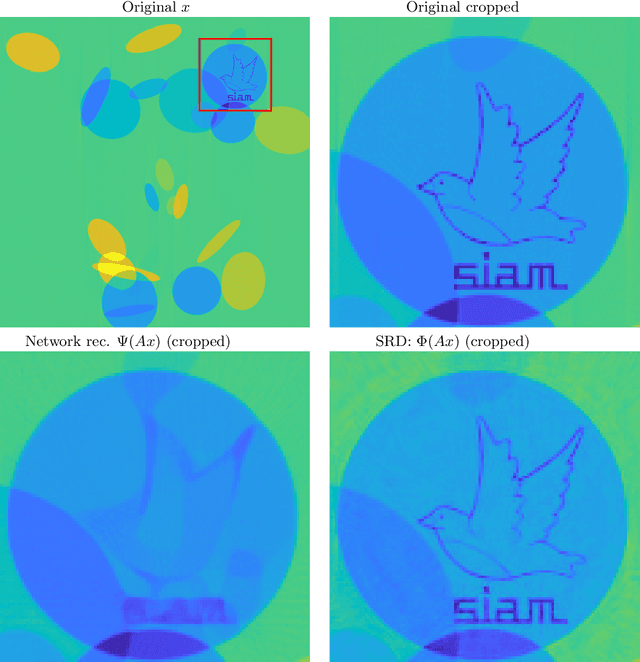
Artificial intelligence (AI) has transformed imaging inverse problems, from medical diagnostics to Earth observation. Yet deep neural networks can produce hallucinations, realistic-looking but incorrect details, undermining their reliability, especially when ground truth data is unavailable. We develop a theoretical framework showing that such hallucinations are not merely artifacts of particular models, but can arise from the ill-posed nature of the inverse problem itself. We derive necessary and sufficient conditions for hallucinations, together with computable bounds on their magnitude that depend only on the forward model. Building on this theory, we introduce algorithms to: (1) estimate the minimum hallucination magnitude achievable by any reconstruction model for a given input; (2) assess the faithfulness of reconstructed details by a given reconstruction model. Experiments across three imaging tasks demonstrate that our approach applies broadly, including to modern generative models, and provides a principled way to quantify and evaluate AI hallucinations.

The troublesome kernel: why deep learning for inverse problems is typically unstable
Jan 05, 2020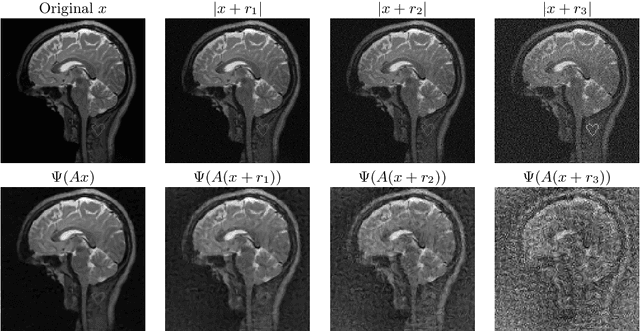
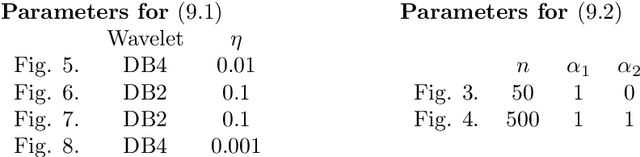
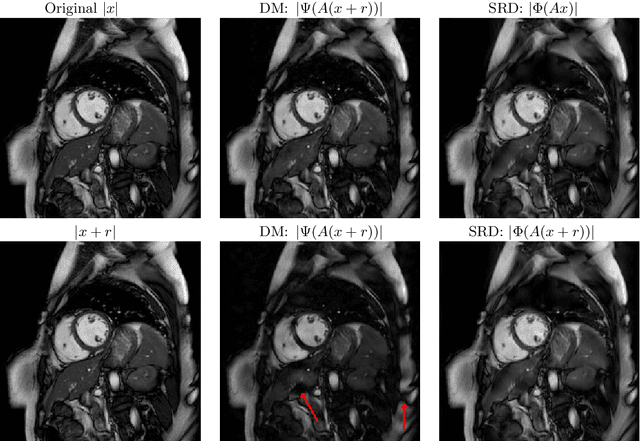
There is overwhelming empirical evidence that Deep Learning (DL) leads to unstable methods in applications ranging from image classification and computer vision to voice recognition and automated diagnosis in medicine. Recently, a similar instability phenomenon has been discovered when DL is used to solve certain problems in computational science, namely, inverse problems in imaging. In this paper we present a comprehensive mathematical analysis explaining the many facets of the instability phenomenon in DL for inverse problems. Our main results not only explain why this phenomenon occurs, they also shed light as to why finding a cure for instabilities is so difficult in practice. Additionally, these theorems show that instabilities are typically not rare events - rather, they can occur even when the measurements are subject to completely random noise - and consequently how easy it can be to destablise certain trained neural networks. We also examine the delicate balance between reconstruction performance and stability, and in particular, how DL methods may outperform state-of-the-art sparse regularization methods, but at the cost of instability. Finally, we demonstrate a counterintuitive phenomenon: training a neural network may generically not yield an optimal reconstruction method for an inverse problem.