 Add to Chrome
 Add to Firefox
 Add to Edge
Epistemic Trustworthiness in Generative AI: A Normative Framework for Warranted Reliance in High-Stakes Workflows
Aug 06, 2026
Generative AI systems are increasingly deployed in high-stakes professional contexts, where their outputs shape what users believe, how they reason, and what they treat as settled. This raises a central question for responsible AI: under what conditions is reliance on generative AI outputs epistemically warranted rather than behaviourally induced? Existing frameworks largely ask whether AI outputs are accurate, fair, explainable, safe, or trusted by users. These questions remain necessary, and each can contribute to warranted reliance. However, they do not directly specify warranted reliance as a distinct evaluative target: the conditions under which users are justified in treating AI outputs as inputs into their own reasoning. We argue that this requires an account of epistemic trustworthiness: what makes a system epistemically worthy of reliance. Drawing on philosophical accounts of trustworthiness as competence and audience-orientation, we develop a constitutive normative framework comprising three jointly necessary and non-fungible conditions. First, epistemic humility requires systems to represent and communicate the limits of their competence. Second, epistemic access requires systems to enable users to inspect, question, and contest outputs in context. Third, resistance to epistemic injustice requires systems to recognise users as legitimate epistemic agents and avoid marginalising their knowledge and experience. Through real-world case analyses in legal reasoning, medical reasoning, and hiring, we show how failures of epistemic humility, epistemic access, and resistance to epistemic injustice can produce consequential harms that standard measures of accuracy, fairness, and usability do not address on their own. We conclude by outlining design and evaluation implications for GenAI systems organised around epistemically warranted reliance rather than output correctness alone.

Learning from AVA: Early Lessons from a Curated and Trustworthy Generative AI for Policy and Development Research
Apr 20, 2026General-purpose LLMs pose misinformation risks for development and policy experts, lacking epistemic humility for verifiable outputs. We present AVA (AI + Verified Analysis), a GenAI platform built on a curated library of over 4,000 World Bank Reports with multilingual capabilities. AVA's multi-agent pipeline enables users to query and receive evidence-based syntheses. It operationalizes epistemic humility through two mechanisms: citation verifiability (tracing claims to sources) and reasoned abstention (declining unsupported queries with justification and redirection). We conducted an in-the-wild evaluation with over 2,200 individuals from heterogeneous organisations and roles in 116 countries, via log analysis, surveys, and 20 interviews. Difference-in-Differences estimates associate sustained engagement with 2.4-3.9 hours saved weekly. Qualitatively, participants used AVA as a specialized "evidence engine"; reasoned abstention clarified scope boundaries, and trust was calibrated through institutional provenance and page-anchored citations. We contribute design guidelines for specialized AI and articulate a vision for "ecosystem-aware" Humble AI.
Expanding the Generative AI Design Space through Structured Prompting and Multimodal Interfaces
Apr 22, 2025
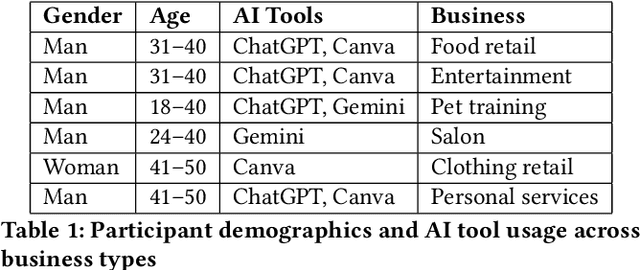
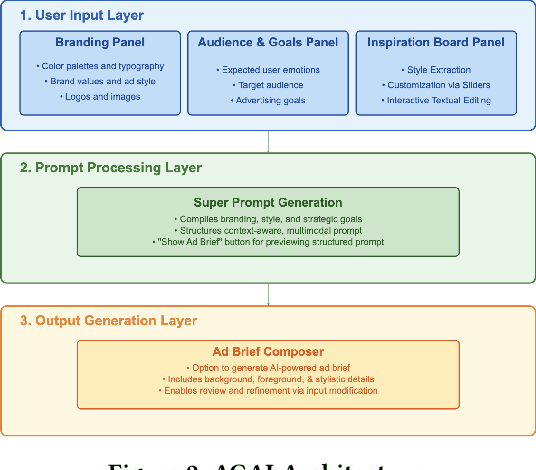
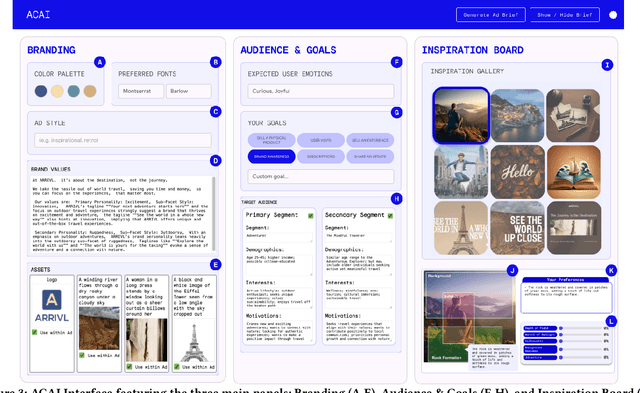
Text-based prompting remains the predominant interaction paradigm in generative AI, yet it often introduces friction for novice users such as small business owners (SBOs), who struggle to articulate creative goals in domain-specific contexts like advertising. Through a formative study with six SBOs in the United Kingdom, we identify three key challenges: difficulties in expressing brand intuition through prompts, limited opportunities for fine-grained adjustment and refinement during and after content generation, and the frequent production of generic content that lacks brand specificity. In response, we present ACAI (AI Co-Creation for Advertising and Inspiration), a multimodal generative AI tool designed to support novice designers by moving beyond traditional prompt interfaces. ACAI features a structured input system composed of three panels: Branding, Audience and Goals, and the Inspiration Board. These inputs allow users to convey brand-relevant context and visual preferences. This work contributes to HCI research on generative systems by showing how structured interfaces can foreground user-defined context, improve alignment, and enhance co-creative control in novice creative workflows.
ACAI for SBOs: AI Co-creation for Advertising and Inspiration for Small Business Owners
Mar 09, 2025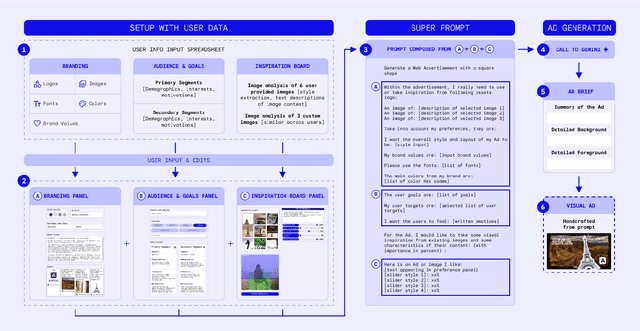
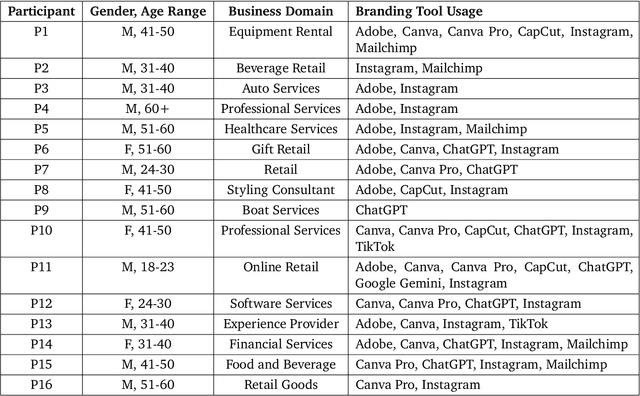
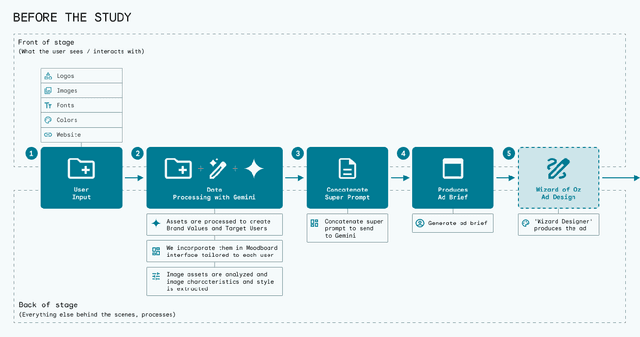
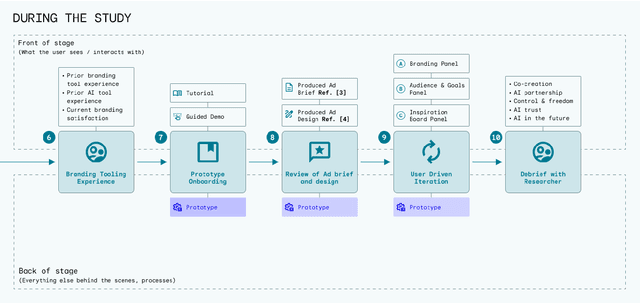
Small business owners (SBOs) often lack the resources and design experience needed to produce high-quality advertisements. To address this, we developed ACAI (AI Co-Creation for Advertising and Inspiration), an GenAI-powered multimodal advertisement creation tool, and conducted a user study with 16 SBOs in London to explore their perceptions of and interactions with ACAI in advertisement creation. Our findings reveal that structured inputs enhance user agency and control while improving AI outputs by facilitating better brand alignment, enhancing AI transparency, and offering scaffolding that assists novice designers, such as SBOs, in formulating prompts. We also found that ACAI's multimodal interface bridges the design skill gap for SBOs with a clear advertisement vision, but who lack the design jargon necessary for effective prompting. Building on our findings, we propose three capabilities: contextual intelligence, adaptive interactions, and data management, with corresponding design recommendations to advance the co-creative attributes of AI-mediated design tools.