 Add to Chrome
 Add to Firefox
 Add to Edge
SAGA: Structure-Attended Generative Action Embedding Model that encodes Multi-Surface User Action Sequences
Aug 15, 2026
Prior embedding models for sequential recommendation typically operate within a homogeneous action space, limiting their ability to capture cross-surface behavioral signals spanning distinct behavioral domains. We present SAGA, a generative action embedding model that encodes multi-surface user interaction sequences across a Financial Service organization's ecosystems, from checkout, peer-to-peer (P2P) transactions, in-app engagement, email to account actions, into a unified user representation for downstream recommendation tasks. Central to SAGA is a per-field tokenization schema that decomposes each action event into multiple field-level tokens (e.g. product, interaction, surface), enabling field-level attention and per-field training objectives that fused single-token approaches cannot support. Through an offline ablation study on loss formulation, tokenization granularity and training data scope, we isolate the contribution of each design choice. A downstream model integrated with SAGA-generated user embeddings delivers the strongest overall click and conversion lift across diverse downstream touchpoints, compared to all ablated and alternative architectures.

Blind Source Separation for NMR Spectra with Negative Intensity
Feb 07, 2020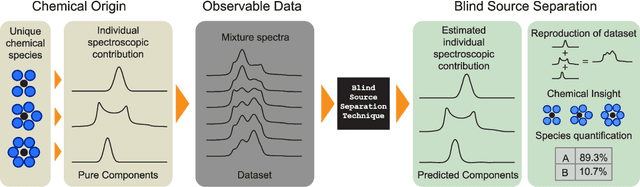
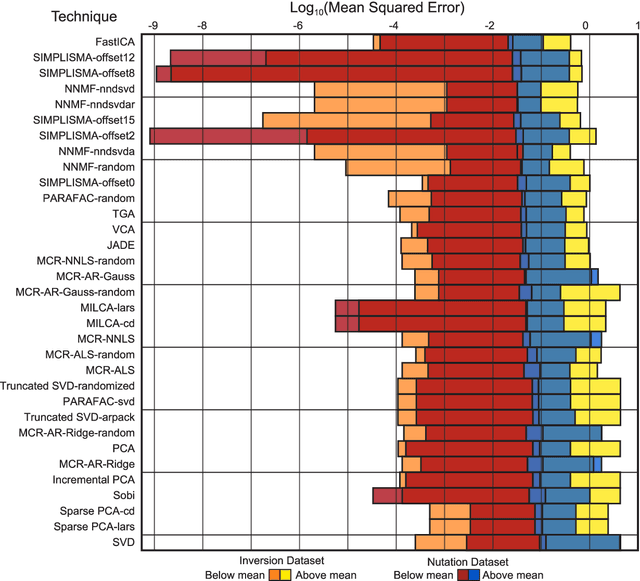
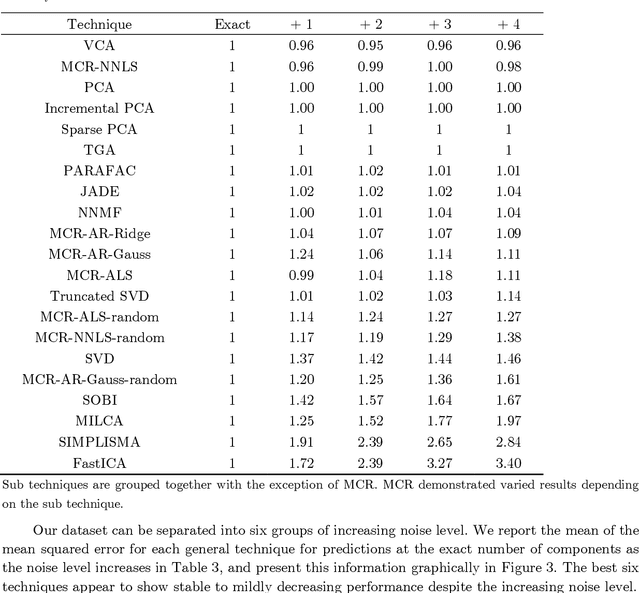
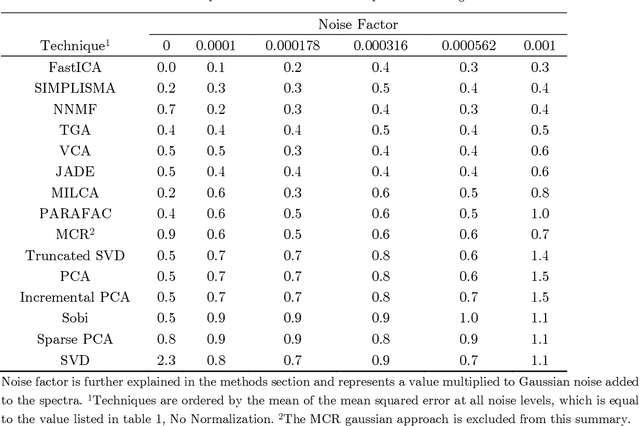
NMR spectral datasets, especially in systems with limited samples, can be difficult to interpret if they contain multiple chemical components (phases, polymorphs, molecules, crystals, glasses, etc...) and the possibility of overlapping resonances. In this paper, we benchmark several blind source separation techniques for analysis of NMR spectral datasets containing negative intensity. For benchmarking purposes, we generated a large synthetic datasbase of quadrupolar solid-state NMR-like spectra that model spin-lattice T1 relaxation or nutation tip/flip angle experiments. Our benchmarking approach focused exclusively on the ability of blind source separation techniques to reproduce the spectra of the underlying pure components. In general, we find that FastICA (Fast Independent Component Analysis), SIMPLISMA (SIMPLe-to-use-Interactive Self-modeling Mixture Analysis), and NNMF (Non-Negative Matrix Factorization) are top-performing techniques. We demonstrate that dataset normalization approaches prior to blind source separation do not considerably improve outcomes. Within the range of noise levels studied, we did not find drastic changes to the ranking of techniques. The accuracy of FastICA and SIMPLISMA degrades quickly if excess (unreal) pure components are predicted. Our results indicate poor performance of SVD (Singular Value Decomposition) methods, and we propose alternative techniques for matrix initialization. The benchmarked techniques are also applied to real solid state NMR datasets. In general, the recommendations from the synthetic datasets agree with the recommendations and results from the real data analysis. The discussion provides some additional recommendations for spectroscopists applying blind source separation to NMR datasets, and for future benchmark studies.