 Add to Chrome
 Add to Firefox
 Add to Edge
A practical probabilistic framework for deformable image registration uncertainty in radiotherapy dose propagation
Jun 08, 2026
Deformable image registration (DIR) is widely used in radiotherapy for dose propagation and accumulation, but uncertainty in the underlying deformation can substantially affect clinically relevant dose estimates. We present a practical probabilistic framework for propagating DIR uncertainty to voxel-wise dose statistics and dose-volume histograms (DVHs). The method models the mapped correspondence at each voxel as a random variable governed by a transparent local certainty map that can be defined by simple safety margins, structure-boundary mismatch, or structure-wise conservative uncertainty values. This yields interpretable quantities such as dose probabilities, expected dose, confidence bounds, and induced DVH envelopes. The framework is designed to remain lightweight and interpretable: it avoids complex biomechanical or ensemble-based uncertainty models and instead emphasizes simple parameterization, computational feasibility, and transparent dose metrics. We further introduce a structure-guided in/out strategy as an optional refinement that restricts mapping probabilities to anatomically plausible target regions. The approach is demonstrated on a prostate radiotherapy case study and used to compare different certainty-map strategies and probability kernels. The experiments show that the certainty-map design has a stronger effect on resulting dose and DVH uncertainty bounds than the specific kernel choice, while the additional benefit of the in/out strategy is case-dependent and modest in the present example. Overall, the proposed framework provides a transparent way to incorporate DIR uncertainty into radiotherapy dose assessment and to study how modelling choices affect propagated dose metrics.

Fully-deformable 3D image registration in two seconds
Dec 17, 2018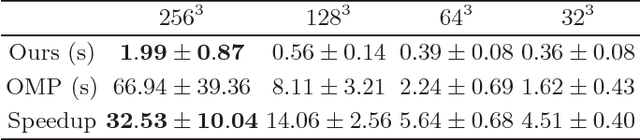
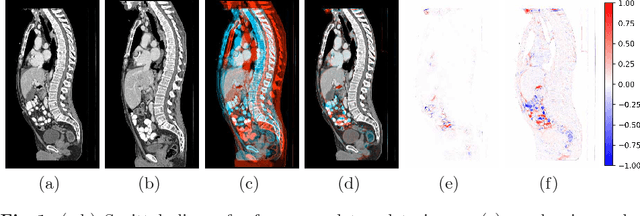
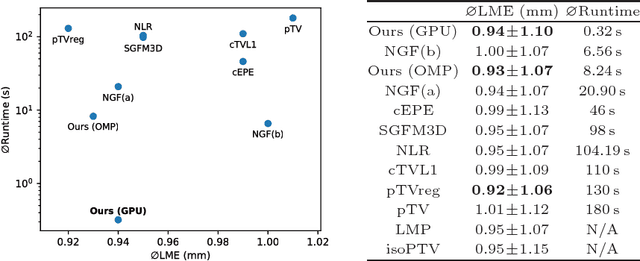
We present a highly parallel method for accurate and efficient variational deformable 3D image registration on a consumer-grade graphics processing unit (GPU). We build on recent matrix-free variational approaches and specialize the concepts to the massively-parallel manycore architecture provided by the GPU. Compared to a parallel and optimized CPU implementation, this allows us to achieve an average speedup of 32.53 on 986 real-world CT thorax-abdomen follow-up scans. At a resolution of approximately $256^3$ voxels, the average runtime is 1.99 seconds for the full registration. On the publicly available DIR-lab benchmark, our method ranks third with respect to average landmark error at an average runtime of 0.32 seconds.