 Add to Chrome
 Add to Firefox
 Add to Edge
Extracting Patterns of Chemical Information from Differential Mobility Spectrometry Measurements under Varying Conditions of Humidity and Temperature
Feb 23, 2026
Differential Mobility Spectrometry (DMS), also known as Field Asymmetric Ion Mobility Spectrometry, is a rapid and affordable technology for extracting information from gas phase samples containing complex volatile organic compounds, and can therefore be used for analyzing surgical smoke. One obstacle to its widespread application is the dependence of DMS measurements on humidity and, to a lesser degree, temperature, making comparison of data measured under different environmental conditions arbitrary. The commonly used solution is to regulate these environmental conditions to some predefined humidity and temperature levels. However, this approach is often unfeasible or even impossible. Therefore, in this paper we analyzed a dataset of 1,852 DMS measurements of surgical smoke evaporated from porcine adipose and muscle tissue to get an understanding of the impact of varying humidity and temperature on DMS measurements. Our analysis confirmed clear dependence of the measurements on these two factors. To overcome this challenge, we fitted regression models to raw and normalized DMS measurement data. Subsequently, these models were used for estimating DMS measurements for known tissue types based on recorded humidity and temperatures. Our test suggests that it is possible to estimate DMS measurements of surgical smoke from porcine adipose and muscle tissue under specific environmental conditions by standardizing DMS measurements separation voltage-wise and training multivariate regression models on the normalized data, which is the first step in removing the need for standardized measurement conditions.

Forecasting mortality associated emergency department crowding
Oct 10, 2024

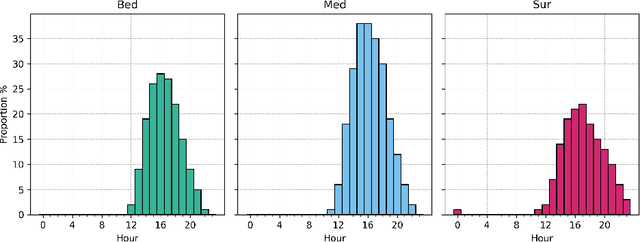
Emergency department (ED) crowding is a global public health issue that has been repeatedly associated with increased mortality. Predicting future service demand would enable preventative measures aiming to eliminate crowding along with it's detrimental effects. Recent findings in our ED indicate that occupancy ratios exceeding 90% are associated with increased 10-day mortality. In this paper, we aim to predict these crisis periods using retrospective data from a large Nordic ED with a LightGBM model. We provide predictions for the whole ED and individually for it's different operational sections. We demonstrate that afternoon crowding can be predicted at 11 a.m. with an AUC of 0.82 (95% CI 0.78-0.86) and at 8 a.m. with an AUC up to 0.79 (95% CI 0.75-0.83). Consequently we show that forecasting mortality-associated crowding using anonymous administrative data is feasible.
Forecasting Emergency Department Crowding with Advanced Machine Learning Models and Multivariable Input
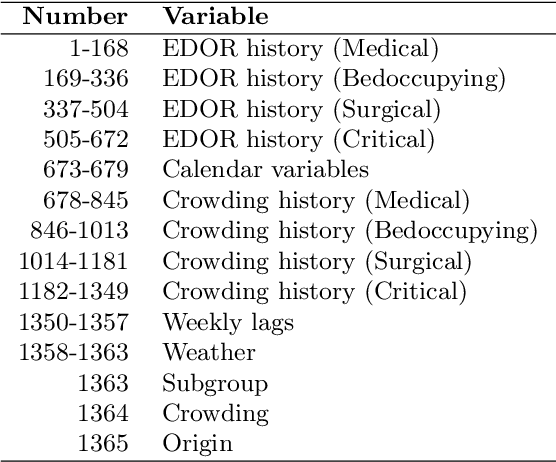
Aug 31, 2023Emergency department (ED) crowding is a significant threat to patient safety and it has been repeatedly associated with increased mortality. Forecasting future service demand has the potential patient outcomes. Despite active research on the subject, several gaps remain: 1) proposed forecasting models have become outdated due to quick influx of advanced machine learning models (ML), 2) amount of multivariable input data has been limited and 3) discrete performance metrics have been rarely reported. In this study, we document the performance of a set of advanced ML models in forecasting ED occupancy 24 hours ahead. We use electronic health record data from a large, combined ED with an extensive set of explanatory variables, including the availability of beds in catchment area hospitals, traffic data from local observation stations, weather variables, etc. We show that N-BEATS and LightGBM outpeform benchmarks with 11 % and 9 % respective improvements and that DeepAR predicts next day crowding with an AUC of 0.76 (95 % CI 0.69-0.84). To the best of our knowledge, this is the first study to document the superiority of LightGBM and N-BEATS over statistical benchmarks in the context of ED forecasting.