 Add to Chrome
 Add to Firefox
 Add to Edge
TRIBE: Predicting Team Performance via Communication Behavior Ensembles
Aug 07, 2026
Designing autonomous agents that effectively assist human teams hinges on understanding team dynamics, often without task specific knowledge. We present TRIBE, a domain independent approach that reveals team behavioral dynamics invisible to traditional performance metrics. We show that communication patterns can categorize teams into performance predictive behavioral tribes, as early as 10% into the task, enabling timely interventions. We test TRIBE on four diverse datasets and demonstrate that communication patterns predict team performance while the prediction strength varies by the degree a task structure allows for behavioral freedom. Our temporal analysis reveals that AI agents significantly alter team behavioral trajectories while human advisors align with natural dynamics, and that teams maintain behavioral flexibility throughout collaboration. Further, we compare TRIBE to Llama and optimize the pipeline, achieving significant speedup with performance improvement.

A Causal Model of Theory of Mind in Conflict for Artificial Intelligence
Jun 15, 2026Theory of mind (ToM), the capacity to ascribe mental states to others and use those ascriptions for prediction and inference, is widely assumed to be essential for effective human-machine integration. Existing AI-ToM models address \emph{how} to mentalize, but leave the question of when largely unaddressed. The central question is: under what situational and agent-level conditions is ToM engagement causally warranted in conflict? This paper presents a structural causal model formalized as a directed acyclic graph (DAG), treating ToM as a mechanism activated by situational and agent-level conditions rather than as an always-on capacity. The model specifies four exogenous variables capturing situational and agent-level conditions, five endogenous mediators, and a mechanistic ToM node producing engagement states through three distinct causal pathways: a tractability pathway, a reasoning-depth pathway, and an enabling-cause pathway. The primary outcome is epistemic accuracy, which decouples social reasoning from behavioral policy and generalizes across social phenomena beyond conflict. The framework gives AI systems a principled, resource-rational decision procedure for mentalizing, with implications for efficiency, trust, and the development of robust artificial social intelligence. Simulation validation, empirical human-machine teaming studies, and ethical considerations arising from conflict-optimized mentalizing are discussed.
The Theory of Mind Utility: Formal Specification of a Mentalizing Mechanism
Jun 10, 2026Inferring others' beliefs requires more than reading surface signals; it requires tracking who told them what, in what order, and how credibly. The Theory of Mind Utility (ToM-U) formalizes this epistemic state inference problem at the computational level of analysis, specifying what mentalizing computes and why without commitment to algorithmic or neural implementation. ToM-U achieves this by constructing Local Epistemic World Models (LEWMs) -- directed typed graphs that represent agents, state nodes, and the epistemic relationships among them -- and evaluating discrete candidate LEWMs against observed behavior until one achieves sufficient confidence. Five formal definitions specify the LEWM structure, agent node properties including ordered information access history, a bounded proliferation mechanism for recursive mentalizing, three inference procedures, and a residue function that captures the structured trace left by failed mentalizing attempts. ToM-U differs from Bayesian Theory of Mind and adjacent formal accounts, which presuppose rather than derive belief states, and from simulation theory and theory-theory, which lack a formal apparatus for epistemic state inference. The architecture generates directional, falsifiable predictions about mentalizing failure that follow from structural properties of the model rather than auxiliary assumptions, and positions ToM-U as a domain-agnostic mechanism upstream of goal inference and other downstream social cognitive processes.
Predicting Team Performance from Communications in Simulated Search-and-Rescue
Mar 05, 2025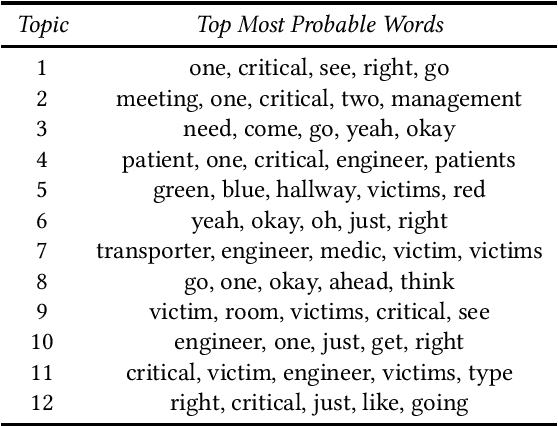
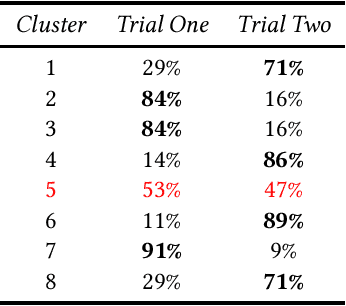
Understanding how individual traits influence team performance is valuable, but these traits are not always directly observable. Prior research has inferred traits like trust from behavioral data. We analyze conversational data to identify team traits and their correlation with teaming outcomes. Using transcripts from a Minecraft-based search-and-rescue experiment, we apply topic modeling and clustering to uncover key interaction patterns. Our findings show that variations in teaming outcomes can be explained through these inferences, with different levels of predictive power derived from individual traits and team dynamics.
Operational Collective Intelligence of Humans and Machines
Feb 16, 2024We explore the use of aggregative crowdsourced forecasting (ACF) as a mechanism to help operationalize ``collective intelligence'' of human-machine teams for coordinated actions. We adopt the definition for Collective Intelligence as: ``A property of groups that emerges from synergies among data-information-knowledge, software-hardware, and individuals (those with new insights as well as recognized authorities) that enables just-in-time knowledge for better decisions than these three elements acting alone.'' Collective Intelligence emerges from new ways of connecting humans and AI to enable decision-advantage, in part by creating and leveraging additional sources of information that might otherwise not be included. Aggregative crowdsourced forecasting (ACF) is a recent key advancement towards Collective Intelligence wherein predictions (X\% probability that Y will happen) and rationales (why I believe it is this probability that X will happen) are elicited independently from a diverse crowd, aggregated, and then used to inform higher-level decision-making. This research asks whether ACF, as a key way to enable Operational Collective Intelligence, could be brought to bear on operational scenarios (i.e., sequences of events with defined agents, components, and interactions) and decision-making, and considers whether such a capability could provide novel operational capabilities to enable new forms of decision-advantage.
Spontaneous Theory of Mind for Artificial Intelligence
Feb 16, 2024Existing approaches to Theory of Mind (ToM) in Artificial Intelligence (AI) overemphasize prompted, or cue-based, ToM, which may limit our collective ability to develop Artificial Social Intelligence (ASI). Drawing from research in computer science, cognitive science, and related disciplines, we contrast prompted ToM with what we call spontaneous ToM -- reasoning about others' mental states that is grounded in unintentional, possibly uncontrollable cognitive functions. We argue for a principled approach to studying and developing AI ToM and suggest that a robust, or general, ASI will respond to prompts \textit{and} spontaneously engage in social reasoning.
Comparing Psychometric and Behavioral Predictors of Compliance During Human-AI Interactions
Feb 03, 2023Optimization of human-AI teams hinges on the AI's ability to tailor its interaction to individual human teammates. A common hypothesis in adaptive AI research is that minor differences in people's predisposition to trust can significantly impact their likelihood of complying with recommendations from the AI. Predisposition to trust is often measured with self-report inventories that are administered before interactions. We benchmark a popular measure of this kind against behavioral predictors of compliance. We find that the inventory is a less effective predictor of compliance than the behavioral measures in datasets taken from three previous research projects. This suggests a general property that individual differences in initial behavior are more predictive than differences in self-reported trust attitudes. This result also shows a potential for easily accessible behavioral measures to provide an AI with more accurate models without the use of (often costly) survey instruments.
My Actions Speak Louder Than Your Words: When User Behavior Predicts Their Beliefs about Agents' Attributes
Jan 21, 2023An implicit expectation of asking users to rate agents, such as an AI decision-aid, is that they will use only relevant information -- ask them about an agent's benevolence, and they should consider whether or not it was kind. Behavioral science, however, suggests that people sometimes use irrelevant information. We identify an instance of this phenomenon, where users who experience better outcomes in a human-agent interaction systematically rated the agent as having better abilities, being more benevolent, and exhibiting greater integrity in a post hoc assessment than users who experienced worse outcome -- which were the result of their own behavior -- with the same agent. Our analyses suggest the need for augmentation of models so that they account for such biased perceptions as well as mechanisms so that agents can detect and even actively work to correct this and similar biases of users.
The Role of Heuristics and Biases During Complex Choices with an AI Teammate
Jan 14, 2023Behavioral scientists have classically documented aversion to algorithmic decision aids, from simple linear models to AI. Sentiment, however, is changing and possibly accelerating AI helper usage. AI assistance is, arguably, most valuable when humans must make complex choices. We argue that classic experimental methods used to study heuristics and biases are insufficient for studying complex choices made with AI helpers. We adapted an experimental paradigm designed for studying complex choices in such contexts. We show that framing and anchoring effects impact how people work with an AI helper and are predictive of choice outcomes. The evidence suggests that some participants, particularly those in a loss frame, put too much faith in the AI helper and experienced worse choice outcomes by doing so. The paradigm also generates computational modeling-friendly data allowing future studies of human-AI decision making.