 Add to Chrome
 Add to Firefox
 Add to Edge
CARGO: Carbon-Aware Gossip Orchestration in Smart Shipping
Mar 29, 2026
Smart shipping operations increasingly depend on collaborative AI, yet the underlying data are generated across vessels with uneven connectivity, limited backhaul, and clear commercial sensitivity. In such settings, server-coordinated FL remains a weak systems assumption, depending on a reachable aggregation point and repeated wide-area synchronization, both of which are difficult to guarantee in maritime networks. A serverless gossip approach therefore represents a more natural approach, but existing methods still treat communication mainly as an optimization bottleneck, rather than as a resource that must be managed jointly with carbon cost, reliability, and long-term participation balance. In this context, this paper presents CARGO, a carbon-aware gossip orchestration framework for smart-shipping. CARGO separates learning into a control and a data plane. The data plane performs local optimization with compressed gossip exchange, while the control plane decides, at each round, which vessels should participate, which communication edges should be activated, how aggressively updates should be compressed, and when recovery actions should be triggered. We evaluate CARGO under a predictive-maintenance scenario using operational bulk-carrier engine data and a trace-driven maritime communication protocol that captures client dropout, partial participation, packet loss, and multiple connectivity regimes, derived from mobility-aware vessel interactions. Across the tested stress settings, CARGO consistently remains in the high-accuracy regime while reducing carbon footprint and communication overheads, compared to accuracy-competitive decentralized baselines. Overall, the conducted performance evaluation demonstrates that CARGO is a feasible and practical solution for reliable and resource-conscious maritime AI deployment.

A Survey on UAV-Aided Maritime Communications: Deployment Considerations, Applications, and Future Challenges
Sep 20, 2022
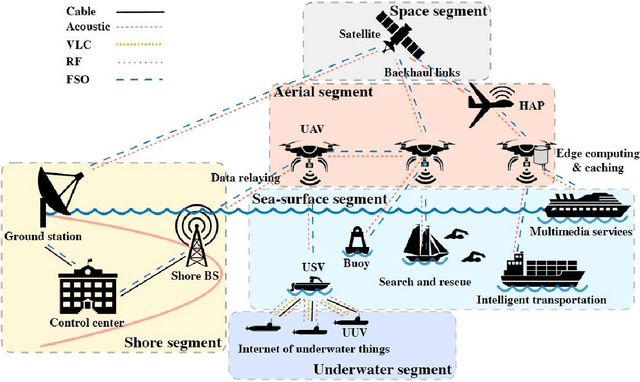


Maritime activities represent a major domain of economic growth with several emerging maritime Internet of Things use cases, such as smart ports, autonomous navigation, and ocean monitoring systems. The major enabler for this exciting ecosystem is the provision of broadband, low-delay, and reliable wireless coverage to the ever-increasing number of vessels, buoys, platforms, sensors, and actuators. Towards this end, the integration of unmanned aerial vehicles (UAVs) in maritime communications introduces an aerial dimension to wireless connectivity going above and beyond current deployments, which are mainly relying on shore-based base stations with limited coverage and satellite links with high latency. Considering the potential of UAV-aided wireless communications, this survey presents the state-of-the-art in UAV-aided maritime communications, which, in general, are based on both conventional optimization and machine-learning-aided approaches. More specifically, relevant UAV-based network architectures are discussed together with the role of their building blocks. Then, physical-layer, resource management, and cloud/edge computing and caching UAV-aided solutions in maritime environments are discussed and grouped based on their performance targets. Moreover, as UAVs are characterized by flexible deployment with high re-positioning capabilities, studies on UAV trajectory optimization for maritime applications are thoroughly discussed. In addition, aiming at shedding light on the current status of real-world deployments, experimental studies on UAV-aided maritime communications are presented and implementation details are given. Finally, several important open issues in the area of UAV-aided maritime communications are given, related to the integration of sixth generation (6G) advancements.
A Survey on Reinforcement Learning-Aided Caching in Mobile Edge Networks
May 14, 2021

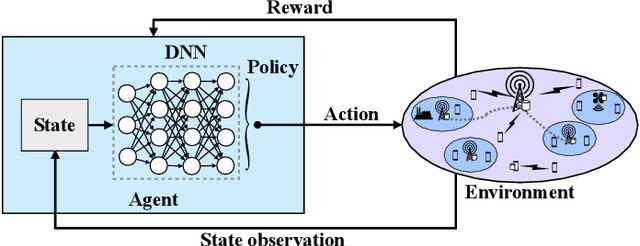

Mobile networks are experiencing tremendous increase in data volume and user density. An efficient technique to alleviate this issue is to bring the data closer to the users by exploiting the caches of edge network nodes, such as fixed or mobile access points and even user devices. Meanwhile, the fusion of machine learning and wireless networks offers a viable way for network optimization as opposed to traditional optimization approaches which incur high complexity, or fail to provide optimal solutions. Among the various machine learning categories, reinforcement learning operates in an online and autonomous manner without relying on large sets of historical data for training. In this survey, reinforcement learning-aided mobile edge caching is presented, aiming at highlighting the achieved network gains over conventional caching approaches. Taking into account the heterogeneity of sixth generation (6G) networks in various wireless settings, such as fixed, vehicular and flying networks, learning-aided edge caching is presented, departing from traditional architectures. Furthermore, a categorization according to the desirable performance metric, such as spectral, energy and caching efficiency, average delay, and backhaul and fronthaul offloading is provided. Finally, several open issues are discussed, targeting to stimulate further interest in this important research field.