 Add to Chrome
 Add to Firefox
 Add to Edge
Interval and fuzzy physics-augmented neural networks (iPANN and fPANN) for uncertainty quantification and propagation in constitutive modeling
Jul 22, 2026
Constitutive modeling under uncertainty remains a central challenge for reliable mechanics simulations, particularly when the available stress-deformation data are sparse, noisy, or heterogeneous. We propose interval and fuzzy physics-augmented neural networks (iPANNs and fPANNs) for uncertainty-aware hyperelastic constitutive modeling. iPANNs learn sparse lower, mean, and upper free energy density branches whose stresses, obtained by automatic differentiation, ultimately enclose noisy stress observations. In contrast to this deterministic interval description, fPANNs embed the learned iPANN branches into a fuzzy-set representation through alpha-cut interpolation, yielding a nested family of admissible responses. iPANNs and fPANNs encode mechanistic constraints - preserving objectivity, consistency and promoting polyconvexity - and smoothed L0 regularization promotes interpretable energy representations. The bound models are trained through a two-stage transfer-learning procedure in which a sparse mean constitutive response is learned first and then fine-tuned into lower and upper energy branches. We evaluate the framework on synthetic isotropic hyperelastic data with heteroscedastic noise, varying random realizations, shifted noise means, and varying noise magnitudes. The results show that the learned bounds enclose noisy stress observations while generalizing to the test set. Further, we examine the propagation of uncertainty through the mean, upper and lower bound predictions of the learned iPANN models in a finite element setting. The proposed framework provides a compact, physics-consistent route for distribution-free aleatoric uncertainty quantification in hyperelastic constitutive modeling, and propagation in downstream finite element simulations.

Towards end-to-end optimization in multimaterial 3D printing
Jul 14, 2026Multimaterial 3D printing enables the fabrication of functionally graded components, but optimizing their spatial material distribution alongside structural topology remains a formidable challenge due to high-dimensional design spaces and complex constitutive modeling. This paper presents an end-to-end computational framework integrating sparsified physics-augmented neural networks with finite-element-based topology optimization. By extracting closed-form, composition-aware hyperelastic constitutive laws from experimental data, this approach facilitates exact symbolic differentiation via the adjoint state method implemented with FEniCSx, efficiently circumventing the bottlenecks of applying neural network constitutive models. This pipeline is deployed on soft robotic gripper applications, demonstrating continuous composition optimization for highly anisotropic contact responses, and the concurrent optimization of macroscopic topology and material distribution under non-failure stretch constraints. This methodology could replace laborious empirical prototyping, establishing interpretable machine-learning models as practical, robust design primitives for advanced multimaterial additive manufacturing.
Courant: a State-Adaptive Perceiver-Based Neural Surrogate with Local Support and Interpretable Field Decomposition
May 24, 2026We introduce "Courant", a Perceiver-based encoder-processor-decoder surrogate model that has latent features exhibiting adaptive specialization and local support in the physical space, enabling functionality akin to an adaptive hp-refinement scheme, an attribute that is highly desirable in traditional numerical solvers and scientific machine learning broadly. The proposed architecture combines a shared random Fourier feature coordinate embedding, state-adapted latent queries, and a light-weight decoder. Courant is trained end-to-end with steady or transient simulation data and only a standard L_2 prediction loss in the physical space, achieving competitive accuracy on benchmarks. We demonstrate that Courant's inductive biases yield latents that are interpretable by design: they develop multiscale geometric specialization in the simulation domain and track coherent structures in the time-dependent case, acting analogously to time-evolving spatial basis functions and allowing for decoding a compact, geometry-anchored, partition-of-unity-like decomposition of the simulated field.
Towards Rapid Constitutive Model Discovery from Multi-Modal Data: Physics Augmented Finite Element Model Updating (paFEMU)
Apr 09, 2026Recent progress in AI-enabled constitutive modeling has concentrated on moving from a purely data-driven paradigm to the enforcement of physical constraints and mechanistic principles, a concept referred to as physics augmentation. Classical phenomenological approaches rely on selecting a pre-defined model and calibrating its parameters, while machine learning methods often focus on discovery of the model itself. Sparse regression approaches lie in between, where large libraries of pre-defined models are probed during calibration. Sparsification in the aforementioned paradigm, but also in the context of neural network architecture, has been shown to enable interpretability, uncertainty quantification, but also heterogeneous software integration due to the low-dimensional nature of the resulting models. Most works in AI-enabled constitutive modeling have also focused on data from a single source, but in reality, materials modeling workflows can contain data from many different sources (multi-modal data), and also from testing other materials within the same materials class (multi-fidelity data). In this work, we introduce physics augmented finite element model updating (paFEMU), as a transfer learning approach that combines AI-enabled constitutive modeling, sparsification for interpretable model discovery, and finite element-based adjoint optimization utilizing multi-modal data. This is achieved by combining simple mechanical testing data, potentially from a distinct material, with digital image correlation-type full-field data acquisition to ultimately enable rapid constitutive modeling discovery. The simplicity of the sparse representation enables easy integration of neural constitutive models in existing finite element workflows, and also enables low-dimensional updating during transfer learning.
Condensed Stein Variational Gradient Descent for Uncertainty Quantification of Neural Networks
Dec 21, 2024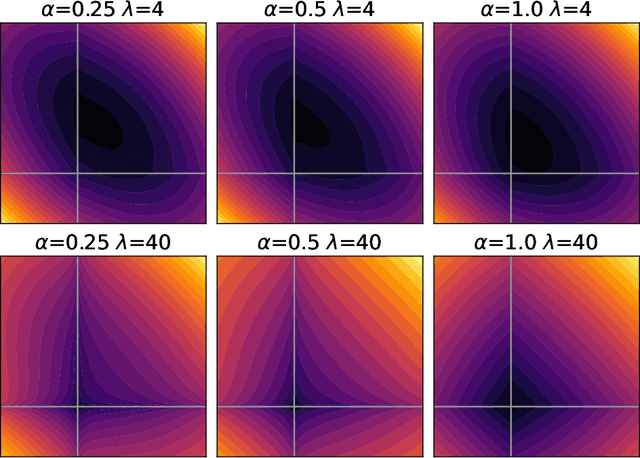
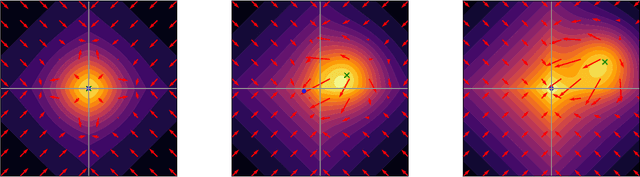
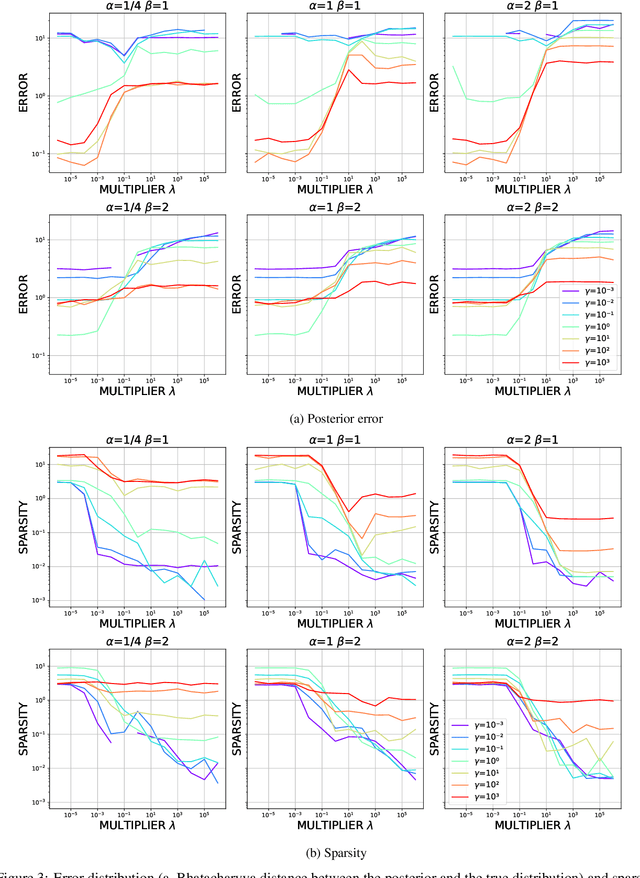
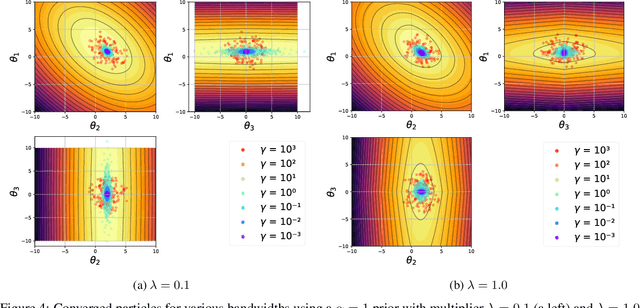
We propose a Stein variational gradient descent method to concurrently sparsify, train, and provide uncertainty quantification of a complexly parameterized model such as a neural network. It employs a graph reconciliation and condensation process to reduce complexity and increase similarity in the Stein ensemble of parameterizations. Therefore, the proposed condensed Stein variational gradient (cSVGD) method provides uncertainty quantification on parameters, not just outputs. Furthermore, the parameter reduction speeds up the convergence of the Stein gradient descent as it reduces the combinatorial complexity by aligning and differentiating the sensitivity to parameters. These properties are demonstrated with an illustrative example and an application to a representation problem in solid mechanics.
Improving the performance of Stein variational inference through extreme sparsification of physically-constrained neural network models
Jun 30, 2024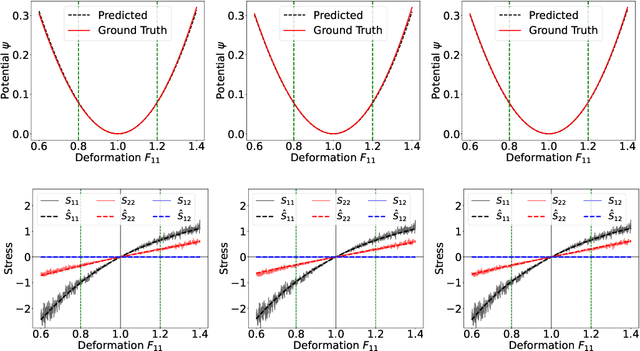
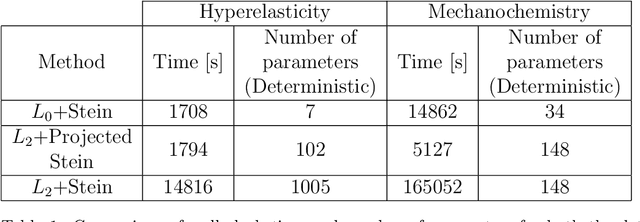
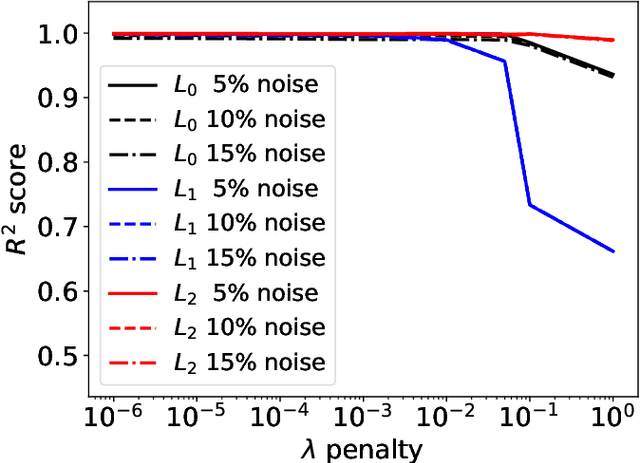
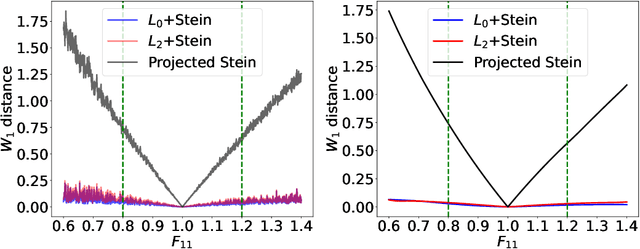
Most scientific machine learning (SciML) applications of neural networks involve hundreds to thousands of parameters, and hence, uncertainty quantification for such models is plagued by the curse of dimensionality. Using physical applications, we show that $L_0$ sparsification prior to Stein variational gradient descent ($L_0$+SVGD) is a more robust and efficient means of uncertainty quantification, in terms of computational cost and performance than the direct application of SGVD or projected SGVD methods. Specifically, $L_0$+SVGD demonstrates superior resilience to noise, the ability to perform well in extrapolated regions, and a faster convergence rate to an optimal solution.
A review on data-driven constitutive laws for solids
May 06, 2024


This review article highlights state-of-the-art data-driven techniques to discover, encode, surrogate, or emulate constitutive laws that describe the path-independent and path-dependent response of solids. Our objective is to provide an organized taxonomy to a large spectrum of methodologies developed in the past decades and to discuss the benefits and drawbacks of the various techniques for interpreting and forecasting mechanics behavior across different scales. Distinguishing between machine-learning-based and model-free methods, we further categorize approaches based on their interpretability and on their learning process/type of required data, while discussing the key problems of generalization and trustworthiness. We attempt to provide a road map of how these can be reconciled in a data-availability-aware context. We also touch upon relevant aspects such as data sampling techniques, design of experiments, verification, and validation.
Extreme sparsification of physics-augmented neural networks for interpretable model discovery in mechanics
Oct 05, 2023Data-driven constitutive modeling with neural networks has received increased interest in recent years due to its ability to easily incorporate physical and mechanistic constraints and to overcome the challenging and time-consuming task of formulating phenomenological constitutive laws that can accurately capture the observed material response. However, even though neural network-based constitutive laws have been shown to generalize proficiently, the generated representations are not easily interpretable due to their high number of trainable parameters. Sparse regression approaches exist that allow to obtaining interpretable expressions, but the user is tasked with creating a library of model forms which by construction limits their expressiveness to the functional forms provided in the libraries. In this work, we propose to train regularized physics-augmented neural network-based constitutive models utilizing a smoothed version of $L^{0}$-regularization. This aims to maintain the trustworthiness inherited by the physical constraints, but also enables interpretability which has not been possible thus far on any type of machine learning-based constitutive model where model forms were not assumed a-priory but were actually discovered. During the training process, the network simultaneously fits the training data and penalizes the number of active parameters, while also ensuring constitutive constraints such as thermodynamic consistency. We show that the method can reliably obtain interpretable and trustworthy constitutive models for compressible and incompressible hyperelasticity, yield functions, and hardening models for elastoplasticity, for synthetic and experimental data.
Stress representations for tensor basis neural networks: alternative formulations to Finger-Rivlin-Ericksen
Aug 21, 2023Data-driven constitutive modeling frameworks based on neural networks and classical representation theorems have recently gained considerable attention due to their ability to easily incorporate constitutive constraints and their excellent generalization performance. In these models, the stress prediction follows from a linear combination of invariant-dependent coefficient functions and known tensor basis generators. However, thus far the formulations have been limited to stress representations based on the classical Rivlin and Ericksen form, while the performance of alternative representations has yet to be investigated. In this work, we survey a variety of tensor basis neural network models for modeling hyperelastic materials in a finite deformation context, including a number of so far unexplored formulations which use theoretically equivalent invariants and generators to Finger-Rivlin-Ericksen. Furthermore, we compare potential-based and coefficient-based approaches, as well as different calibration techniques. Nine variants are tested against both noisy and noiseless datasets for three different materials. Theoretical and practical insights into the performance of each formulation are given.
Modular machine learning-based elastoplasticity: generalization in the context of limited data
Oct 15, 2022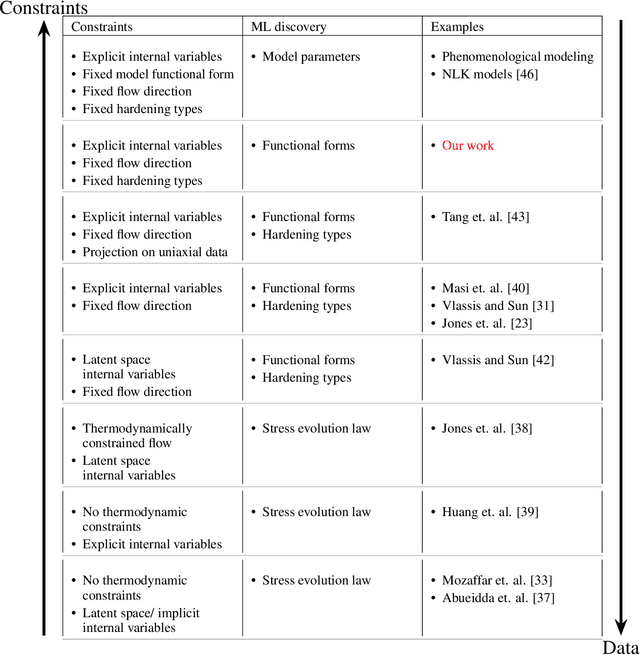
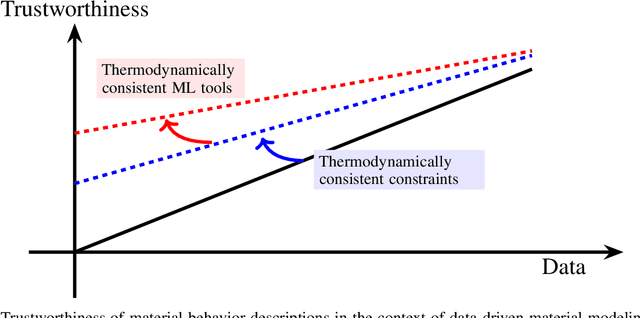
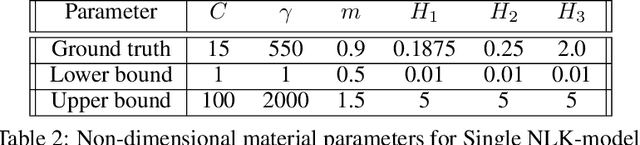
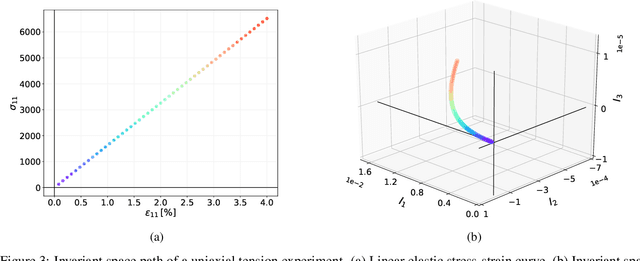
The development of accurate constitutive models for materials that undergo path-dependent processes continues to be a complex challenge in computational solid mechanics. Challenges arise both in considering the appropriate model assumptions and from the viewpoint of data availability, verification, and validation. Recently, data-driven modeling approaches have been proposed that aim to establish stress-evolution laws that avoid user-chosen functional forms by relying on machine learning representations and algorithms. However, these approaches not only require a significant amount of data but also need data that probes the full stress space with a variety of complex loading paths. Furthermore, they rarely enforce all necessary thermodynamic principles as hard constraints. Hence, they are in particular not suitable for low-data or limited-data regimes, where the first arises from the cost of obtaining the data and the latter from the experimental limitations of obtaining labeled data, which is commonly the case in engineering applications. In this work, we discuss a hybrid framework that can work on a variable amount of data by relying on the modularity of the elastoplasticity formulation where each component of the model can be chosen to be either a classical phenomenological or a data-driven model depending on the amount of available information and the complexity of the response. The method is tested on synthetic uniaxial data coming from simulations as well as cyclic experimental data for structural materials. The discovered material models are found to not only interpolate well but also allow for accurate extrapolation in a thermodynamically consistent manner far outside the domain of the training data. Training aspects and details of the implementation of these models into Finite Element simulations are discussed and analyzed.