 Add to Chrome
 Add to Firefox
 Add to Edge
Universality and Approximation Rates of Graph Neural Networks with Random Features
Jul 29, 2026
We investigate message-passing graph neural networks with random node features. Random node features are known to enhance the expressiveness of graph neural networks (GNNs) both theoretically and empirically. Here, we establish a novel universality result focusing on permutation-equivariant neural networks (PENNs), a class of GNNs built from feedforward neural network components that subsumes many prominent GNN architectures. We show that PENNs, combined with partially random node features, can approximate arbitrarily well in probability any measurable permutation-invariant or permutation-equivariant function on directed graphs of fixed size with multidimensional node and edge features. For $k$-times continuously differentiable functions, $k\geq 2$, we also derive upper bounds on the approximation rates, relating the complexity of the feedforward components of a PENN in terms of layer depth and number of nonzero weights to the desired approximation accuracy.

Extending Open Bandit Pipeline to Simulate Industry Challenges
Sep 09, 2022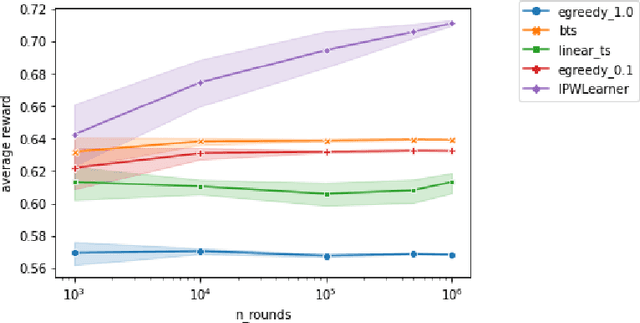
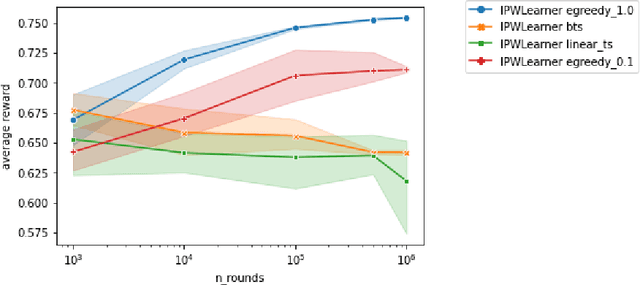
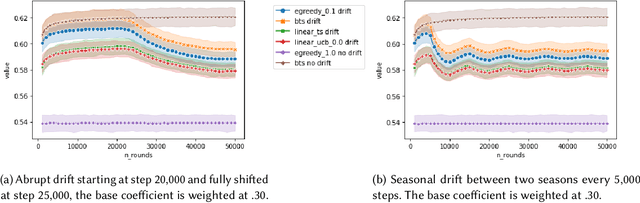
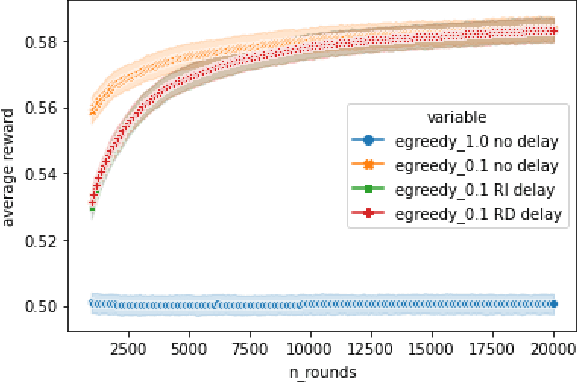
Bandit algorithms are often used in the e-commerce industry to train Machine Learning (ML) systems when pre-labeled data is unavailable. However, the industry setting poses various challenges that make implementing bandit algorithms in practice non-trivial. In this paper, we elaborate on the challenges of off-policy optimisation, delayed reward, concept drift, reward design, and business rules constraints that practitioners at Booking.com encounter when applying bandit algorithms. Our main contributions is an extension to the Open Bandit Pipeline (OBP) framework. We provide simulation components for some of the above-mentioned challenges to provide future practitioners, researchers, and educators with a resource to address challenges encountered in the e-commerce industry.