 Add to Chrome
 Add to Firefox
 Add to Edge
Multimodal Routing for Interpretable, Robust, and Auditable Clinical Prediction
Jul 10, 2026
Electronic health record (EHR) data are inherently multimodal, and leveraging multiple modalities can improve predictive performance. However, most existing approaches rely on deep fusion, which obscures how individual modalities contribute to predictions and limits the interpretability of multimodal reasoning. We propose an explicit multimodal routing framework for clinical prediction that enables interpretable, robust, and auditable reasoning across three EHR modalities: structured longitudinal variables (L), clinical notes (N), and chest X-rays (I). Our model constructs discrete unimodal, directional bimodal, and trimodal routes to capture both individual modality signals and asymmetric cross-modal interactions. To audit multimodal reasoning and assess robustness, we introduce inference-time route masking, which simulates missing modalities and reweights the remaining routes without retraining. We analyze changes in performance and routing weights under these scenarios to understand model decision-making. We evaluate our framework on multi-label phenotype prediction (K = 25) and binary ICU mortality prediction using trimodal patient stays from MIMIC-IV, revealing systematic differences in modality reliance across clinical condition groups. Overall, our framework offers a transparent, auditable, and practical approach to multimodal clinical prediction, providing interpretability, robustness, and insights into how different data sources drive model decisions.

Equitable Electronic Health Record Prediction with FAME: Fairness-Aware Multimodal Embedding
Jun 16, 2025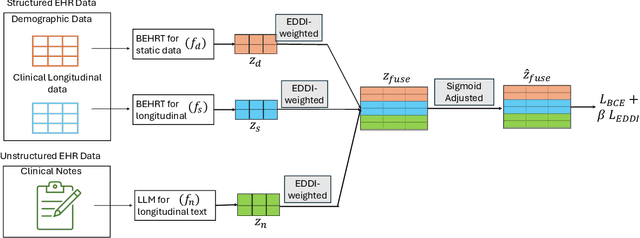
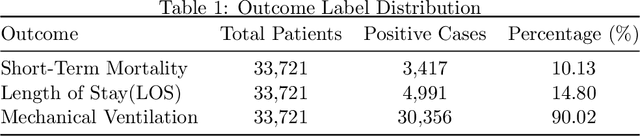
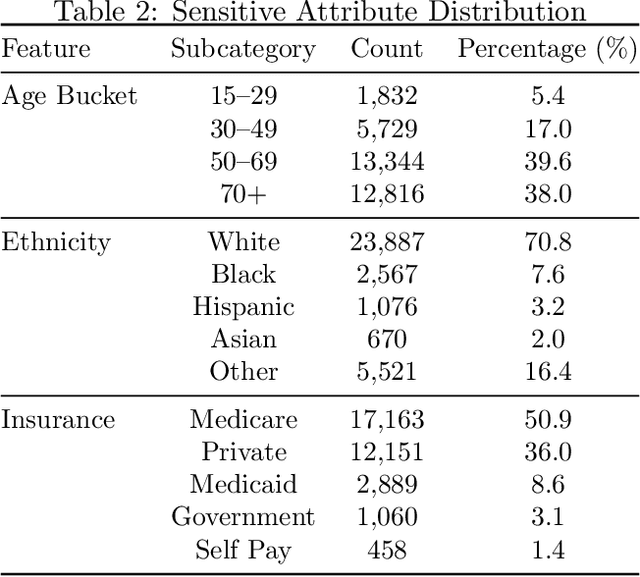
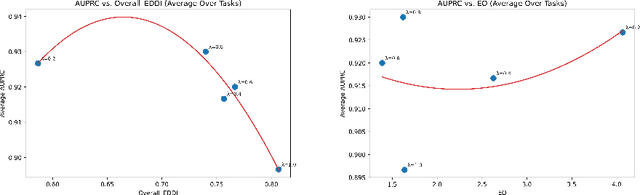
Electronic Health Record (EHR) data encompass diverse modalities -- text, images, and medical codes -- that are vital for clinical decision-making. To process these complex data, multimodal AI (MAI) has emerged as a powerful approach for fusing such information. However, most existing MAI models optimize for better prediction performance, potentially reinforcing biases across patient subgroups. Although bias-reduction techniques for multimodal models have been proposed, the individual strengths of each modality and their interplay in both reducing bias and optimizing performance remain underexplored. In this work, we introduce FAME (Fairness-Aware Multimodal Embeddings), a framework that explicitly weights each modality according to its fairness contribution. FAME optimizes both performance and fairness by incorporating a combined loss function. We leverage the Error Distribution Disparity Index (EDDI) to measure fairness across subgroups and propose a sign-agnostic aggregation method to balance fairness across subgroups, ensuring equitable model outcomes. We evaluate FAME with BEHRT and BioClinicalBERT, combining structured and unstructured EHR data, and demonstrate its effectiveness in terms of performance and fairness compared with other baselines across multiple EHR prediction tasks.