 Add to Chrome
 Add to Firefox
 Add to Edge
T-pro 2.0: An Efficient Russian Hybrid-Reasoning Model and Playground
Dec 11, 2025
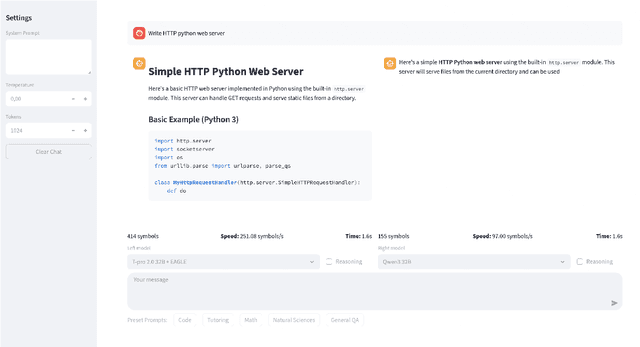
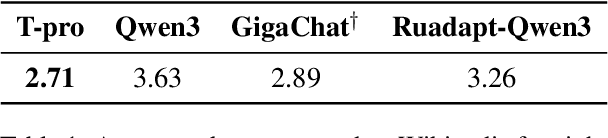
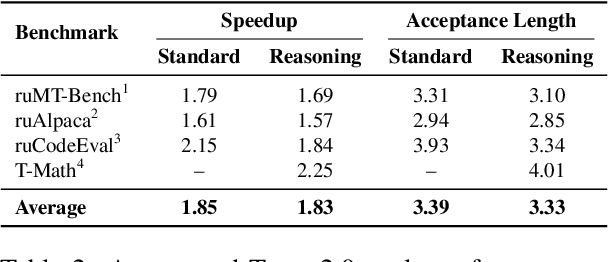
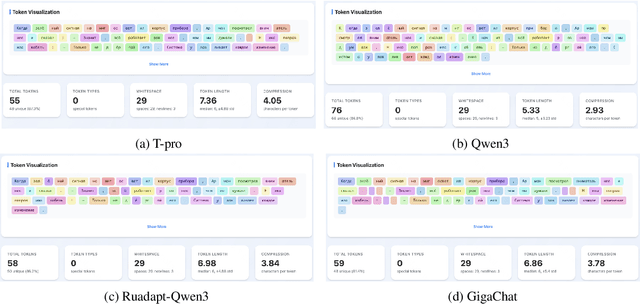
We introduce T-pro 2.0, an open-weight Russian LLM for hybrid reasoning and efficient inference. The model supports direct answering and reasoning-trace generation, using a Cyrillic-dense tokenizer and an adapted EAGLE speculative-decoding pipeline to reduce latency. To enable reproducible and extensible research, we release the model weights, the T-Wix 500k instruction corpus, the T-Math reasoning benchmark, and the EAGLE weights on Hugging Face. These resources allow users to study Russian-language reasoning and to extend or adapt both the model and the inference pipeline. A public web demo exposes reasoning and non-reasoning modes and illustrates the speedups achieved by our inference stack across domains. T-pro 2.0 thus serves as an accessible open system for building and evaluating efficient, practical Russian LLM applications.

Cache Me If You Must: Adaptive Key-Value Quantization for Large Language Models
Jan 31, 2025Efficient real-world deployments of large language models (LLMs) rely on Key-Value (KV) caching for processing and generating long outputs, reducing the need for repetitive computation. For large contexts, Key-Value caches can take up tens of gigabytes of device memory, as they store vector representations for each token and layer. Recent work has shown that the cached vectors can be compressed through quantization, pruning or merging, but these techniques often compromise quality towards higher compression rates. In this work, we aim to improve Key & Value compression by exploiting two observations: 1) the inherent dependencies between keys and values across different layers, and 2) high-compression mechanisms for internal network states. We propose AQUA-KV, an adaptive quantization for Key-Value caches that relies on compact adapters to exploit existing dependencies between Keys and Values, and aims to "optimally" compress the information that cannot be predicted. AQUA-KV significantly improves compression rates, while maintaining high accuracy on state-of-the-art LLM families. On Llama 3.2 LLMs, we achieve near-lossless inference at 2-2.5 bits per value with under $1\%$ relative error in perplexity and LongBench scores. AQUA-KV is one-shot, simple, and efficient: it can be calibrated on a single GPU within 1-6 hours, even for 70B models.