 Add to Chrome
 Add to Firefox
 Add to Edge
Exploring Real-Time Super-Resolution: Benchmarking and Fine-Tuning for Streaming Content
Feb 14, 2026
Recent advancements in real-time super-resolution have enabled higher-quality video streaming, yet existing methods struggle with the unique challenges of compressed video content. Commonly used datasets do not accurately reflect the characteristics of streaming media, limiting the relevance of current benchmarks. To address this gap, we introduce a comprehensive dataset - StreamSR - sourced from YouTube, covering a wide range of video genres and resolutions representative of real-world streaming scenarios. We benchmark 11 state-of-the-art real-time super-resolution models to evaluate their performance for the streaming use-case. Furthermore, we propose EfRLFN, an efficient real-time model that integrates Efficient Channel Attention and a hyperbolic tangent activation function - a novel design choice in the context of real-time super-resolution. We extensively optimized the architecture to maximize efficiency and designed a composite loss function that improves training convergence. EfRLFN combines the strengths of existing architectures while improving both visual quality and runtime performance. Finally, we show that fine-tuning other models on our dataset results in significant performance gains that generalize well across various standard benchmarks. We made the dataset, the code, and the benchmark available at https://github.com/EvgeneyBogatyrev/EfRLFN.

BASED: Benchmarking, Analysis, and Structural Estimation of Deblurring
May 27, 2023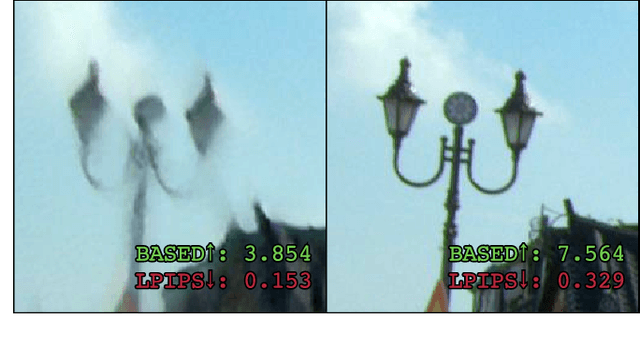
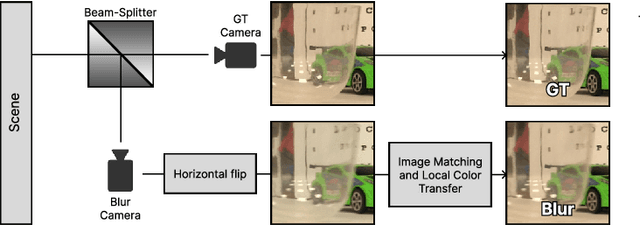
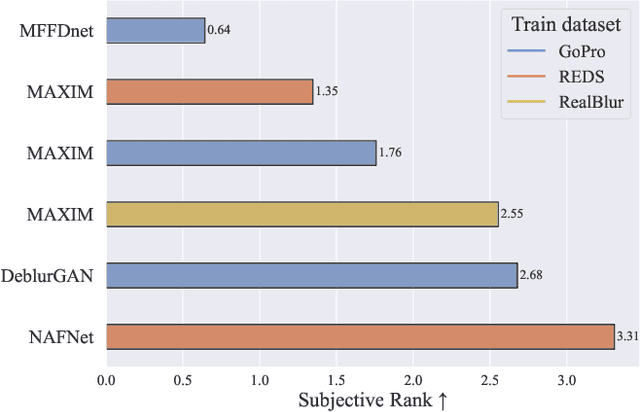
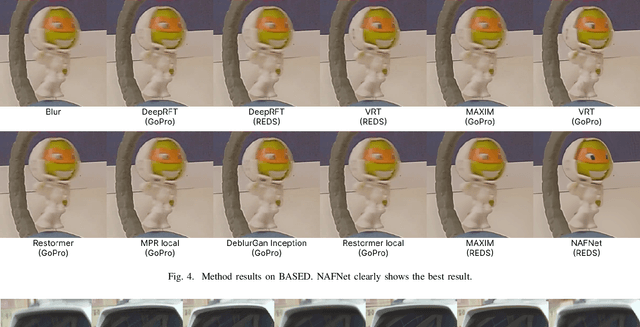
This paper discusses the challenges of evaluating deblurring-methods quality and proposes a reduced-reference metric based on machine learning. Traditional quality-assessment metrics such as PSNR and SSIM are common for this task, but not only do they correlate poorly with subjective assessments, they also require ground-truth (GT) frames, which can be difficult to obtain in the case of deblurring. To develop and evaluate our metric, we created a new motion-blur dataset using a beam splitter. The setup captured various motion types using a static camera, as most scenes in existing datasets include blur due to camera motion. We also conducted two large subjective comparisons to aid in metric development. Our resulting metric requires no GT frames, and it correlates well with subjective human perception of blur.
Color Mismatches in Stereoscopic Video: Real-World Dataset and Deep Correction Method
Mar 12, 2023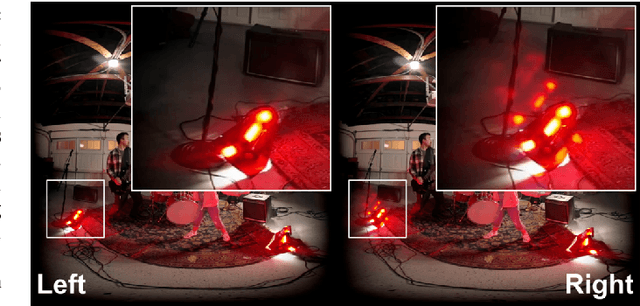
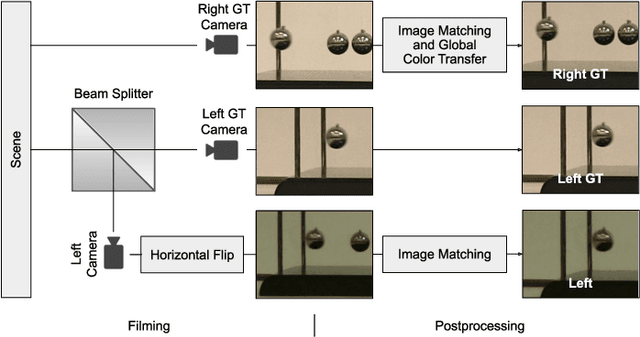
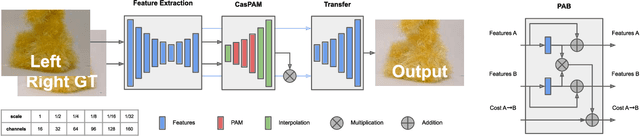
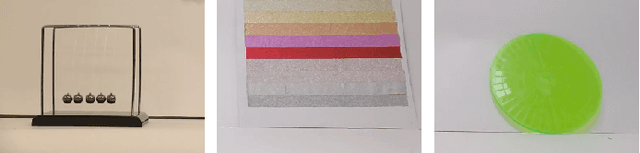
We propose a real-world dataset of stereoscopic videos for color-mismatch correction. It includes real-world distortions achieved using a beam splitter. Our dataset is larger than any other for this task. We compared eight color-mismatch-correction methods on artificial and real-world datasets and showed that local methods are best suited to artificial distortions and that global methods are best suited to real-world distortions. Our efforts improved on the latest local neural-network method for color-mismatch correction in stereoscopic images, making it work faster and better on both artificial and real-world distortions.