 Add to Chrome
 Add to Firefox
 Add to Edge
It's All Connected: Topology-Aware Structural Graph Encoding Improves Performance on Polymer Prediction
May 11, 2026
Graph Neural Networks (GNNs) have achieved strong results in molecular property prediction, but polymers present distinct challenges: labeled datasets are scarce and small (typically in the order of hundreds of polymers) due to the need for expensive experimentation, and complex polymer chain distributions influence polymer properties. Established practice in polymer prediction represents polymers solely by graphs of their repeat units, discarding the chain-scale morphology that governs key properties such as the glass transition temperature ($T_g$). In this work, we propose a principled graph construction that addresses this gap. Given a polymer's molecular mass distribution (MMD), we sample representative chains from the Schulz-Zimm distribution and construct representative sets of large graphs encoding chain-scale topology directly, with atoms and bonds featurized using rich chemical descriptors. We further pretrain GNN encoders via masked graph modeling on 100,000 unlabeled PSMILES strings before fine-tuning on labeled data. On a dataset of 381 polymers (180 homopolymers and 201 copolymers), we show that graph construction and self-supervised pretraining are jointly necessary: without pretraining, the large graph method matches the repeat-unit baseline (28.40 K vs. 28.36 K RMSE); with pretraining, it achieves 24.76 K +/- 3.30 K, a 5.1% reduction in mean error over the pretrained repeat-unit baseline (26.08 K +/- 4.20 K, p < 0.001, 30 runs). An ablation removing chemical features degrades performance to 36.65 K, confirming both components are essential. Results are architecture-agnostic, holding for both GINE and GATv2 encoders.

Position: Federated Foundation Language Model Post-Training Should Focus on Open-Source Models
May 29, 2025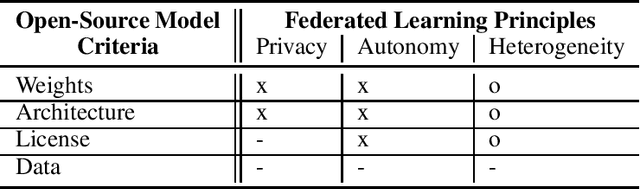
Post-training of foundation language models has emerged as a promising research domain in federated learning (FL) with the goal to enable privacy-preserving model improvements and adaptations to user's downstream tasks. Recent advances in this area adopt centralized post-training approaches that build upon black-box foundation language models where there is no access to model weights and architecture details. Although the use of black-box models has been successful in centralized post-training, their blind replication in FL raises several concerns. Our position is that using black-box models in FL contradicts the core principles of federation such as data privacy and autonomy. In this position paper, we critically analyze the usage of black-box models in federated post-training, and provide a detailed account of various aspects of openness and their implications for FL.