 Add to Chrome
 Add to Firefox
 Add to Edge
Advancing Machine Learning Optimization of Chiral Photonic Metasurface: Comparative Study of Neural Network and Genetic Algorithm Approaches
Dec 15, 2025
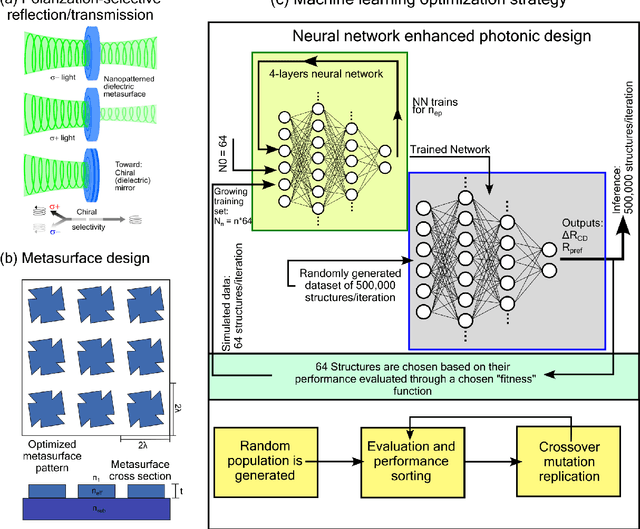
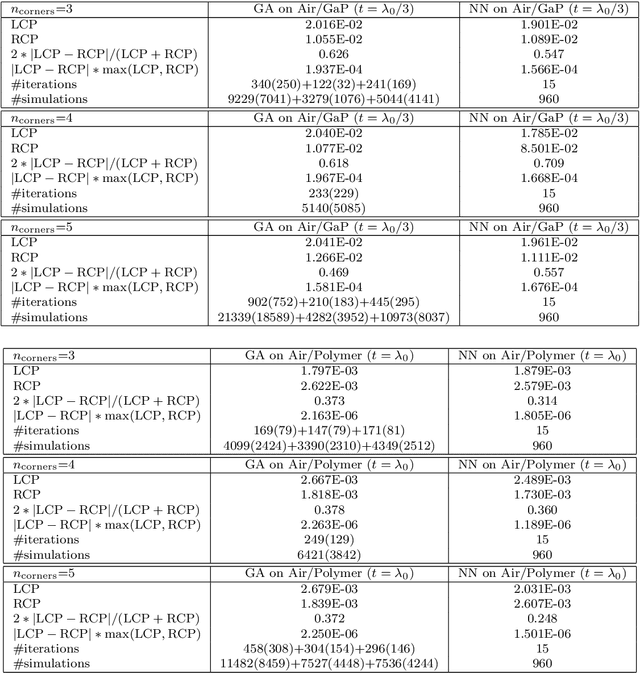
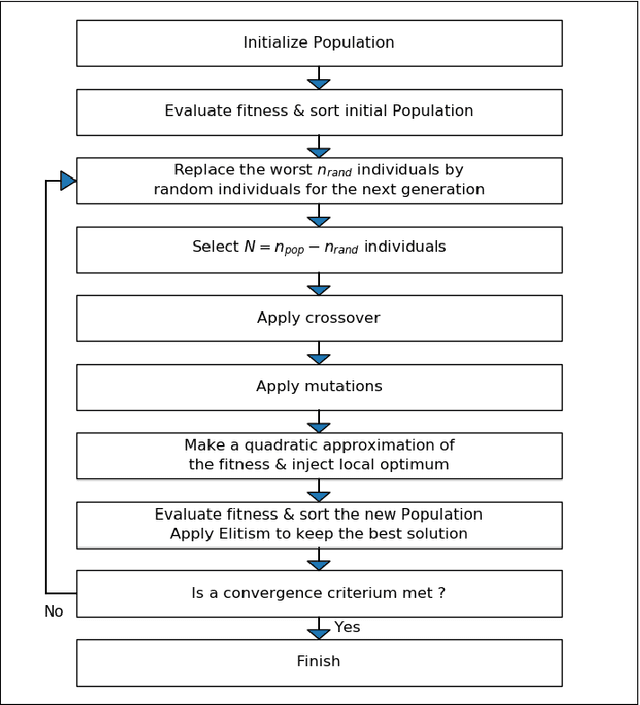
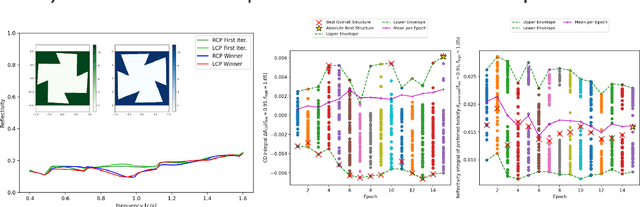
Chiral photonic metasurfaces provide unique capabilities for tailoring light-matter interactions, which are essential for next-generation photonic devices. Here, we report an advanced optimization framework that combines deep learning and evolutionary algorithms to significantly improve both the design and performance of chiral photonic nanostructures. Building on previous work utilizing a three-layer perceptron reinforced learning and stochastic evolutionary algorithm with decaying changes and mass extinction for chiral photonic optimization, our study introduces a refined pipeline featuring a two-output neural network architecture to reduce the trade-off between high chiral dichroism (CD) and reflectivity. Additionally, we use an improved fitness function, and efficient data augmentation techniques. A comparative analysis between a neural network (NN)-based approach and a genetic algorithm (GA) is presented for structures of different interface pattern depth, material combinations, and geometric complexity. We demonstrate a twice higher CD and the impact of both the corner number and the refractive index contrast at the example of a GaP/air and PMMA/air metasurface as a result of superior optimization performance. Additionally, a substantial increase in the number of structures explored within limited computational resources is highlighted, with tailored spectral reflectivity suggested by our electromagnetic simulations, paving the way for chiral mirrors applicable to polarization-selective light-matter interaction studies.

Towards Photonic Band Diagram Generation with Transformer-Latent Diffusion Models
Oct 02, 2025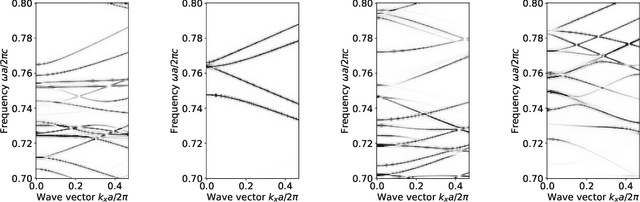



Photonic crystals enable fine control over light propagation at the nanoscale, and thus play a central role in the development of photonic and quantum technologies. Photonic band diagrams (BDs) are a key tool to investigate light propagation into such inhomogeneous structured materials. However, computing BDs requires solving Maxwell's equations across many configurations, making it numerically expensive, especially when embedded in optimization loops for inverse design techniques, for example. To address this challenge, we introduce the first approach for BD generation based on diffusion models, with the capacity to later generalize and scale to arbitrary three dimensional structures. Our method couples a transformer encoder, which extracts contextual embeddings from the input structure, with a latent diffusion model to generate the corresponding BD. In addition, we provide insights into why transformers and diffusion models are well suited to capture the complex interference and scattering phenomena inherent to photonics, paving the way for new surrogate modeling strategies in this domain.
Photonic Structures Optimization Using Highly Data-Efficient Deep Learning: Application To Nanofin And Annular Groove Phase Masks
Sep 05, 2023Metasurfaces offer a flexible framework for the manipulation of light properties in the realm of thin film optics. Specifically, the polarization of light can be effectively controlled through the use of thin phase plates. This study aims to introduce a surrogate optimization framework for these devices. The framework is applied to develop two kinds of vortex phase masks (VPMs) tailored for application in astronomical high-contrast imaging. Computational intelligence techniques are exploited to optimize the geometric features of these devices. The large design space and computational limitations necessitate the use of surrogate models like partial least squares Kriging, radial basis functions, or neural networks. However, we demonstrate the inadequacy of these methods in modeling the performance of VPMs. To address the shortcomings of these methods, a data-efficient evolutionary optimization setup using a deep neural network as a highly accurate and efficient surrogate model is proposed. The optimization process in this study employs a robust particle swarm evolutionary optimization scheme, which operates on explicit geometric parameters of the photonic device. Through this approach, optimal designs are developed for two design candidates. In the most complex case, evolutionary optimization enables optimization of the design that would otherwise be impractical (requiring too much simulations). In both cases, the surrogate model improves the reliability and efficiency of the procedure, effectively reducing the required number of simulations by up to 75% compared to conventional optimization techniques.