 Add to Chrome
 Add to Firefox
 Add to Edge
Multi-scale radiomics in pelvic MRI for endometriosis subtyping: highlighting data heterogeneity constraints
Jul 29, 2026
Analyzing female pelvic MRIs is challenging, especially for evaluating endometriosis, where visual features are influenced by several factors, including anatomical complexity, technical variability, and inter-reader variability. Here, we evaluate a radiomics-based pipeline for patient-level endometriosis subtyping using the publicly available UT-EndoMRI dataset. We extract radiomics features from manually segmented uterine and ovarian regions and compare several multi-scale feature representations and feature-selection strategies. We train supervised classifiers to distinguish patients with at least one endometrioma from those without, and perform an unsupervised perturbation analysis to assess whether radiomics profiles reveal reproducible patient subgroups. The best supervised performance is achieved using raw Wavelet-derived features and a Gradient Boosting classifier, yielding an AUC of 0.80. However, this model produces several false positives, resulting in low specificity. ComBat harmonization does not consistently improve performance, suggesting that post hoc harmonization is insufficient in a small, multi-site cohort in which acquisition groups contained very few patients. Using an unsupervised clustering analysis, we identify reproducible but poorly separated partitions that remain associated with acquisition variables. Overall, these results suggest that pelvic MRI radiomics contain a preliminary signal for endometriosis subtyping, while highlighting the fragility of radiomics-based subtyping in small, multi-site datasets.

Towards deep learning-powered IVF: A large public benchmark for morphokinetic parameter prediction
Mar 01, 2022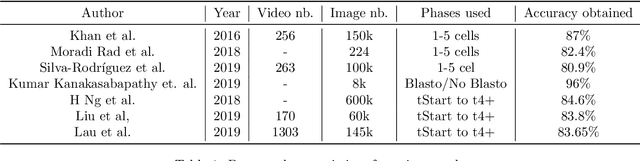
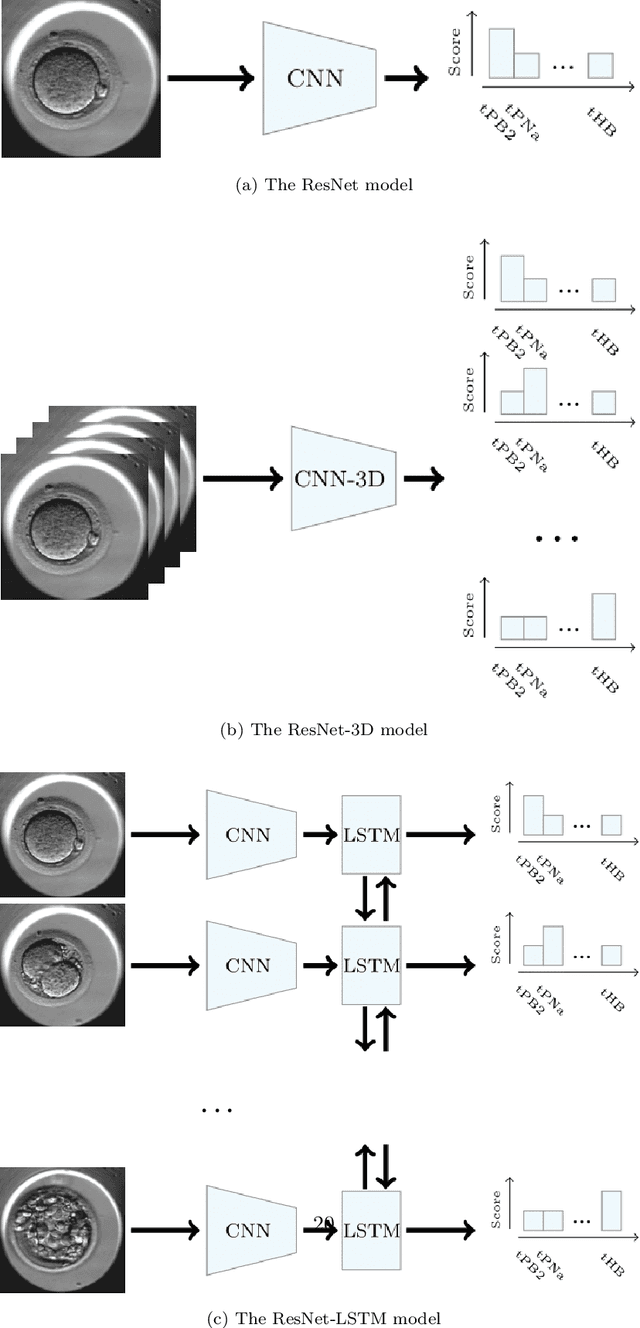
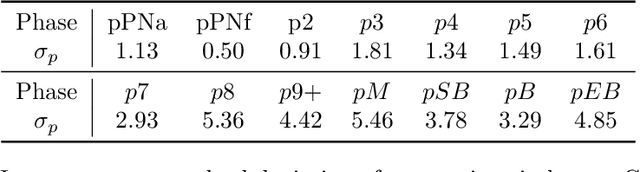
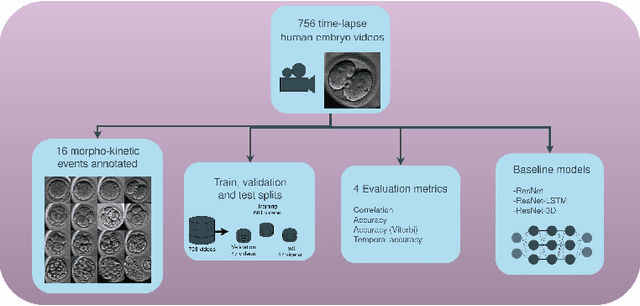
An important limitation to the development of Artificial Intelligence (AI)-based solutions for In Vitro Fertilization (IVF) is the absence of a public reference benchmark to train and evaluate deep learning (DL) models. In this work, we describe a fully annotated dataset of 756 videos of developing embryos, for a total of 337k images. We applied ResNet, LSTM, and ResNet-3D architectures to our dataset and demonstrate that they overperform algorithmic approaches to automatically annotate stage development phases. Altogether, we propose the first public benchmark that will allow the community to evaluate morphokinetic models. This is the first step towards deep learning-powered IVF. Of note, we propose highly detailed annotations with 16 different development phases, including early cell division phases, but also late cell divisions, phases after morulation, and very early phases, which have never been used before. We postulate that this original approach will help improve the overall performance of deep learning approaches on time-lapse videos of embryo development, ultimately benefiting infertile patients with improved clinical success rates (Code and data are available at https://gitlab.univ-nantes.fr/E144069X/bench_mk_pred.git).