 Add to Chrome
 Add to Firefox
 Add to Edge
ADOPT: Analytical Demodulation of Periodic Textures for In-Plane Wave Tracking
May 19, 2026
This paper addresses the problem of tracking in-plane waves from image sequences using periodic surface patterns. Wave-induced deformation is modeled as a spatial phase modulation of a periodic carrier. We propose ADOPT (Analytical Demodulation of Periodic Texture), a method based on an oriented two-dimensional analytic signal to estimate displacement phase and orientation. The approach relies on a physical model describing longitudinal and transverse in-plane waves. Orientation-selective filtering isolates relevant spectral components, and phase extraction provides a stable reconstruction of the displacement field. A theoretical analysis using the Cramer--Rao bound evaluates performance limits of ADOPT. Simulations show that the proposed method outperforms state-of-the-art Digital Image Correlation (DIC) at high signal-to-noise ratios, especially for small displacements where DIC becomes limited. Moreover, ADOPT is more computationally efficient. Experiments on silicone membranes with periodic patterns confirm accurate estimation of wave fields and dispersion curves under impulsive excitation. Overall, the proposed framework provides a robust and efficient solution for wave-induced displacement estimation.

On the rank of quaternion Hankel matrices
Apr 24, 2026This paper discusses the left and right ranks of quaternion matrices with Hankel structure. While they are in general different for arbitrary quaternion matrices, we show that the left and right ranks of quaternion Hankel matrices are equal. Moreover, we establish the relation between Hankel matrices and the existence of linear recurrence relations with quaternion coefficients.
Beyond R-barycenters: an effective averaging method on Stiefel and Grassmann manifolds
Jan 20, 2025In this paper, the issue of averaging data on a manifold is addressed. While the Fr\'echet mean resulting from Riemannian geometry appears ideal, it is unfortunately not always available and often computationally very expensive. To overcome this, R-barycenters have been proposed and successfully applied to Stiefel and Grassmann manifolds. However, R-barycenters still suffer severe limitations as they rely on iterative algorithms and complicated operators. We propose simpler, yet efficient, barycenters that we call RL-barycenters. We show that, in the setting relevant to most applications, our framework yields astonishingly simple barycenters: arithmetic means projected onto the manifold. We apply this approach to the Stiefel and Grassmann manifolds. On simulated data, our approach is competitive with respect to existing averaging methods, while computationally cheaper.
Two-way kernel matrix puncturing: towards resource-efficient PCA and spectral clustering
Feb 25, 2021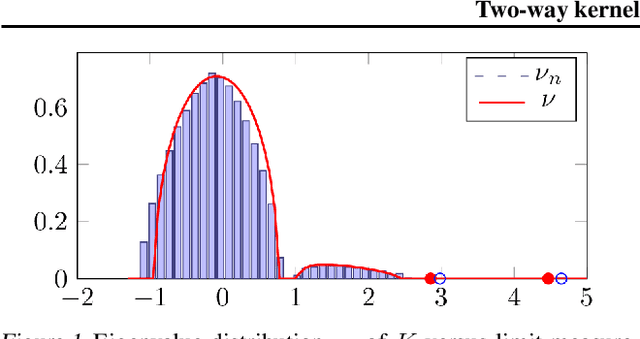
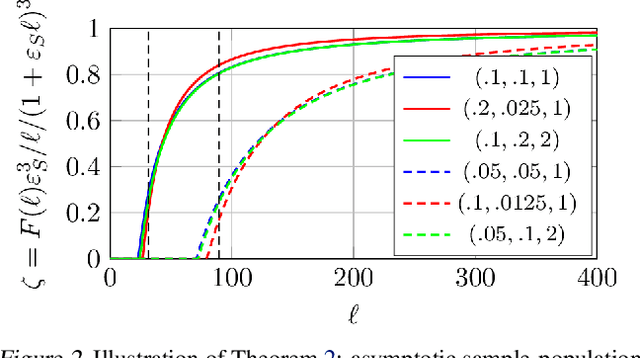
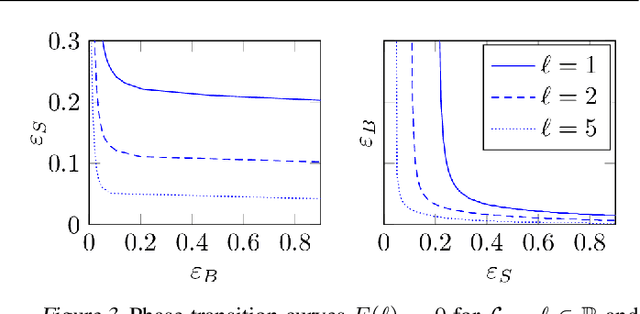
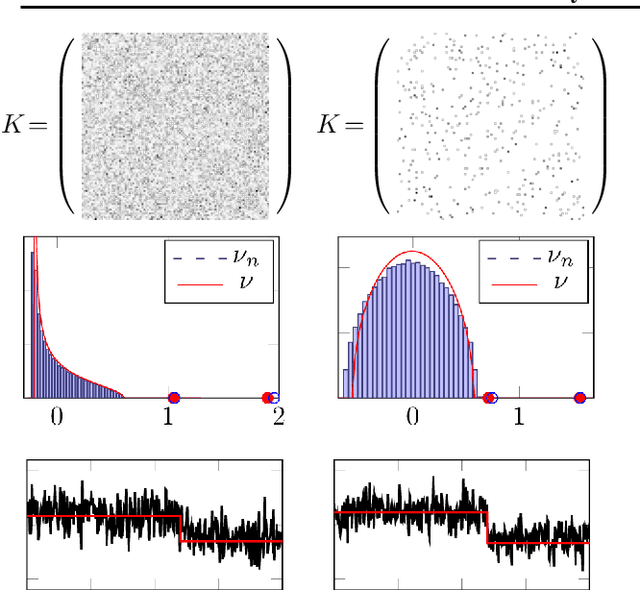
The article introduces an elementary cost and storage reduction method for spectral clustering and principal component analysis. The method consists in randomly "puncturing" both the data matrix $X\in\mathbb{C}^{p\times n}$ (or $\mathbb{R}^{p\times n}$) and its corresponding kernel (Gram) matrix $K$ through Bernoulli masks: $S\in\{0,1\}^{p\times n}$ for $X$ and $B\in\{0,1\}^{n\times n}$ for $K$. The resulting "two-way punctured" kernel is thus given by $K=\frac{1}{p}[(X \odot S)^{\sf H} (X \odot S)] \odot B$. We demonstrate that, for $X$ composed of independent columns drawn from a Gaussian mixture model, as $n,p\to\infty$ with $p/n\to c_0\in(0,\infty)$, the spectral behavior of $K$ -- its limiting eigenvalue distribution, as well as its isolated eigenvalues and eigenvectors -- is fully tractable and exhibits a series of counter-intuitive phenomena. We notably prove, and empirically confirm on GAN-generated image databases, that it is possible to drastically puncture the data, thereby providing possibly huge computational and storage gains, for a virtually constant (clustering of PCA) performance. This preliminary study opens as such the path towards rethinking, from a large dimensional standpoint, computational and storage costs in elementary machine learning models.