 Add to Chrome
 Add to Firefox
 Add to Edge
Approximate Structured Diffusion for Sequence Labelling
Jun 17, 2026
Sequence labelling, a core task of Natural Language Processing (NLP), consists in assigning each token of an input sentence a label. From a Machine Learning point of view, sequence labelling is often cast as a Linear-Chain Conditional Random Field (CRF) parametrised by a neural network. While this approach gives good empirical results, CRFs assume a finite decision span (eg label bigrams) which can limit their expressivity and hurt performance when long-range dependencies are required. We show we can leverage diffusion to train a CRF conditioned on an entire label sequence, with the caveat that the condition is on a noisy version of labels. We show experimentally that this method, in conjunction with approximate CRF inference, improves label accuracy with a 16.5% error reduction for POS-tagging.

Scaling Graph-Based Dependency Parsing with Arc Vectorization and Attention-Based Refinement
Jan 16, 2025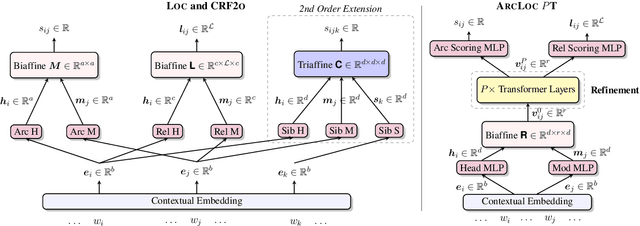
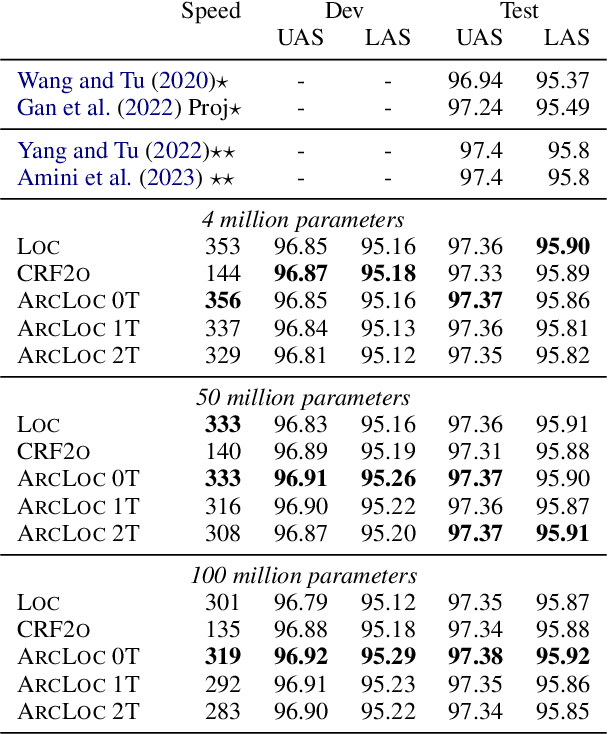
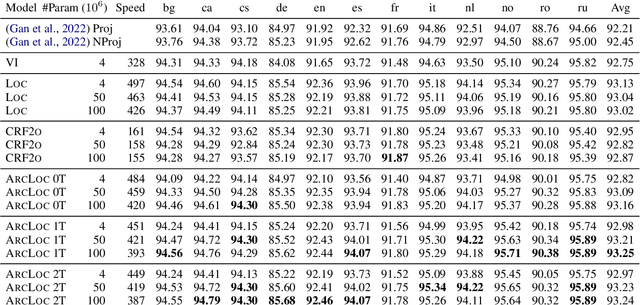
We propose a novel architecture for graph-based dependency parsing that explicitly constructs vectors, from which both arcs and labels are scored. Our method addresses key limitations of the standard two-pipeline approach by unifying arc scoring and labeling into a single network, reducing scalability issues caused by the information bottleneck and lack of parameter sharing. Additionally, our architecture overcomes limited arc interactions with transformer layers to efficiently simulate higher-order dependencies. Experiments on PTB and UD show that our model outperforms state-of-the-art parsers in both accuracy and efficiency.