 Add to Chrome
 Add to Firefox
 Add to Edge
SyMTRS: Benchmark Multi-Task Synthetic Dataset for Depth, Domain Adaptation and Super-Resolution in Aerial Imagery
Apr 23, 2026
Recent advances in deep learning for remote sensing rely heavily on large annotated datasets, yet acquiring high-quality ground truth for geometric, radiometric, and multi-domain tasks remains costly and often infeasible. In particular, the lack of accurate depth annotations, controlled illumination variations, and multi-scale paired imagery limits progress in monocular depth estimation, domain adaptation, and super-resolution for aerial scenes. We present SyMTRS, a large-scale synthetic dataset generated using a high-fidelity urban simulation pipeline. The dataset provides high-resolution RGB aerial imagery (2048 x 2048), pixel-perfect depth maps, night-time counterparts for domain adaptation, and aligned low-resolution variants for super-resolution at x2, x4, and x8 scales. Unlike existing remote sensing datasets that focus on a single task or modality, SyMTRS is designed as a unified multi-task benchmark enabling joint research in geometric understanding, cross-domain robustness, and resolution enhancement. We describe the dataset generation process, its statistical properties, and its positioning relative to existing benchmarks. SyMTRS aims to bridge critical gaps in remote sensing research by enabling controlled experiments with perfect geometric ground truth and consistent multi-domain supervision. The results obtained in this work can be reproduced from this Github repository: https://github.com/safouaneelg/SyMTRS.

FlightScope: A Deep Comprehensive Assessment of Aircraft Detection Algorithms in Satellite Imagery
Apr 03, 2024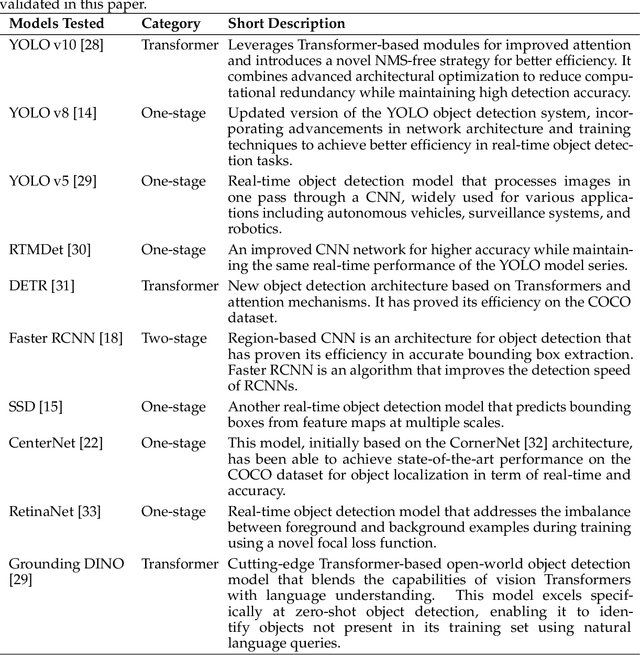
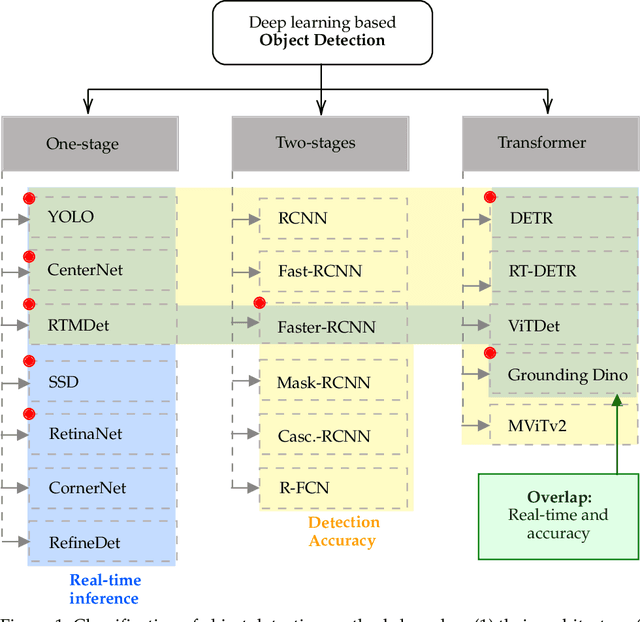
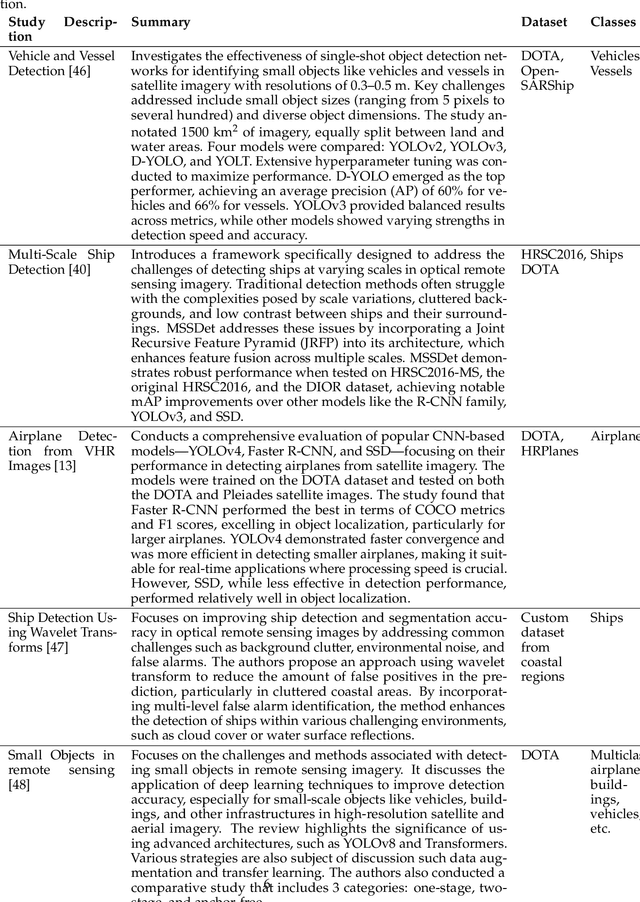
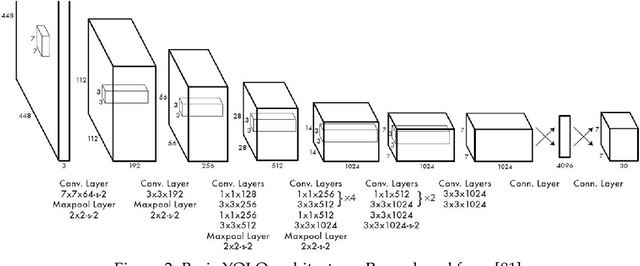
Object detection in remotely sensed satellite pictures is fundamental in many fields such as biophysical, and environmental monitoring. While deep learning algorithms are constantly evolving, they have been mostly implemented and tested on popular ground-based taken photos. This paper critically evaluates and compares a suite of advanced object detection algorithms customized for the task of identifying aircraft within satellite imagery. Using the large HRPlanesV2 dataset, together with a rigorous validation with the GDIT dataset, this research encompasses an array of methodologies including YOLO versions 5 and 8, Faster RCNN, CenterNet, RetinaNet, RTMDet, and DETR, all trained from scratch. This exhaustive training and validation study reveal YOLOv5 as the preeminent model for the specific case of identifying airplanes from remote sensing data, showcasing high precision and adaptability across diverse imaging conditions. This research highlight the nuanced performance landscapes of these algorithms, with YOLOv5 emerging as a robust solution for aerial object detection, underlining its importance through superior mean average precision, Recall, and Intersection over Union scores. The findings described here underscore the fundamental role of algorithm selection aligned with the specific demands of satellite imagery analysis and extend a comprehensive framework to evaluate model efficacy. The benchmark toolkit and codes, available via https://github.com/toelt-llc/FlightScope_Bench, aims to further exploration and innovation in the realm of remote sensing object detection, paving the way for improved analytical methodologies in satellite imagery applications.