 Add to Chrome
 Add to Firefox
 Add to Edge
SSA-3DGS: Unsupervised Removal of Screen-Space Artifacts for 3D Gaussian Splatting
Jul 06, 2026
Novel View Synthesis (NVS) methods, such as 3D Gaussian Splatting (3DGS), rely heavily on the assumption of clean, multi-view consistent, posed input images. Real-world captures can violate this assumption due to screen-space artifacts-static occlusions fixed to the 2D image plane rather than to the 3D world. Common examples include physical sensor defects, environmental obstructions (such as rain or mud on the lens enclosure), capture obstructions (such as a thumb over the camera sensor or a dashboard visible in dashcam footage), and digital overlays (such as watermarks or UI elements). When present, they are erroneously baked into the 3D geometry as "floaters" or near-camera artifacts, degrading the quality of novel-view rendering. In this work, we propose SSA-3DGS, an unsupervised framework that jointly optimizes a 3D scene and a learnable 2D overlay to recover a clean 3D scene and the corrupting artifacts. By exploiting geometric consensus across views, our method effectively disentangles static artifacts from the 3D scene geometry without supervision or manual input. Across diverse synthetic corruptions and a self-captured real-world dataset, SSA-3DGS improves reconstruction fidelity by up to 9 dB PSNR over 3DGS trained on the same corrupted inputs, while faithfully preserving the corrupting artifact.

Dataset Biases and Shortcut Learning in Motion-Based AI-Generated Video Detection
Jul 01, 2026The visual quality of AI-generated videos has improved drastically in recent years, making it increasingly difficult for humans to distinguish between real and synthetic media. In this work, we evaluate the robustness and applicability of four state-of-the-art motion-based AI-generated video detectors. We identify significant preprocessing and sampling biases in these methods and demonstrate that they account for a substantial portion of their reported performance. Furthermore, we find that these detectors are highly sensitive to motion patterns specific to their evaluation datasets, where AI-generated videos generally exhibit less inter-frame movement than real videos. We show that for all detectors, performance collapses to near-random levels when evaluated on a dataset that does not contain this motion bias. Additionally, through dataset rebalancing and the application of simple spatial augmentations, we observe severe performance degradation across all evaluated models. In contrast, we find that an existing frequency-based detector maintains strong performance across all evaluated datasets, suggesting that frequency-based approaches may offer a more generalizable path forward for AI-generated video detection. We hope that our work raises awareness towards these vulnerabilities and encourages the development of more representative, unbiased datasets and more robust evaluation protocols.
Practical High-Fidelity Novel-View Synthesis of Mounted Lepidoptera
Jun 30, 2026Mounted butterflies are among the most striking objects in natural history collections. However, their beauty is notoriously hard to digitize in 3D: they are small and fragile, with microscopic hairs and vein structures. Capturing them in sufficient detail, therefore, requires a macro lens, which has a very limited Depth of Field (DoF). Moreover, a camera body cannot be maneuvered beneath a pinned specimen to photograph its ventral surface (the underside of the wings). We introduce an end-to-end pipeline that resolves these challenges to turn such specimens into photo-realistic 3D models viewable from every direction. It combines three ingredients: handheld focus stacking for all-in-focus macro capture without a tripod, a non-contact first-surface mirror system that exposes the ventral surface without touching the specimen, and a segmentation-free, mirror-aware 3D Gaussian Splatting extension. We validate the reconstructions on four diverse specimens.
A Comparative Study of 3D Model Acquisition Methods for Synthetic Data Generation of Agricultural Products
Jan 07, 2026In the manufacturing industry, computer vision systems based on artificial intelligence (AI) are widely used to reduce costs and increase production. Training these AI models requires a large amount of training data that is costly to acquire and annotate, especially in high-variance, low-volume manufacturing environments. A popular approach to reduce the need for real data is the use of synthetic data that is generated by leveraging computer-aided design (CAD) models available in the industry. However, in the agricultural industry these models are not readily available, increasing the difficulty in leveraging synthetic data. In this paper, we present different techniques for substituting CAD files to create synthetic datasets. We measure their relative performance when used to train an AI object detection model to separate stones and potatoes in a bin picking environment. We demonstrate that using highly representative 3D models acquired by scanning or using image-to-3D approaches can be used to generate synthetic data for training object detection models. Finetuning on a small real dataset can significantly improve the performance of the models and even get similar performance when less representative models are used.
DASP: Self-supervised Nighttime Monocular Depth Estimation with Domain Adaptation of Spatiotemporal Priors
Dec 16, 2025Self-supervised monocular depth estimation has achieved notable success under daytime conditions. However, its performance deteriorates markedly at night due to low visibility and varying illumination, e.g., insufficient light causes textureless areas, and moving objects bring blurry regions. To this end, we propose a self-supervised framework named DASP that leverages spatiotemporal priors for nighttime depth estimation. Specifically, DASP consists of an adversarial branch for extracting spatiotemporal priors and a self-supervised branch for learning. In the adversarial branch, we first design an adversarial network where the discriminator is composed of four devised spatiotemporal priors learning blocks (SPLB) to exploit the daytime priors. In particular, the SPLB contains a spatial-based temporal learning module (STLM) that uses orthogonal differencing to extract motion-related variations along the time axis and an axial spatial learning module (ASLM) that adopts local asymmetric convolutions with global axial attention to capture the multiscale structural information. By combining STLM and ASLM, our model can acquire sufficient spatiotemporal features to restore textureless areas and estimate the blurry regions caused by dynamic objects. In the self-supervised branch, we propose a 3D consistency projection loss to bilaterally project the target frame and source frame into a shared 3D space, and calculate the 3D discrepancy between the two projected frames as a loss to optimize the 3D structural consistency and daytime priors. Extensive experiments on the Oxford RobotCar and nuScenes datasets demonstrate that our approach achieves state-of-the-art performance for nighttime depth estimation. Ablation studies further validate the effectiveness of each component.
Cut-and-Splat: Leveraging Gaussian Splatting for Synthetic Data Generation
Apr 11, 2025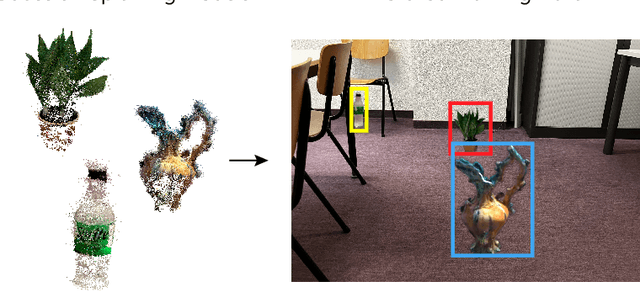
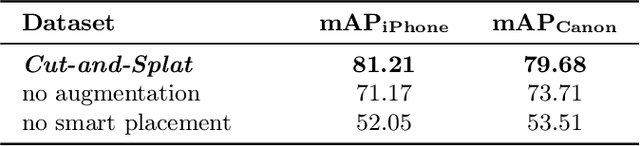
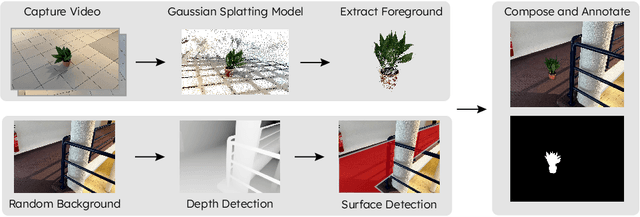
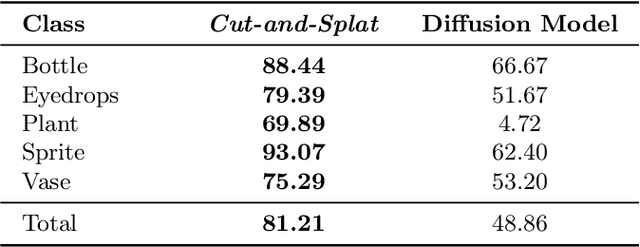
Generating synthetic images is a useful method for cheaply obtaining labeled data for training computer vision models. However, obtaining accurate 3D models of relevant objects is necessary, and the resulting images often have a gap in realism due to challenges in simulating lighting effects and camera artifacts. We propose using the novel view synthesis method called Gaussian Splatting to address these challenges. We have developed a synthetic data pipeline for generating high-quality context-aware instance segmentation training data for specific objects. This process is fully automated, requiring only a video of the target object. We train a Gaussian Splatting model of the target object and automatically extract the object from the video. Leveraging Gaussian Splatting, we then render the object on a random background image, and monocular depth estimation is employed to place the object in a believable pose. We introduce a novel dataset to validate our approach and show superior performance over other data generation approaches, such as Cut-and-Paste and Diffusion model-based generation.
Real-time Neural Rendering of LiDAR Point Clouds
Feb 17, 2025Static LiDAR scanners produce accurate, dense, colored point clouds, but often contain obtrusive artifacts which makes them ill-suited for direct display. We propose an efficient method to render photorealistic images of such scans without any expensive preprocessing or training of a scene-specific model. A naive projection of the point cloud to the output view using 1x1 pixels is fast and retains the available detail, but also results in unintelligible renderings as background points leak in between the foreground pixels. The key insight is that these projections can be transformed into a realistic result using a deep convolutional model in the form of a U-Net, and a depth-based heuristic that prefilters the data. The U-Net also handles LiDAR-specific problems such as missing parts due to occlusion, color inconsistencies and varying point densities. We also describe a method to generate synthetic training data to deal with imperfectly-aligned ground truth images. Our method achieves real-time rendering rates using an off-the-shelf GPU and outperforms the state-of-the-art in both speed and quality.
PRoGS: Progressive Rendering of Gaussian Splats
Sep 03, 2024Over the past year, 3D Gaussian Splatting (3DGS) has received significant attention for its ability to represent 3D scenes in a perceptually accurate manner. However, it can require a substantial amount of storage since each splat's individual data must be stored. While compression techniques offer a potential solution by reducing the memory footprint, they still necessitate retrieving the entire scene before any part of it can be rendered. In this work, we introduce a novel approach for progressively rendering such scenes, aiming to display visible content that closely approximates the final scene as early as possible without loading the entire scene into memory. This approach benefits both on-device rendering applications limited by memory constraints and streaming applications where minimal bandwidth usage is preferred. To achieve this, we approximate the contribution of each Gaussian to the final scene and construct an order of prioritization on their inclusion in the rendering process. Additionally, we demonstrate that our approach can be combined with existing compression methods to progressively render (and stream) 3DGS scenes, optimizing bandwidth usage by focusing on the most important splats within a scene. Overall, our work establishes a foundation for making remotely hosted 3DGS content more quickly accessible to end-users in over-the-top consumption scenarios, with our results showing significant improvements in quality across all metrics compared to existing methods.
DistillGrasp: Integrating Features Correlation with Knowledge Distillation for Depth Completion of Transparent Objects
Aug 01, 2024Due to the visual properties of reflection and refraction, RGB-D cameras cannot accurately capture the depth of transparent objects, leading to incomplete depth maps. To fill in the missing points, recent studies tend to explore new visual features and design complex networks to reconstruct the depth, however, these approaches tremendously increase computation, and the correlation of different visual features remains a problem. To this end, we propose an efficient depth completion network named DistillGrasp which distillates knowledge from the teacher branch to the student branch. Specifically, in the teacher branch, we design a position correlation block (PCB) that leverages RGB images as the query and key to search for the corresponding values, guiding the model to establish correct correspondence between two features and transfer it to the transparent areas. For the student branch, we propose a consistent feature correlation module (CFCM) that retains the reliable regions of RGB images and depth maps respectively according to the consistency and adopts a CNN to capture the pairwise relationship for depth completion. To avoid the student branch only learning regional features from the teacher branch, we devise a distillation loss that not only considers the distance loss but also the object structure and edge information. Extensive experiments conducted on the ClearGrasp dataset manifest that our teacher network outperforms state-of-the-art methods in terms of accuracy and generalization, and the student network achieves competitive results with a higher speed of 48 FPS. In addition, the significant improvement in a real-world robotic grasping system illustrates the effectiveness and robustness of our proposed system.
Genetic Learning for Designing Sim-to-Real Data Augmentations
Mar 11, 2024Data augmentations are useful in closing the sim-to-real domain gap when training on synthetic data. This is because they widen the training data distribution, thus encouraging the model to generalize better to other domains. Many image augmentation techniques exist, parametrized by different settings, such as strength and probability. This leads to a large space of different possible augmentation policies. Some policies work better than others for overcoming the sim-to-real gap for specific datasets, and it is unclear why. This paper presents two different interpretable metrics that can be combined to predict how well a certain augmentation policy will work for a specific sim-to-real setting, focusing on object detection. We validate our metrics by training many models with different augmentation policies and showing a strong correlation with performance on real data. Additionally, we introduce GeneticAugment, a genetic programming method that can leverage these metrics to automatically design an augmentation policy for a specific dataset without needing to train a model.