 Add to Chrome
 Add to Firefox
 Add to Edge
FDN: Interpretable Spatiotemporal Forecasting with Future Decomposition Networks
Jun 23, 2026
Spatiotemporal systems comprise a collection of spatially distributed yet interdependent entities each generating unique dynamic signals. Highly sophisticated methods have been proposed in recent years delivering state-of-the-art (SOTA) forecasts but few have focused on interpretability. To address this, we propose the Future Decomposition Network (FDN), a novel forecast model capable of (a) providing interpretable predictions through classification (b) revealing latent activity patterns in the target time-series and (c) delivering forecasts competitive with SOTA methods at a fraction of their memory and runtime cost. We conduct comprehensive analyses on FDN for multiple datasets from hydrologic, traffic, and energy systems, demonstrating its improved accuracy and interpretability.

Inductive Predictions of Extreme Hydrologic Events in The Wabash River Watershed
Apr 25, 2021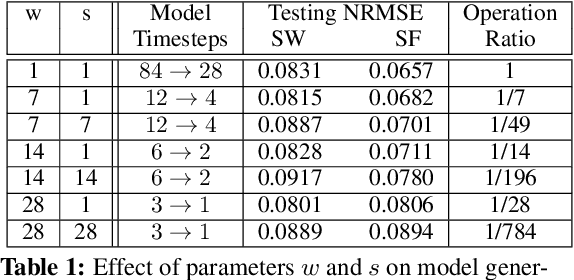
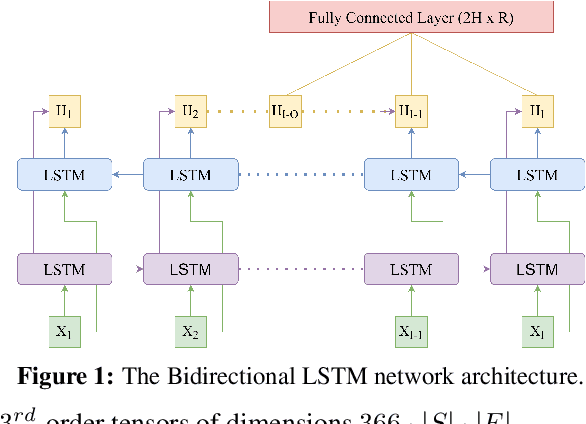
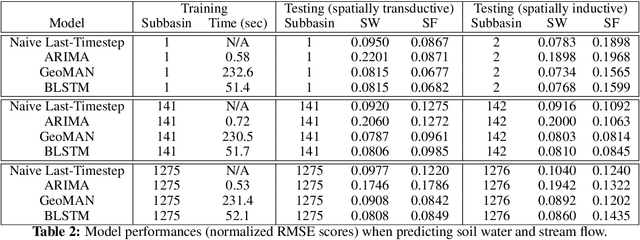
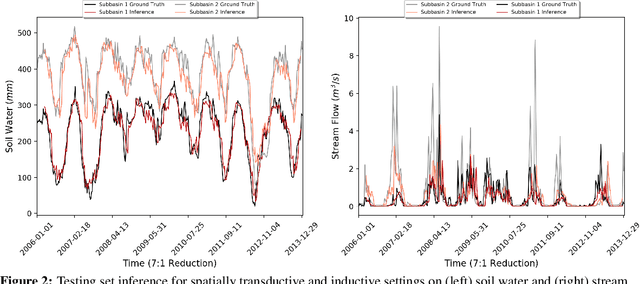
We present a machine learning method to predict extreme hydrologic events from spatially and temporally varying hydrological and meteorological data. We used a timestep reduction technique to reduce the computational and memory requirements and trained a bidirection LSTM network to predict soil water and stream flow from time series data observed and simulated over eighty years in the Wabash River Watershed. We show that our simple model can be trained much faster than complex attention networks such as GeoMAN without sacrificing accuracy. Based on the predicted values of soil water and stream flow, we predict the occurrence and severity of extreme hydrologic events such as droughts. We also demonstrate that extreme events can be predicted in geographical locations separate from locations observed during the training process. This spatially-inductive setting enables us to predict extreme events in other areas in the US and other parts of the world using our model trained with the Wabash Basin data.