 Add to Chrome
 Add to Firefox
 Add to Edge
Emyx: Fast and efficient all-atom protein generation
Jun 12, 2026
Computational enzyme design requires generating proteins that scaffold catalytic residues and ligands, a task that demands both geometric accuracy and structural diversity from the underlying generative model. Current all-atom generators inherit expensive architectures from structure prediction, leading to high training costs and limited sample diversity. We argue that much of this complexity is unnecessary for generators, which condition on sparse geometric constraints rather than rich co-evolutionary signals. Emyx is a 140M-parameter conditional flow matching model that concentrates capacity within standard transformer blocks, replacing heavy embedding stacks with lightweight conditional representations and sparse connectivity. We additionally derive an exact reparametrisation of the flow matching interpolant into the EDM noise-level framework, bridging flow matching training efficiency with state-of-the-art sampling methods designed for diffusion models without retraining. Despite being the smallest model, Emyx outperforms both Proteína-Complexa and RFdiffusion3 against the AME enzyme design benchmark across success rate under strict evaluation requiring both global fold recovery and catalytic geometry accuracy, structural novelty, scaffold diversity, and geometric validity, while training in just $682$ GPU-hours, roughly $4\times$ less than RFdiffusion3.

Hessian QM9: A quantum chemistry database of molecular Hessians in implicit solvents
Aug 15, 2024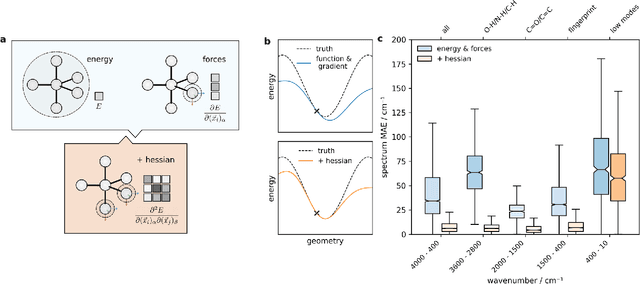
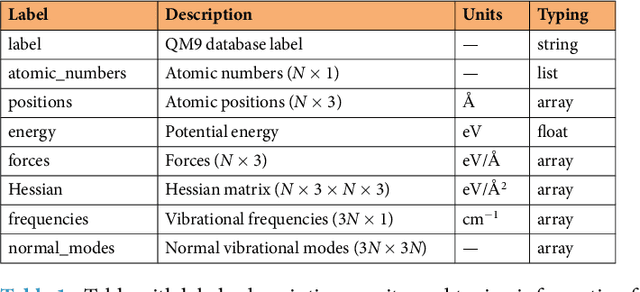
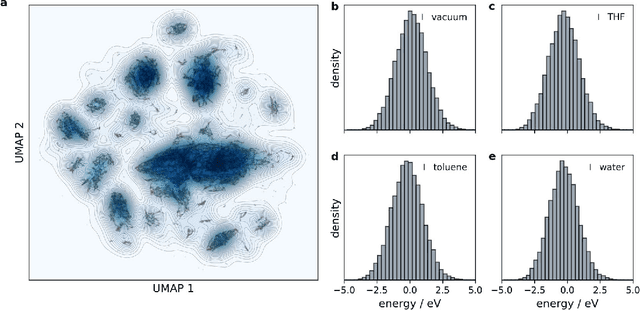

A significant challenge in computational chemistry is developing approximations that accelerate \emph{ab initio} methods while preserving accuracy. Machine learning interatomic potentials (MLIPs) have emerged as a promising solution for constructing atomistic potentials that can be transferred across different molecular and crystalline systems. Most MLIPs are trained only on energies and forces in vacuum, while an improved description of the potential energy surface could be achieved by including the curvature of the potential energy surface. We present Hessian QM9, the first database of equilibrium configurations and numerical Hessian matrices, consisting of 41,645 molecules from the QM9 dataset at the $\omega$B97x/6-31G* level. Molecular Hessians were calculated in vacuum, as well as water, tetrahydrofuran, and toluene using an implicit solvation model. To demonstrate the utility of this dataset, we show that incorporating second derivatives of the potential energy surface into the loss function of a MLIP significantly improves the prediction of vibrational frequencies in all solvent environments, thus making this dataset extremely useful for studying organic molecules in realistic solvent environments for experimental characterization.