 Add to Chrome
 Add to Firefox
 Add to Edge
Large Language Models in Peer-Run Community Behavioral Health Services: Understanding Peer Specialists and Service Users' Perspectives on Opportunities, Risks, and Mitigation Strategies
Feb 09, 2026
Peer-run organizations (PROs) provide critical, recovery-based behavioral health support rooted in lived experience. As large language models (LLMs) enter this domain, their scale, conversationality, and opacity introduce new challenges for situatedness, trust, and autonomy. Partnering with Collaborative Support Programs of New Jersey (CSPNJ), a statewide PRO in the Northeastern United States, we used comicboarding, a co-design method, to conduct workshops with 16 peer specialists and 10 service users exploring perceptions of integrating an LLM-based recommendation system into peer support. Findings show that depending on how LLMs are introduced, constrained, and co-used, they can reconfigure in-room dynamics by sustaining, undermining, or amplifying the relational authority that grounds peer support. We identify opportunities, risks, and mitigation strategies across three tensions: bridging scale and locality, protecting trust and relational dynamics, and preserving peer autonomy amid efficiency gains. We contribute design implications that center lived-experience-in-the-loop, reframe trust as co-constructed, and position LLMs not as clinical tools but as relational collaborators in high-stakes, community-led care.

PATIENT-Ψ: Using Large Language Models to Simulate Patients for Training Mental Health Professionals
May 30, 2024Mental illness remains one of the most critical public health issues, with a significant gap between the available mental health support and patient needs. Many mental health professionals highlight a disconnect between their training and real-world patient interactions, leaving some trainees feeling unprepared and potentially affecting their early career success. In this paper, we propose PATIENT-{\Psi}, a novel patient simulation framework for cognitive behavior therapy (CBT) training. To build PATIENT-{\Psi}, we constructed diverse patient profiles and their corresponding cognitive models based on CBT principles, and then used large language models (LLMs) programmed with the patient cognitive models to act as a simulated therapy patient. We propose an interactive training scheme, PATIENT-{\Psi}-TRAINER, for mental health trainees to practice a key skill in CBT -- formulating the cognitive model of the patient -- through role-playing a therapy session with PATIENT-{\Psi}. To evaluate PATIENT-{\Psi}, we conducted a user study of 4 mental health trainees and 10 experts. The results demonstrate that practice using PATIENT-{\Psi}-TRAINER greatly enhances the perceived skill acquisition and confidence of the trainees beyond existing forms of training such as textbooks, videos, and role-play with non-patients. Based on the experts' perceptions, PATIENT-{\Psi} is perceived to be closer to real patient interactions than GPT-4, and PATIENT-{\Psi}-TRAINER holds strong promise to improve trainee competencies. Our pioneering patient simulation training framework, using LLMs, holds great potential to enhance and advance mental health training, ultimately leading to improved patient care and outcomes. We will release all our data, code, and the training platform.
Understanding Frontline Workers' and Unhoused Individuals' Perspectives on AI Used in Homeless Services
Mar 17, 2023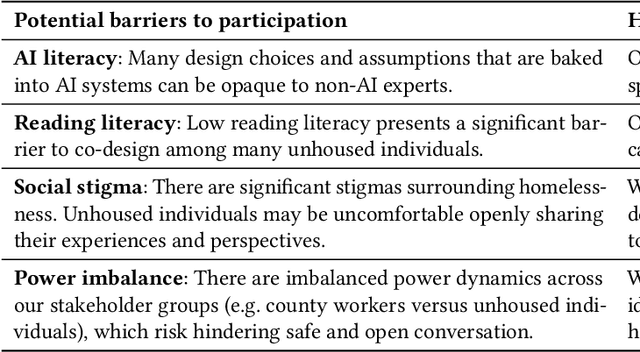
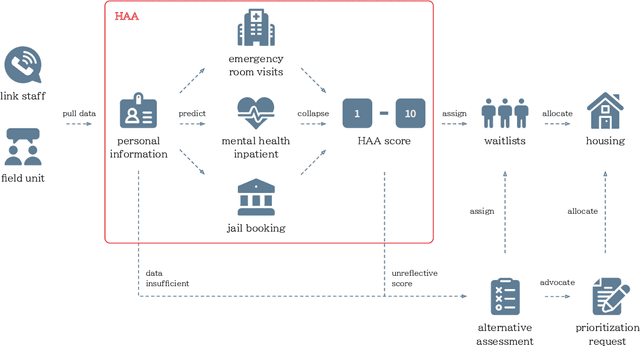
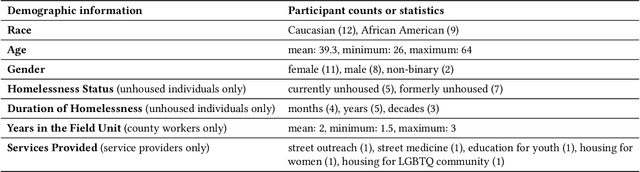
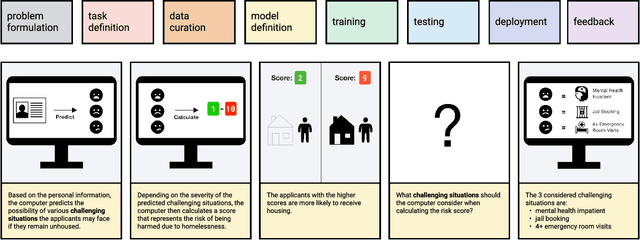
Recent years have seen growing adoption of AI-based decision-support systems (ADS) in homeless services, yet we know little about stakeholder desires and concerns surrounding their use. In this work, we aim to understand impacted stakeholders' perspectives on a deployed ADS that prioritizes scarce housing resources. We employed AI lifecycle comicboarding, an adapted version of the comicboarding method, to elicit stakeholder feedback and design ideas across various components of an AI system's design. We elicited feedback from county workers who operate the ADS daily, service providers whose work is directly impacted by the ADS, and unhoused individuals in the region. Our participants shared concerns and design suggestions around the AI system's overall objective, specific model design choices, dataset selection, and use in deployment. Our findings demonstrate that stakeholders, even without AI knowledge, can provide specific and critical feedback on an AI system's design and deployment, if empowered to do so.