 Add to Chrome
 Add to Firefox
 Add to Edge
Online Generation of Collision-Free Trajectories in Dynamic Environments
Feb 28, 2026
In this paper, we present an online method for converting an arbitrary geometric path represented by a sequence of states, generated by any planner (e.g., sampling-based planners like RRT or PRM, search-based planners like ARA*, etc.), into a corresponding kinematically feasible, jerk-limited trajectory. The method generates a sequence of quintic/quartic splines that can be discretized at a user-specified control rate, and then streamed to a low-level robot controller. Our approach enables real-time adaptation to newly captured changes in the environment. It can also be re-invoked at any time instance to generate a new trajectory from the robot's current to a desired target state or sequence of states. We can guarantee that the trajectory will remain collision-free for a certain amount of time in dynamic environments, while allowing bounded geometric deviation from the original path. The kinematic constraints are taken into account, including limited jerk. We validate the approach in a comparative simulation study against the competing method, demonstrating favorable behavior w.r.t. smoothness, computational time, and real-time performance, particularly in scenarios with frequent changes of target states (up to 1 [kHz]). Experiments on a real robot demonstrate that the proposed approach can be used in real-world scenarios including human presence.

Search-Based Robot Motion Planning With Distance-Based Adaptive Motion Primitives
Jul 01, 2025This work proposes a motion planning algorithm for robotic manipulators that combines sampling-based and search-based planning methods. The core contribution of the proposed approach is the usage of burs of free configuration space (C-space) as adaptive motion primitives within the graph search algorithm. Due to their feature to adaptively expand in free C-space, burs enable more efficient exploration of the configuration space compared to fixed-sized motion primitives, significantly reducing the time to find a valid path and the number of required expansions. The algorithm is implemented within the existing SMPL (Search-Based Motion Planning Library) library and evaluated through a series of different scenarios involving manipulators with varying number of degrees-of-freedom (DoF) and environment complexity. Results demonstrate that the bur-based approach outperforms fixed-primitive planning in complex scenarios, particularly for high DoF manipulators, while achieving comparable performance in simpler scenarios.
Real-Time Sampling-Based Safe Motion Planning for Robotic Manipulators in Dynamic Environments
Dec 31, 2024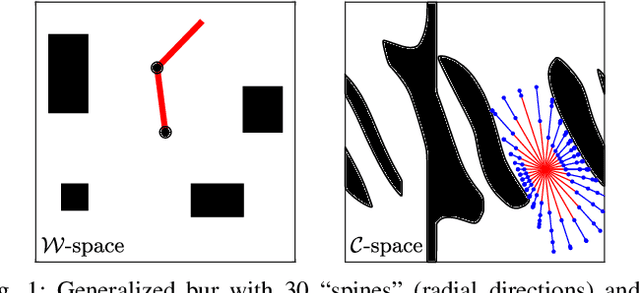
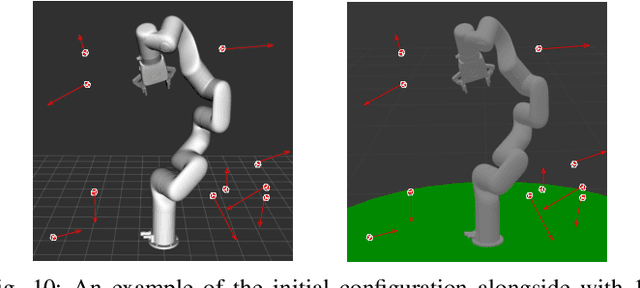

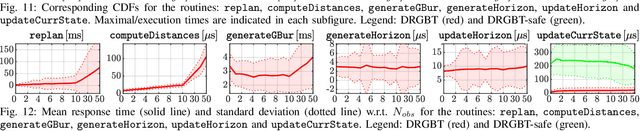
In this paper, we present the main features of Dynamic Rapidly-exploring Generalized Bur Tree (DRGBT) algorithm, a sampling-based planner for dynamic environments. We provide a detailed time analysis and appropriate scheduling to facilitate a real-time operation. To this end, an extensive analysis is conducted to identify the time-critical routines and their dependence on the number of obstacles. Furthermore, information about the distance to obstacles is used to compute a structure called dynamic expanded bubble of free configuration space, which is then utilized to establish sufficient conditions for a guaranteed safe motion of the robot while satisfying all kinematic constraints. An extensive randomized simulation trial is conducted to compare the proposed algorithm to a competing state-of-the-art method. Finally, an experimental study on a real robot is carried out covering a variety of scenarios including those with human presence. The results show the effectiveness and feasibility of real-time execution of the proposed motion planning algorithm within a typical sensor-based arrangement, using cheap hardware and sequential architecture, without the necessity for GPUs or heavy parallelization.