 Add to Chrome
 Add to Firefox
 Add to Edge
Lost in Speech: Benchmarking, Evaluation, and Parsing of Spoken Code-Switching Beyond Standard UD Assumptions
Feb 06, 2026
Spoken code-switching (CSW) challenges syntactic parsing in ways not observed in written text. Disfluencies, repetition, ellipsis, and discourse-driven structure routinely violate standard Universal Dependencies (UD) assumptions, causing parsers and large language models (LLMs) to fail despite strong performance on written data. These failures are compounded by rigid evaluation metrics that conflate genuine structural errors with acceptable variation. In this work, we present a systems-oriented approach to spoken CSW parsing. We introduce a linguistically grounded taxonomy of spoken CSW phenomena and SpokeBench, an expert-annotated gold benchmark designed to test spoken-language structure beyond standard UD assumptions. We further propose FLEX-UD, an ambiguity-aware evaluation metric, which reveals that existing parsing techniques perform poorly on spoken CSW by penalizing linguistically plausible analyses as errors. We then propose DECAP, a decoupled agentic parsing framework that isolates spoken-phenomena handling from core syntactic analysis. Experiments show that DECAP produces more robust and interpretable parses without retraining and achieves up to 52.6% improvements over existing parsing techniques. FLEX-UD evaluations further reveal qualitative improvements that are masked by standard metrics.

Parsing the Switch: LLM-Based UD Annotation for Complex Code-Switched and Low-Resource Languages
Jun 08, 2025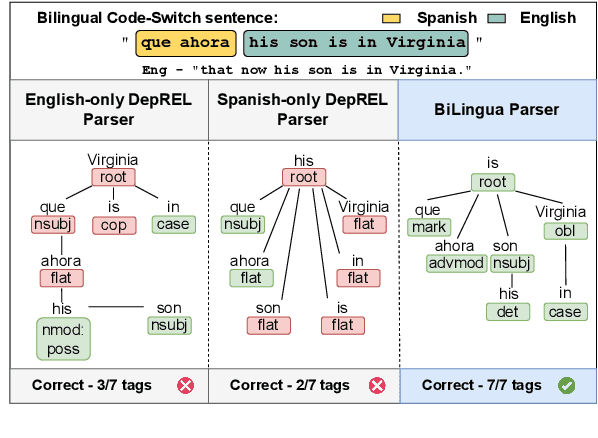
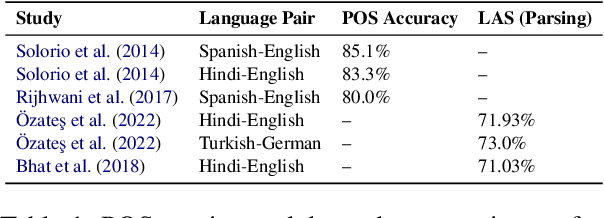
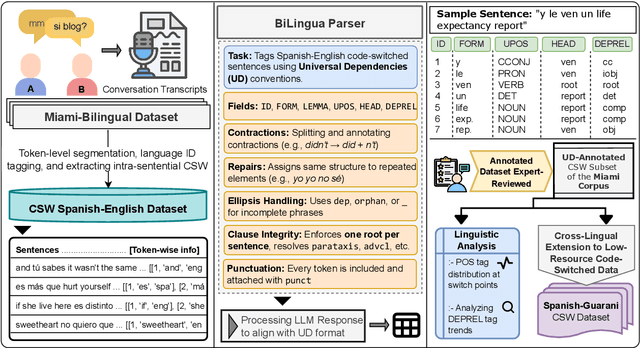
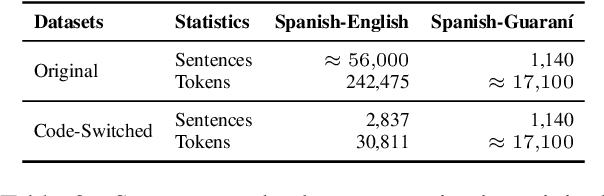
Code-switching presents a complex challenge for syntactic analysis, especially in low-resource language settings where annotated data is scarce. While recent work has explored the use of large language models (LLMs) for sequence-level tagging, few approaches systematically investigate how well these models capture syntactic structure in code-switched contexts. Moreover, existing parsers trained on monolingual treebanks often fail to generalize to multilingual and mixed-language input. To address this gap, we introduce the BiLingua Parser, an LLM-based annotation pipeline designed to produce Universal Dependencies (UD) annotations for code-switched text. First, we develop a prompt-based framework for Spanish-English and Spanish-Guaran\'i data, combining few-shot LLM prompting with expert review. Second, we release two annotated datasets, including the first Spanish-Guaran\'i UD-parsed corpus. Third, we conduct a detailed syntactic analysis of switch points across language pairs and communicative contexts. Experimental results show that BiLingua Parser achieves up to 95.29% LAS after expert revision, significantly outperforming prior baselines and multilingual parsers. These results show that LLMs, when carefully guided, can serve as practical tools for bootstrapping syntactic resources in under-resourced, code-switched environments. Data and source code are available at https://github.com/N3mika/ParsingProject