 Add to Chrome
 Add to Firefox
 Add to Edge
Optimisation of Aircraft Maintenance Schedules
Dec 19, 2025

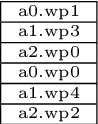
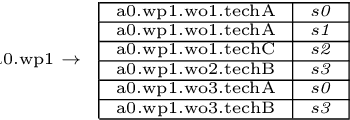
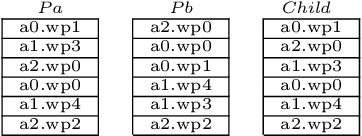
We present an aircraft maintenance scheduling problem, which requires suitably qualified staff to be assigned to maintenance tasks on each aircraft. The tasks on each aircraft must be completed within a given turn around window so that the aircraft may resume revenue earning service. This paper presents an initial study based on the application of an Evolutionary Algorithm to the problem. Evolutionary Algorithms evolve a solution to a problem by evaluating many possible solutions, focusing the search on those solutions that are of a higher quality, as defined by a fitness function. In this paper, we benchmark the algorithm on 60 generated problem instances to demonstrate the underlying representation and associated genetic operators.

A Conceptual Framework for Establishing Trust in Real World Intelligent Systems
Apr 12, 2021
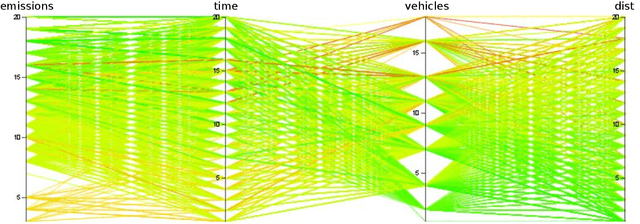
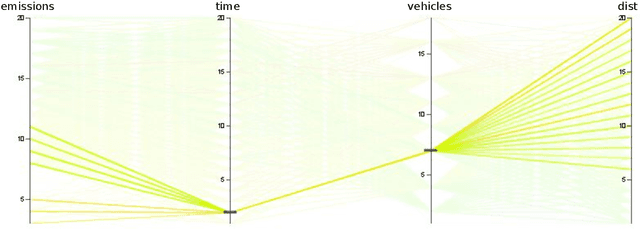
Intelligent information systems that contain emergent elements often encounter trust problems because results do not get sufficiently explained and the procedure itself can not be fully retraced. This is caused by a control flow depending either on stochastic elements or on the structure and relevance of the input data. Trust in such algorithms can be established by letting users interact with the system so that they can explore results and find patterns that can be compared with their expected solution. Reflecting features and patterns of human understanding of a domain against algorithmic results can create awareness of such patterns and may increase the trust that a user has in the solution. If expectations are not met, close inspection can be used to decide whether a solution conforms to the expectations or whether it goes beyond the expected. By either accepting or rejecting a solution, the user's set of expectations evolves and a learning process for the users is established. In this paper we present a conceptual framework that reflects and supports this process. The framework is the result of an analysis of two exemplary case studies from two different disciplines with information systems that assist experts in their complex tasks.
Optimisation and Illumination of a Real-world Workforce Scheduling and Routing Application via Map-Elites
May 29, 2018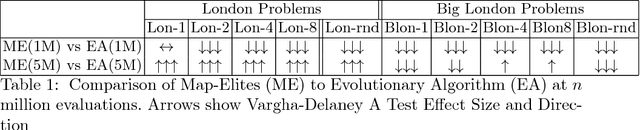
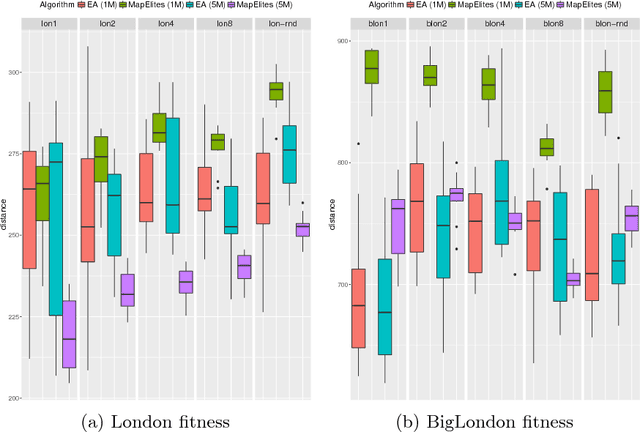
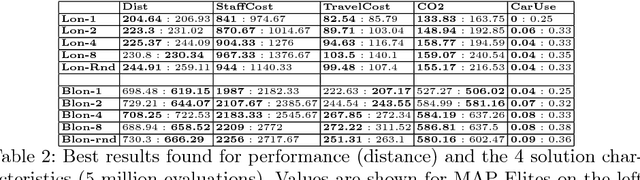
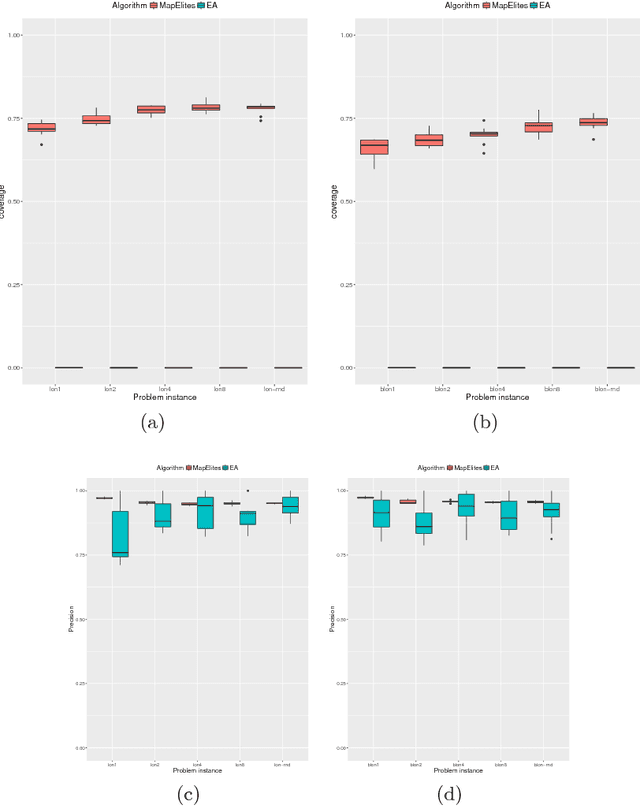
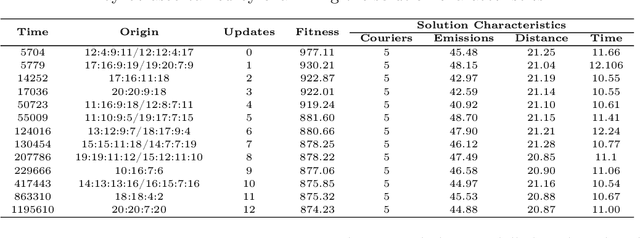
Workforce Scheduling and Routing Problems (WSRP) are very common in many practical domains, and usually, have a number of objectives. Illumination algorithms such as Map-Elites (ME) have recently gained traction in application to {\em design} problems, in providing multiple diverse solutions as well as illuminating the solution space in terms of user-defined characteristics, but typically require significant computational effort to produce the solution archive. We investigate whether ME can provide an effective approach to solving WSRP, a {\em repetitive} problem in which solutions have to be produced quickly and often. The goals of the paper are two-fold. The first is to evaluate whether ME can provide solutions of competitive quality to an Evolutionary Algorithm (EA) in terms of a single objective function, and the second to examine its ability to provide a repertoire of solutions that maximise user choice. We find that very small computational budgets favour the EA in terms of quality, but ME outperforms the EA at larger budgets, provides a more diverse array of solutions, and lends insight to the end-user.