 Add to Chrome
 Add to Firefox
 Add to Edge
Learning through Internalization
Jun 18, 2026
We study internalization processes, by which neural-network-based systems absorb an explicit computational procedure into their own weights, and how they facilitate learning. We investigate how transformers internalize the simulation of semiautomata by internalizing chain-of-thought (CoT) tokens, which classes of semiautomata are harder to internalize, and expose the flip side of internalization, that is, a progressive degradation of out-of-distribution performance. We then provide the first provable analysis of successful internalization: for the task of learning parities, we show that a simplified one-layer transformer provably first learns the target with explicit CoT supervision and then internalizes the autoregressive generation as CoT tokens are progressively removed, learning to directly compute the parity. This task is computationally hard to learn from data without CoT supervision. Finally, we discuss how learning through internalization relates to the \textit{Positive Distribution Shift} phenomenon recently introduced by~\citet{Med+26}.

How catastrophic can catastrophic forgetting be in linear regression?
May 25, 2022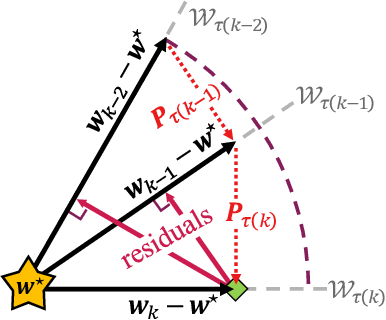
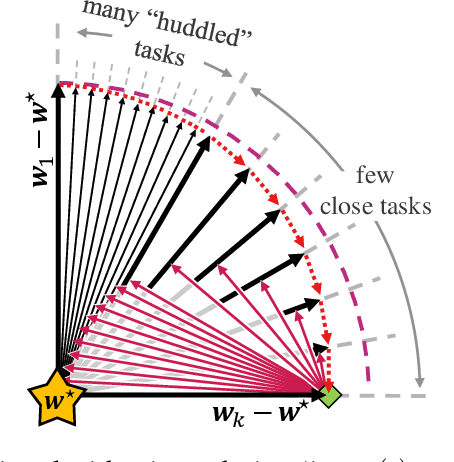
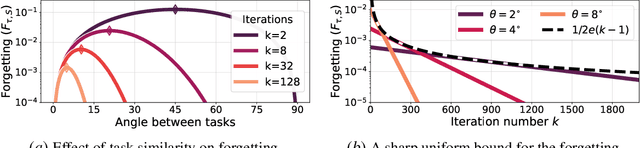
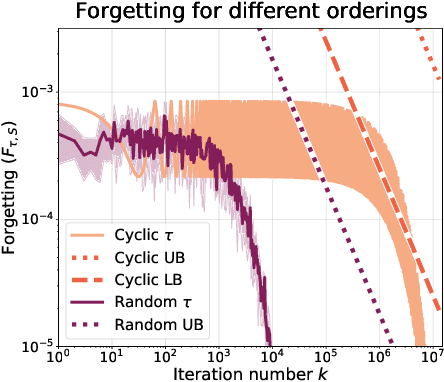
To better understand catastrophic forgetting, we study fitting an overparameterized linear model to a sequence of tasks with different input distributions. We analyze how much the model forgets the true labels of earlier tasks after training on subsequent tasks, obtaining exact expressions and bounds. We establish connections between continual learning in the linear setting and two other research areas: alternating projections and the Kaczmarz method. In specific settings, we highlight differences between forgetting and convergence to the offline solution as studied in those areas. In particular, when T tasks in d dimensions are presented cyclically for k iterations, we prove an upper bound of T^2 * min{1/sqrt(k), d/k} on the forgetting. This stands in contrast to the convergence to the offline solution, which can be arbitrarily slow according to existing alternating projection results. We further show that the T^2 factor can be lifted when tasks are presented in a random ordering.