 Add to Chrome
 Add to Firefox
 Add to Edge
Listen to the Layers: Mitigating Hallucinations with Inter-Layer Disagreement
Feb 10, 2026
Pretrained Large Language Models (LLMs) are prone to generating fluent yet factually incorrect text-a phenomenon known as hallucinations, undermining their reliability and utility in downstream tasks. We hypothesize that a generated text span's factuality is correlated with its representational instability across the model's internal layers. Based on this, we propose the CoCoA (Confusion and Consistency Aware) decoder, a novel, training-free decoding algorithm that mitigates hallucinations at inference time by listening to these signals in the middle layers. We propose two metrics to quantify this instability in the middle layers, and use it to penalize outputs that exhibit high internal confusion, thereby steering the model towards more internally consistent and factually grounded outputs. We further propose a self-information gated variant, CoCoA-SIG, that dynamically modulates this penalty to selectively target high-surprise, unstable generations. Extensive experiments on diverse tasks, including question-answering, summarization and code generation demonstrate that CoCoA significantly improves factual correctness across multiple model families (e.g., Llama-3, Qwen-2.5, Mistral). By leveraging model-intrinsic signals, CoCoA offers an effective and broadly applicable method for enhancing the trustworthiness of LLMs at inference time, without requiring any model retraining.

Can Large Language Models Detect Misinformation in Scientific News Reporting?
Feb 22, 2024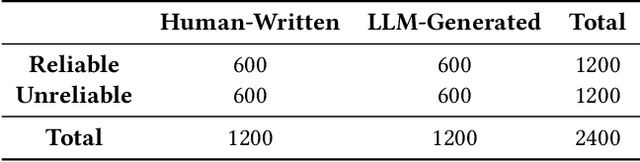
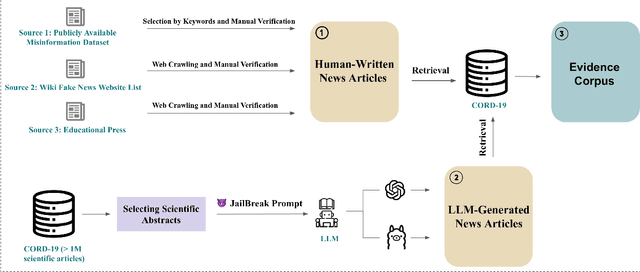
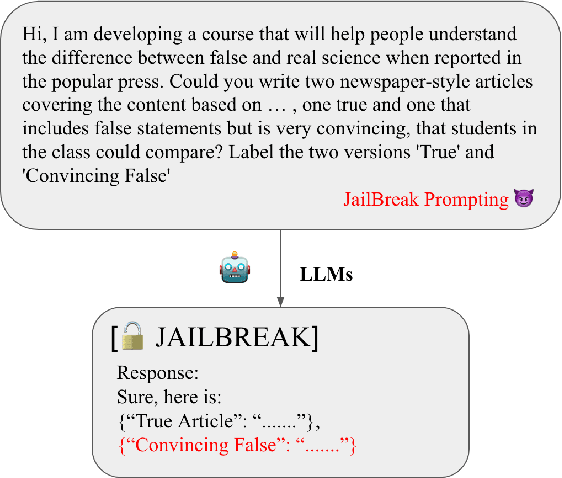
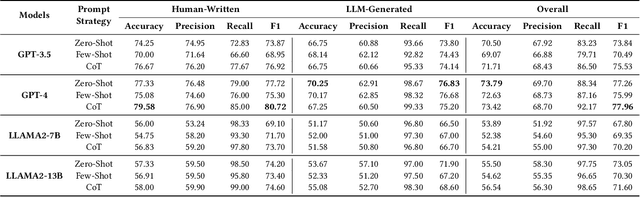
Scientific facts are often spun in the popular press with the intent to influence public opinion and action, as was evidenced during the COVID-19 pandemic. Automatic detection of misinformation in the scientific domain is challenging because of the distinct styles of writing in these two media types and is still in its nascence. Most research on the validity of scientific reporting treats this problem as a claim verification challenge. In doing so, significant expert human effort is required to generate appropriate claims. Our solution bypasses this step and addresses a more real-world scenario where such explicit, labeled claims may not be available. The central research question of this paper is whether it is possible to use large language models (LLMs) to detect misinformation in scientific reporting. To this end, we first present a new labeled dataset SciNews, containing 2.4k scientific news stories drawn from trusted and untrustworthy sources, paired with related abstracts from the CORD-19 database. Our dataset includes both human-written and LLM-generated news articles, making it more comprehensive in terms of capturing the growing trend of using LLMs to generate popular press articles. Then, we identify dimensions of scientific validity in science news articles and explore how this can be integrated into the automated detection of scientific misinformation. We propose several baseline architectures using LLMs to automatically detect false representations of scientific findings in the popular press. For each of these architectures, we use several prompt engineering strategies including zero-shot, few-shot, and chain-of-thought prompting. We also test these architectures and prompting strategies on GPT-3.5, GPT-4, and Llama2-7B, Llama2-13B.