 Add to Chrome
 Add to Firefox
 Add to Edge
DRoPS: Dynamic 3D Reconstruction of Pre-Scanned Objects
Mar 25, 2026
Dynamic scene reconstruction from casual videos has seen recent remarkable progress. Numerous approaches have attempted to overcome the ill-posedness of the task by distilling priors from 2D foundational models and by imposing hand-crafted regularization on the optimized motion. However, these methods struggle to reconstruct scenes from extreme novel viewpoints, especially when highly articulated motions are present. In this paper, we present DRoPS, a novel approach that leverages a static pre-scan of the dynamic object as an explicit geometric and appearance prior. While existing state-of-the-art methods fail to fully exploit the pre-scan, DRoPS leverages our novel setup to effectively constrain the solution space and ensure geometrical consistency throughout the sequence. The core of our novelty is twofold: first, we establish a grid-structured and surface-aligned model by organizing Gaussian primitives into pixel grids anchored to the object surface. Second, by leveraging the grid structure of our primitives, we parameterize motion using a CNN conditioned on those grids, injecting strong implicit regularization and correlating the motion of nearby points. Extensive experiments demonstrate that our method significantly outperforms the current state of the art in rendering quality and 3D tracking accuracy.

DINO-Tracker: Taming DINO for Self-Supervised Point Tracking in a Single Video
Mar 21, 2024We present DINO-Tracker -- a new framework for long-term dense tracking in video. The pillar of our approach is combining test-time training on a single video, with the powerful localized semantic features learned by a pre-trained DINO-ViT model. Specifically, our framework simultaneously adopts DINO's features to fit to the motion observations of the test video, while training a tracker that directly leverages the refined features. The entire framework is trained end-to-end using a combination of self-supervised losses, and regularization that allows us to retain and benefit from DINO's semantic prior. Extensive evaluation demonstrates that our method achieves state-of-the-art results on known benchmarks. DINO-tracker significantly outperforms self-supervised methods and is competitive with state-of-the-art supervised trackers, while outperforming them in challenging cases of tracking under long-term occlusions.
Disentangling Structure and Appearance in ViT Feature Space
Nov 20, 2023We present a method for semantically transferring the visual appearance of one natural image to another. Specifically, our goal is to generate an image in which objects in a source structure image are "painted" with the visual appearance of their semantically related objects in a target appearance image. To integrate semantic information into our framework, our key idea is to leverage a pre-trained and fixed Vision Transformer (ViT) model. Specifically, we derive novel disentangled representations of structure and appearance extracted from deep ViT features. We then establish an objective function that splices the desired structure and appearance representations, interweaving them together in the space of ViT features. Based on our objective function, we propose two frameworks of semantic appearance transfer -- "Splice", which works by training a generator on a single and arbitrary pair of structure-appearance images, and "SpliceNet", a feed-forward real-time appearance transfer model trained on a dataset of images from a specific domain. Our frameworks do not involve adversarial training, nor do they require any additional input information such as semantic segmentation or correspondences. We demonstrate high-resolution results on a variety of in-the-wild image pairs, under significant variations in the number of objects, pose, and appearance. Code and supplementary material are available in our project page: splice-vit.github.io.
Plug-and-Play Diffusion Features for Text-Driven Image-to-Image Translation
Nov 22, 2022Large-scale text-to-image generative models have been a revolutionary breakthrough in the evolution of generative AI, allowing us to synthesize diverse images that convey highly complex visual concepts. However, a pivotal challenge in leveraging such models for real-world content creation tasks is providing users with control over the generated content. In this paper, we present a new framework that takes text-to-image synthesis to the realm of image-to-image translation -- given a guidance image and a target text prompt, our method harnesses the power of a pre-trained text-to-image diffusion model to generate a new image that complies with the target text, while preserving the semantic layout of the source image. Specifically, we observe and empirically demonstrate that fine-grained control over the generated structure can be achieved by manipulating spatial features and their self-attention inside the model. This results in a simple and effective approach, where features extracted from the guidance image are directly injected into the generation process of the target image, requiring no training or fine-tuning and applicable for both real or generated guidance images. We demonstrate high-quality results on versatile text-guided image translation tasks, including translating sketches, rough drawings and animations into realistic images, changing of the class and appearance of objects in a given image, and modifications of global qualities such as lighting and color.
Splicing ViT Features for Semantic Appearance Transfer
Jan 02, 2022
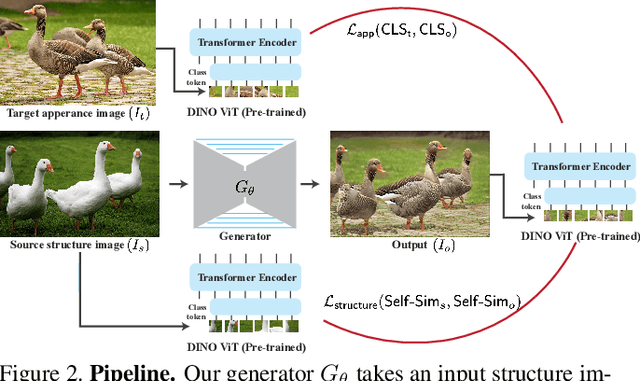
We present a method for semantically transferring the visual appearance of one natural image to another. Specifically, our goal is to generate an image in which objects in a source structure image are "painted" with the visual appearance of their semantically related objects in a target appearance image. Our method works by training a generator given only a single structure/appearance image pair as input. To integrate semantic information into our framework - a pivotal component in tackling this task - our key idea is to leverage a pre-trained and fixed Vision Transformer (ViT) model which serves as an external semantic prior. Specifically, we derive novel representations of structure and appearance extracted from deep ViT features, untwisting them from the learned self-attention modules. We then establish an objective function that splices the desired structure and appearance representations, interweaving them together in the space of ViT features. Our framework, which we term "Splice", does not involve adversarial training, nor does it require any additional input information such as semantic segmentation or correspondences, and can generate high-resolution results, e.g., work in HD. We demonstrate high quality results on a variety of in-the-wild image pairs, under significant variations in the number of objects, their pose and appearance.