 Add to Chrome
 Add to Firefox
 Add to Edge
RepTran: Search-Based Repair of Transformer Models
Jul 14, 2026
To ensure the overall quality of AI-enabled software, not only traditional software components but also AI components need to be tested and repaired. Among AI components, Transformer models are increasingly integrated into software systems, which makes their misbehaviors critical. Although prior work in the software engineering community has proposed deep neural network (DNN) repair methods, most overlook Transformer-specific structures. We propose RepTran, a search-based repair method for Transformer models. It targets their feed-forward networks (FFNs), which play a central role in the architecture. RepTran identifies suspicious weights by combining two types of scores: a variance-based neuron score and an existing bidirectional score. It then iteratively optimizes these weights using differential evolution. Our evaluation includes 18 fault benchmarks constructed from CIFAR-100 and Tiny-ImageNet. We compare RepTran against three baselines: random weight selection, Arachne (a state-of-the-art DNN repair method), and ArachneW, which enables Arachne to control the number of selected weights. RepTran achieved an average repair rate of 74.7%, statistically outperforming random selection and Arachne across all benchmarks. Effect size analysis revealed that RepTran achieved higher repair rates than ArachneW regardless of the number of selected weights. These results suggest that RepTran is effective for enhancing the reliability of AI-enabled software.

ArgRE: Formal Argumentation for Conflict Resolution in Multi-Agent Requirements Negotiation
Apr 25, 2026As software systems grow in complexity, they must satisfy an increasing number of competing quality attributes, making it essential to balance them in a principled manner -- for example, a safety requirement for sensor-fusion verification may conflict with a tight planning-cycle budget. Multi-agent large language model frameworks support this balancing process by assigning specialized agents to different objectives. However, their conflict resolution is typically heuristic. Requirements are aggregated implicitly without explicit acceptance or rejection, limiting auditability in regulated domains. We present ArgRE, a multi-agent requirements negotiation system that embeds Dung-style abstract argumentation into the negotiation stage. Each proposal, critique, and refinement is modeled as an argument, conflicts are represented as directed attack relations, and the accepted set of arguments is computed under grounded and preferred semantics. The pipeline further integrates KAOS goal modeling, multi-layer verification, and standards-oriented artifact generation. Evaluation across five case studies spanning safety-critical, financial, and information-system domains shows that ArgRE provides argument-level traceability absent from existing frameworks. Independent evaluators rated its decision justifications significantly higher than those of heuristic synthesis (4.32 vs. 3.07, p < 0.001), indicating improved auditability, while semantic intent preservation remains comparable (94.9% BERTScore F1) and compliance coverage reaches 84.7% versus 47.6%--47.8% for baselines. Structural analysis further confirms that the default pairwise protocol yields acyclic graphs in which grounded and preferred semantics coincide, whereas cross-pair arbitration introduces controlled cyclicity, leading to predictable divergence between the two semantics.
Generative AI for Requirements Engineering: A Systematic Literature Review
Sep 10, 2024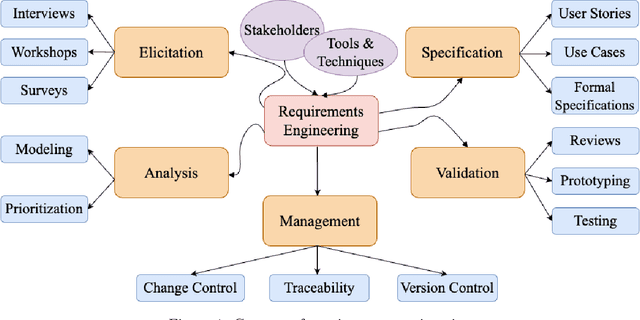
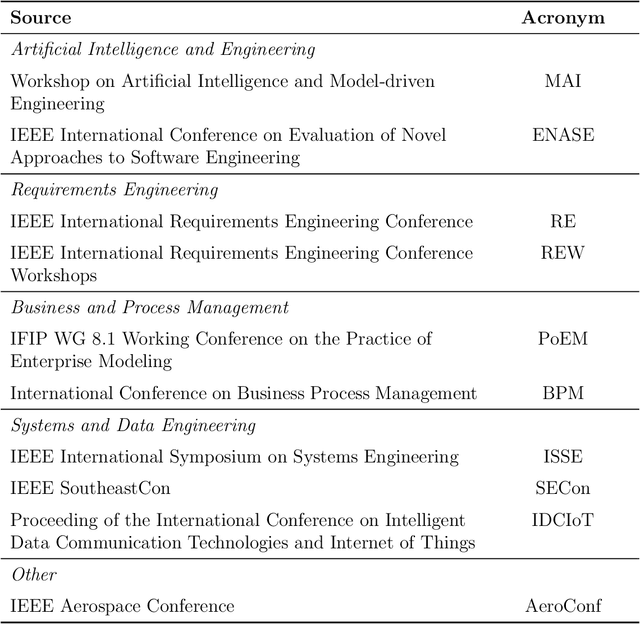
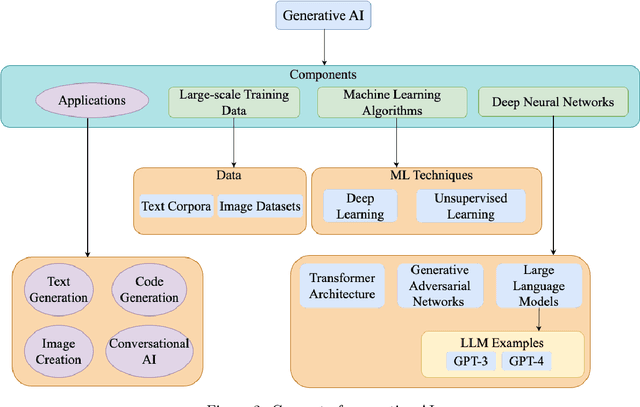
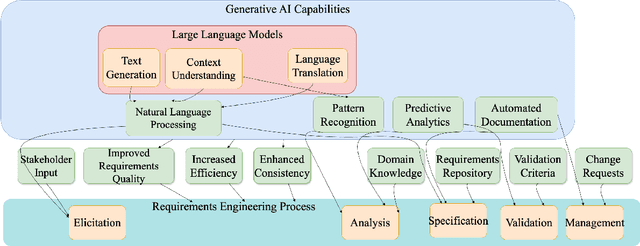
Context: Generative AI (GenAI) has emerged as a transformative tool in software engineering, with requirements engineering (RE) actively exploring its potential to revolutionize processes and outcomes. The integration of GenAI into RE presents both promising opportunities and significant challenges that necessitate systematic analysis and evaluation. Objective: This paper presents a comprehensive systematic literature review (SLR) analyzing state-of-the-art applications and innovative proposals leveraging GenAI in RE. It surveys studies focusing on the utilization of GenAI to enhance RE processes while identifying key challenges and opportunities in this rapidly evolving field. Method: A rigorous SLR methodology was used to analyze 27 carefully selected primary studies in-depth. The review examined research questions pertaining to the application of GenAI across various RE phases, the models and techniques used, and the challenges encountered in implementation and adoption. Results: The most salient findings include i) a predominant focus on the early stages of RE, particularly the elicitation and analysis of requirements, indicating potential for expansion into later phases; ii) the dominance of large language models, especially the GPT series, highlighting the need for diverse AI approaches; and iii) persistent challenges in domain-specific applications and the interpretability of AI-generated outputs, underscoring areas requiring further research and development. Conclusions: The results highlight the critical need for comprehensive evaluation frameworks, improved human-AI collaboration models, and thorough consideration of ethical implications in GenAI-assisted RE. Future research should prioritize extending GenAI applications across the entire RE lifecycle, enhancing domain-specific capabilities, and developing strategies for responsible AI integration in RE practices.