 Add to Chrome
 Add to Firefox
 Add to Edge
Omics-scale polymer computational database transferable to real-world artificial intelligence applications
Nov 07, 2025
Developing large-scale foundational datasets is a critical milestone in advancing artificial intelligence (AI)-driven scientific innovation. However, unlike AI-mature fields such as natural language processing, materials science, particularly polymer research, has significantly lagged in developing extensive open datasets. This lag is primarily due to the high costs of polymer synthesis and property measurements, along with the vastness and complexity of the chemical space. This study presents PolyOmics, an omics-scale computational database generated through fully automated molecular dynamics simulation pipelines that provide diverse physical properties for over $10^5$ polymeric materials. The PolyOmics database is collaboratively developed by approximately 260 researchers from 48 institutions to bridge the gap between academia and industry. Machine learning models pretrained on PolyOmics can be efficiently fine-tuned for a wide range of real-world downstream tasks, even when only limited experimental data are available. Notably, the generalisation capability of these simulation-to-real transfer models improve significantly as the size of the PolyOmics database increases, exhibiting power-law scaling. The emergence of scaling laws supports the "more is better" principle, highlighting the significance of ultralarge-scale computational materials data for improving real-world prediction performance. This unprecedented omics-scale database reveals vast unexplored regions of polymer materials, providing a foundation for AI-driven polymer science.

ABCAS: Adaptive Bound Control of spectral norm as Automatic Stabilizer
Nov 12, 2022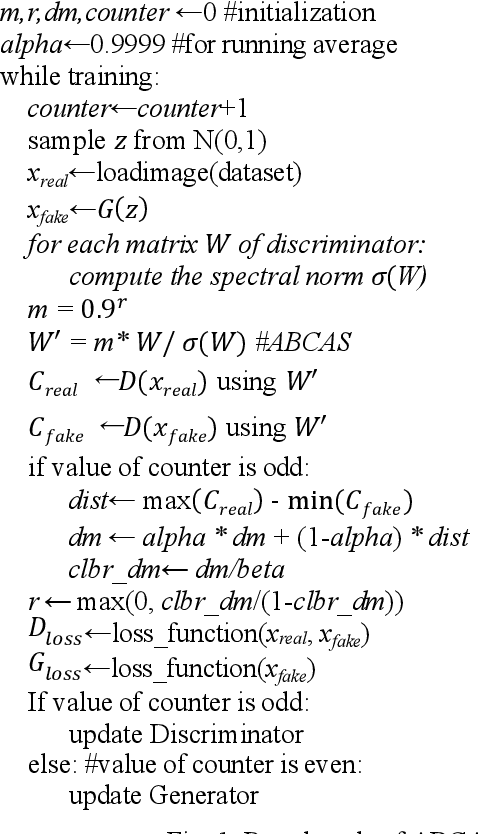
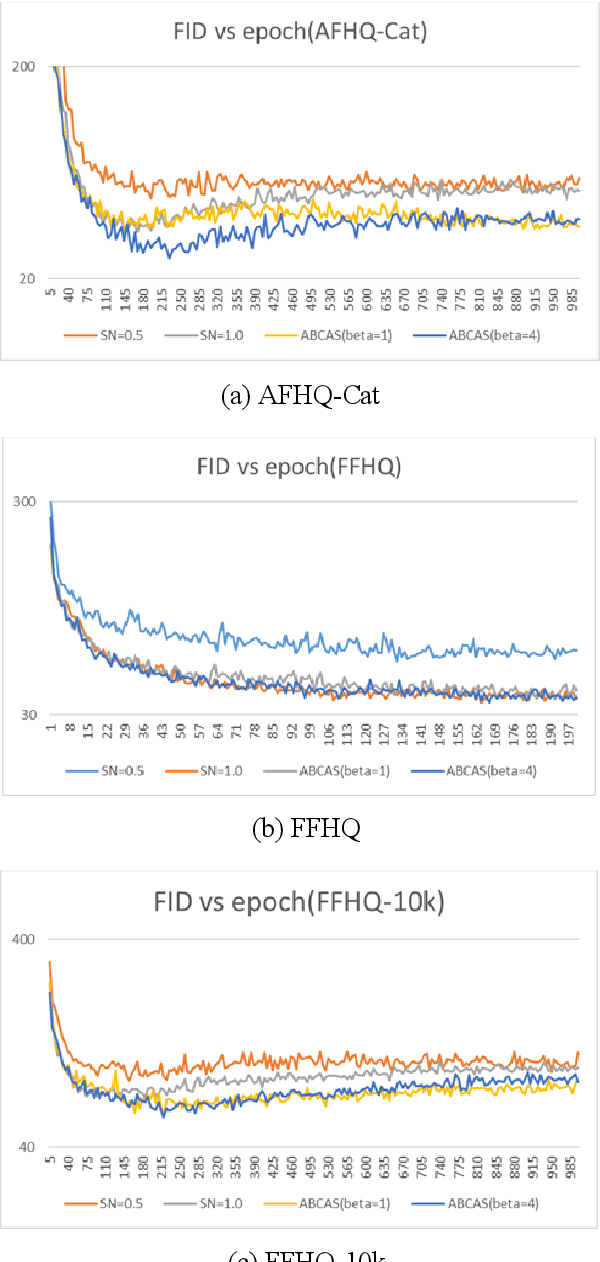
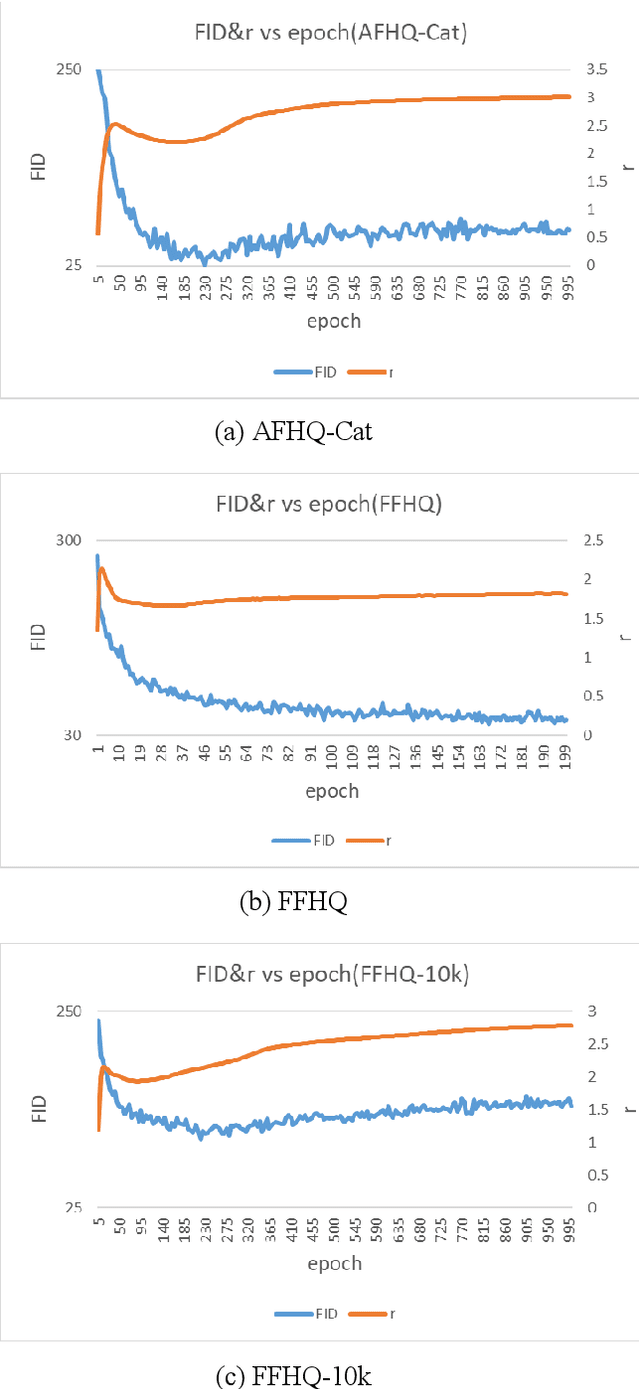
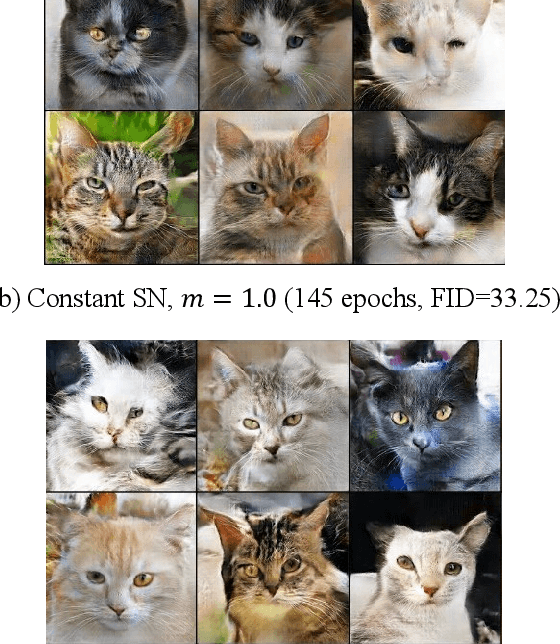
Spectral Normalization is one of the best methods for stabilizing the training of Generative Adversarial Network. Spectral Normalization limits the gradient of discriminator between the distribution between real data and fake data. However, even with this normalization, GAN's training sometimes fails. In this paper, we reveal that more severe restriction is sometimes needed depending on the training dataset, then we propose a novel stabilizer which offers an adaptive normalization method, called ABCAS. Our method decides discriminator's Lipschitz constant adaptively, by checking the distance of distributions of real and fake data. Our method improves the stability of the training of Generative Adversarial Network and achieved better Fr\'echet Inception Distance score of generated images. We also investigated suitable spectral norm for three datasets. We show the result as an ablation study.