 Add to Chrome
 Add to Firefox
 Add to Edge
Designed Vocalizations Dataset: Sound-Designed Human and Animal Voices for Non-human Voice Conversion
Jul 23, 2026
Advances in AI-based voice conversion have enabled a wide range of media applications, including films, audiobooks, and games. However, most research and public benchmarks still focus on natural human speech, leaving designed vocalizations, such as monster growls and robotic voices, underexplored, partly due to the lack of publicly available resources. To address this gap, we introduce the Designed Vocalizations Dataset, constructed by curating diverse raw vocal sources, including speech and animal vocalizations, and applying professional vocal effects processing to produce corresponding effect modified variants. We further provide a standardized test set with explicit seen/unseen splits over source timbre groups and preset styles to assess generalization under controlled conditions. Finally, we report baseline benchmark results to support reproducible evaluation and future research. The dataset and demo samples are available at https://ncai-official.github.io/speech/publications/designed-vocalizations-dataset/.

When Humans Growl and Birds Speak: High-Fidelity Voice Conversion from Human to Animal and Designed Sounds
May 30, 2025Human to non-human voice conversion (H2NH-VC) transforms human speech into animal or designed vocalizations. Unlike prior studies focused on dog-sounds and 16 or 22.05kHz audio transformation, this work addresses a broader range of non-speech sounds, including natural sounds (lion-roars, birdsongs) and designed voice (synthetic growls). To accomodate generation of diverse non-speech sounds and 44.1kHz high-quality audio transformation, we introduce a preprocessing pipeline and an improved CVAE-based H2NH-VC model, both optimized for human and non-human voices. Experimental results showed that the proposed method outperformed baselines in quality, naturalness, and similarity MOS, achieving effective voice conversion across diverse non-human timbres. Demo samples are available at https://nc-ai.github.io/speech/publications/nonhuman-vc/
iPhonMatchNet: Zero-Shot User-Defined Keyword Spotting Using Implicit Acoustic Echo Cancellation
Sep 13, 2023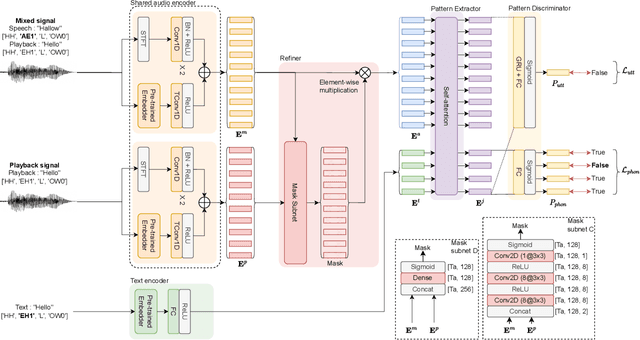
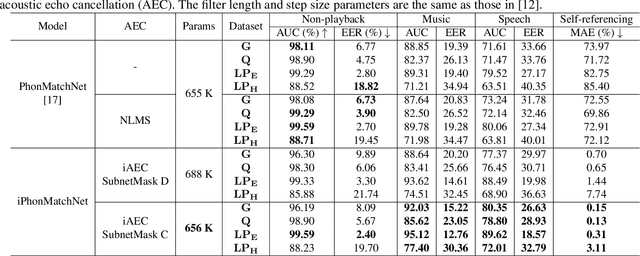
In response to the increasing interest in human--machine communication across various domains, this paper introduces a novel approach called iPhonMatchNet, which addresses the challenge of barge-in scenarios, wherein user speech overlaps with device playback audio, thereby creating a self-referencing problem. The proposed model leverages implicit acoustic echo cancellation (iAEC) techniques to increase the efficiency of user-defined keyword spotting models, achieving a remarkable 95% reduction in mean absolute error with a minimal increase in model size (0.13%) compared to the baseline model, PhonMatchNet. We also present an efficient model structure and demonstrate its capability to learn iAEC functionality without requiring a clean signal. The findings of our study indicate that the proposed model achieves competitive performance in real-world deployment conditions of smart devices.
PhonMatchNet: Phoneme-Guided Zero-Shot Keyword Spotting for User-Defined Keywords
Aug 31, 2023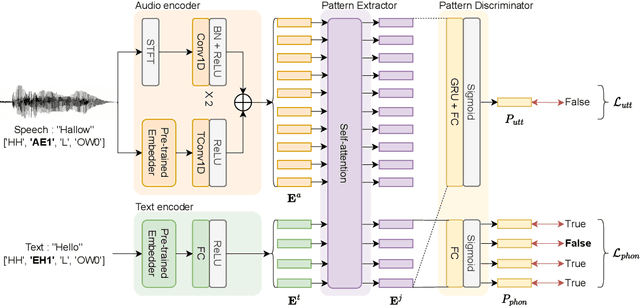

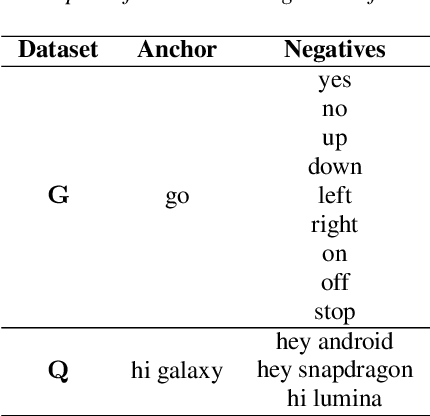
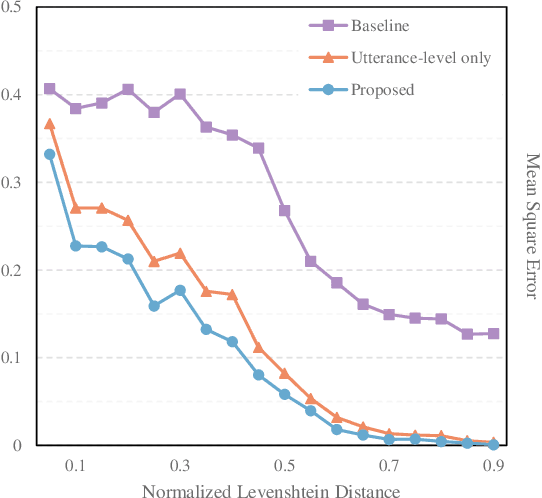
This study presents a novel zero-shot user-defined keyword spotting model that utilizes the audio-phoneme relationship of the keyword to improve performance. Unlike the previous approach that estimates at utterance level, we use both utterance and phoneme level information. Our proposed method comprises a two-stream speech encoder architecture, self-attention-based pattern extractor, and phoneme-level detection loss for high performance in various pronunciation environments. Based on experimental results, our proposed model outperforms the baseline model and achieves competitive performance compared with full-shot keyword spotting models. Our proposed model significantly improves the EER and AUC across all datasets, including familiar words, proper nouns, and indistinguishable pronunciations, with an average relative improvement of 67% and 80%, respectively. The implementation code of our proposed model is available at https://github.com/ncsoft/PhonMatchNet.