 Add to Chrome
 Add to Firefox
 Add to Edge
Multi-Tag Collision Recovery in UHF-RFID Using Self-Attention Decoding
Aug 17, 2026
Passive ultra high frequency (UHF) radio frequency identification (RFID) enables battery-free tags to communicate with a reader through backscatter. When multiple tags respond in the same time slot, their waveforms overlap at the reader, and a conventional reader that follows framed slotted ALOHA (FSA) discards the resulting collided slot. This limits the throughput of the overall protocol even though the received signal still contains recoverable information about the responding tags. To address this limitation, we propose Self-Attention Tag Recovery (SATR), a transformer-based decoding algorithm that operates directly on the baseband in-phase and quadrature (I/Q) samples received during a standard tag response. SATR uses self-attention to model the temporal structure of the modulated waveform and learns candidate tag representations. It jointly estimates the number of responding tags and, more importantly, decodes the bit sequence of each detected tag. We numerically evaluate the decoding and throughput performance of SATR over a range of collision sizes and recovery configurations, and validate it with measurements of commercial UHF-RFID tags. The results show that, with proper design and training, SATR can reliably decode collisions of up to four tags. It achieves a throughput of approximately $0.815$ tags per slot under single acknowledgment and $1.87$ tags per slot under full recovery, corresponding to $2.2$ and $5.1$ times the conventional FSA limit of $1/e \approx 0.368$ tags per slot, while approaching optimal decoding performance and outperforming existing collision recovery methods.

Multibeam Phased Arrays with Spherical Gold Spatio-temporal Coding for Fading-Resilient and Delay Robust Beam Isolations
Mar 20, 2026Future integrated sensing and communication (ISAC) systems require simultaneous multibeam operation with low-latency hardware and robust isolation under synchronization error and fading. Conventional code-division multiplexing using Walsh-Hadamard codes is extremely time-sensitive. This paper demonstrates that conventional temporal-only coded multibeam arrays suffer from inter-beam sidelobe level (SLL) collapse to within a few dB of the main lobe, with variations exceeding 10-20 dB over delay. By embedding moderate-length Gold sequences into a spherical spatial codebook, the proposed Spherical-Gold scheme leverages both temporal and spatial correlation bounds, achieving effective inter-beam isolation without increasing RF complexity. Measurement results and verifications are performed using an Analog Devices ADAR3002 Ka-band 256-element receiver with four simultaneous beams. The proposed scheme demonstrates at least 15 dB rejection with less than 2.5 dB variation in SLL under time error and fading, whereas temporal-only CDMA degrades to approximately -5 to -7 dB SLL with nearly 8 dB variation under time delay.
Compact Heterogeneous Integration for Next Generation High Frequency Scalable Array with Miniaturized and Efficient Power Delivery Network
Nov 15, 2021


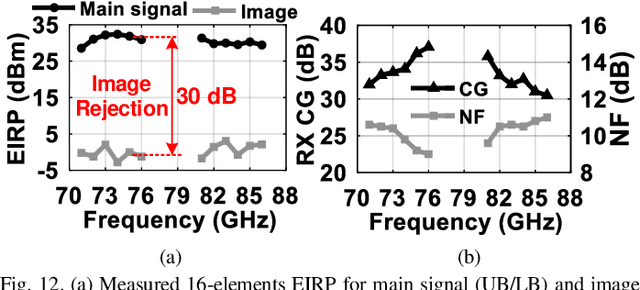
Next generation communication and sensing require enabling technologies for miniaturized and efficient heterogeneous systems while integrating technologies ranging from silicon to compound semiconductors and from photonic chips to micro-sensors. To this end, high frequency and mm-wave (MMW) lossy parasitics and delay between modules need to be significantly reduced to minimize area, loss and thermal heating of inter-chip wiring and power delivery networks. In this work, we propose novel approaches to achieve an efficient wideband MMW array integrations. The proposed techniques are built upon the following: 1) fixed antenna package buildup for every element with differential excitation on two half sides of array to reduce the fabrication cost and the IC-to-antenna routing loss; 2) miniaturized aperture coupled local oscillator (LO) and intermediate frequency (IF) power delivery feed distribution to minimize the packaging stacked layers and their loss. The proposed 16-element antenna array is integrated which 4 dies in 2x2 configurations implemented in a 90-nm SiGe BiCMOS process using compact Weaver image-selection architecture (WISA). The proposed miniaturized and efficient architecture from circuit and chip level to package level results in 1.5 GHz modulation bandwidth for 64 QAM (9 Gb/s) and 2 GHz for 16 QAM with only +-2 dB EVM variation over the 20% FBW (71-86 GHz). The system produces 30-dBm EIRP with enhanced efficiency of 25% EIRP/PDC over the bandwidth
Dual-band Harmonic and Subharmonic Frequency Generation Circuitry for Joint Communication and Localization Applications Under Severe Multipath Environment
Oct 29, 2021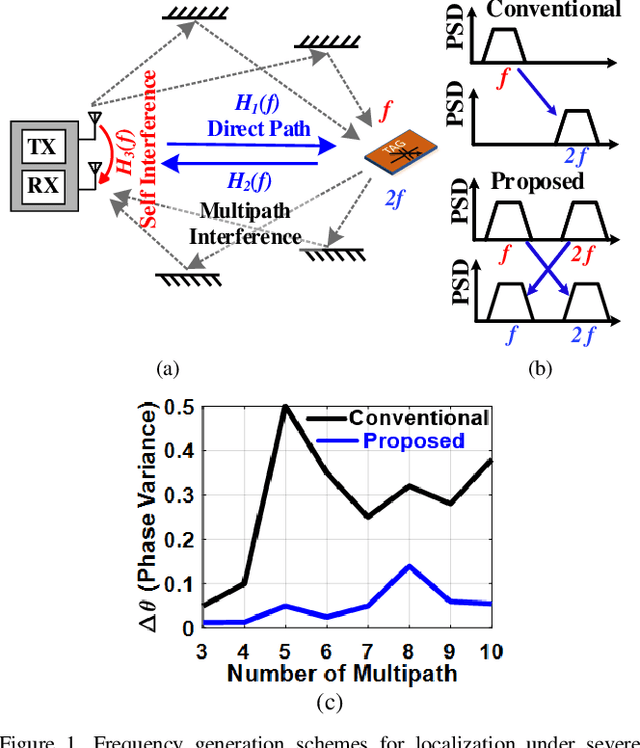
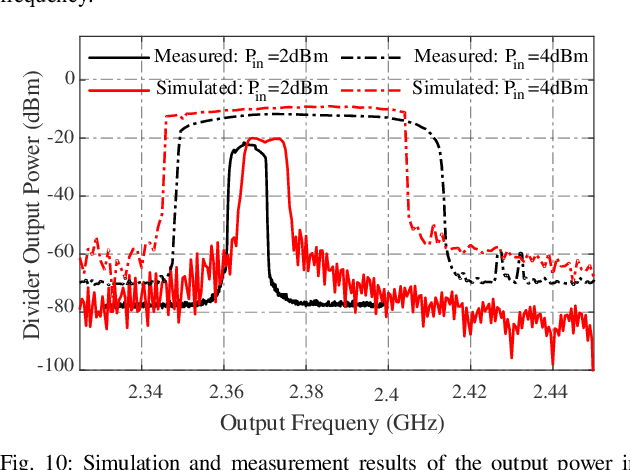
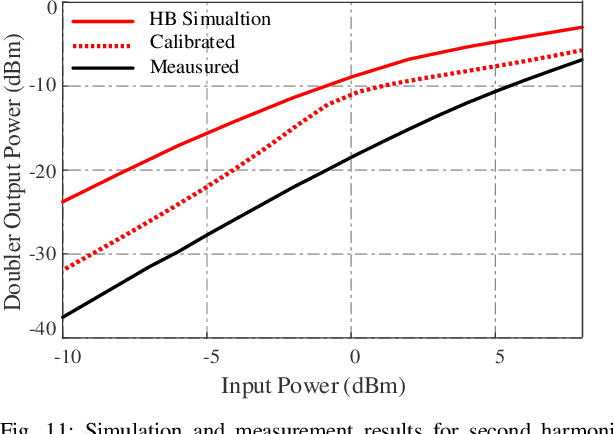
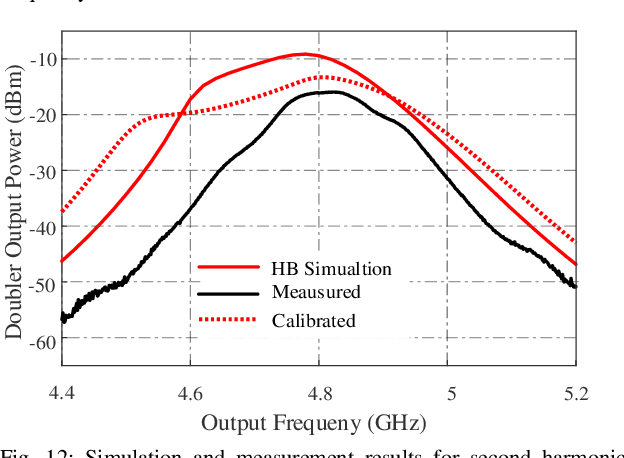
The next generation of ultra-dense connected and automated wireless sensor networks (WSN) requires proximity intelligence for many of its applications, especially for identification and localization. This work presents the first bidirectional circuitry for Internet of Things (IoT) transponder that reciprocally generates harmonics and subharmonics, dual-band frequencies. A multi-band or wideband localization system is essential for future intelligent WSN to mitigate the influence of multipath signals for indoor dense environment. The proposed frequency generation circuitry is based on the novel nonlinear ring resonator (NRR) operating based on standing wave resonation. The proposed NRR generates two sustainable oscillation frequencies based on the periodicity of the nonlinear circuit in the ring configuration. Due to the symmetry and reciprocity of the ring layout, the two bidirectional ports can excite the circuit at the two opposite nodes while maintaining the required boundary conditions for oscillation. The sustainable resonance conditions occur by creating zero, short impedance, or pole, infinite impedance, at subharmonic and harmonic excitation ports. The NRR circuit consumes zero DC power and covers two communication frequency plans interchangeably, which makes it a premier technique compared to the conventional ultra-wideband (UWB) localization system and conventional single-band nonlinear passive circuitry. The latter is narrowband due to the tunning limitation of the nonlinear varactor while the former is power-hungry approach with complex hardware requirements.