 Add to Chrome
 Add to Firefox
 Add to Edge
GenAU: Language-Grounded Industrial Anomaly Understanding with Vision-Language Models
Jul 01, 2026
Industrial inspection requires more than binary anomaly detection: a practical system should determine whether an anomaly exists, localize the defective region, identify the defect type, and provide interpretable visual evidence. Existing CLIP-based methods detect and localize anomalies well but offer limited language-level defect understanding, while instruction-tuned vision-language models can describe defects but do not natively produce pixel-level masks. We introduce GenAU, a Generalist vision-language framework for industrial Anomaly Understanding that unifies image-level detection, pixel-level segmentation, multi-type anomaly detection, and defect analysis in a single instruction-following model. GenAU augments a vision-language model with two segmentation tokens, [SEG_defect] and [SEG_normal], whose hidden states act as language-grounded queries over multi-scale visual features for pixel-level localization; the image-level score fuses this map with the decoder's textual normal/defect decision, while the language decoder produces structured defect-aware responses. Trained with a joint language-modeling and segmentation objective, GenAU covers all four tasks within one architecture and recipe, adding zero-shot multi-type detection and language-grounded defect analysis at a quantified cost to detection and segmentation. Across cross-dataset benchmarks, GenAU attains the strongest image-level detection among CLIP-based zero-shot methods on VisA and Real-IAD, with segmentation approaching but not surpassing specialized CLIP baselines.

Defect-aware Hybrid Prompt Optimization via Progressive Tuning for Zero-Shot Multi-type Anomaly Detection and Segmentation
Dec 10, 2025
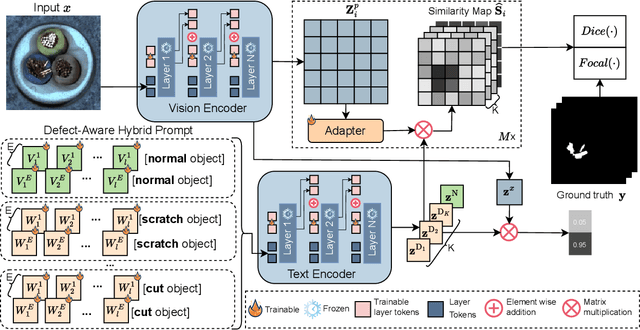
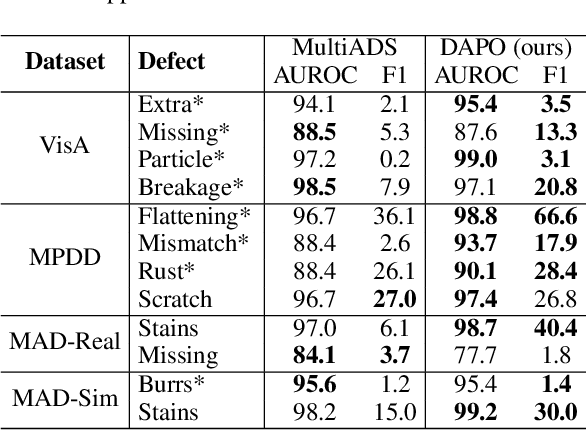
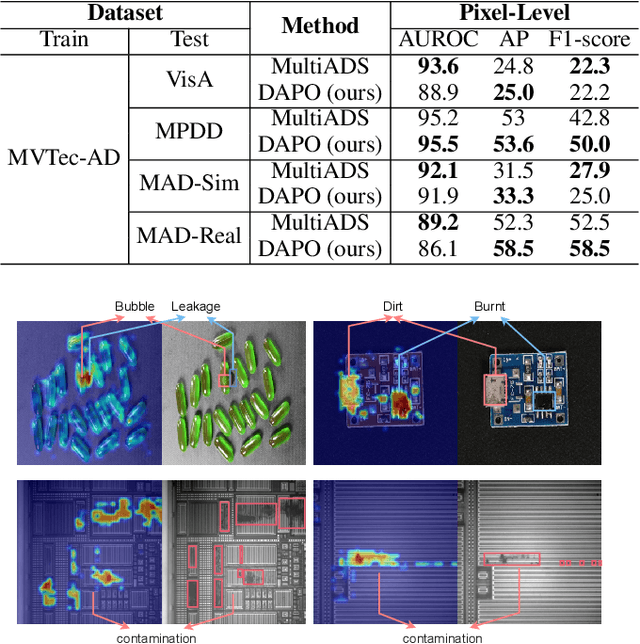
Recent vision language models (VLMs) like CLIP have demonstrated impressive anomaly detection performance under significant distribution shift by utilizing high-level semantic information through text prompts. However, these models often neglect fine-grained details, such as which kind of anomalies, like "hole", "cut", "scratch" that could provide more specific insight into the nature of anomalies. We argue that recognizing fine-grained anomaly types 1) enriches the representation of "abnormal" with structured semantics, narrowing the gap between coarse anomaly signals and fine-grained defect categories; 2) enables manufacturers to understand the root causes of the anomaly and implement more targeted and appropriate corrective measures quickly. While incorporating such detailed semantic information is crucial, designing handcrafted prompts for each defect type is both time-consuming and susceptible to human bias. For this reason, we introduce DAPO, a novel approach for Defect-aware Prompt Optimization based on progressive tuning for the zero-shot multi-type and binary anomaly detection and segmentation under distribution shifts. Our approach aligns anomaly-relevant image features with their corresponding text semantics by learning hybrid defect-aware prompts with both fixed textual anchors and learnable token embeddings. We conducted experiments on public benchmarks (MPDD, VisA, MVTec-AD, MAD, and Real-IAD) and an internal dataset. The results suggest that compared to the baseline models, DAPO achieves a 3.7% average improvement in AUROC and average precision metrics at the image level under distribution shift, and a 6.5% average improvement in localizing novel anomaly types under zero-shot settings.