 Add to Chrome
 Add to Firefox
 Add to Edge
Empowering Epidemic Response: The Role of Reinforcement Learning in Infectious Disease Control
Mar 26, 2026
Reinforcement learning (RL), owing to its adaptability to various dynamic systems in many real-world scenarios and the capability of maximizing long-term outcomes under different constraints, has been used in infectious disease control to optimize the intervention strategies for controlling infectious disease spread and responding to outbreaks in recent years. The potential of RL for assisting public health sectors in preventing and controlling infectious diseases is gradually emerging and being explored by rapidly increasing publications relevant to COVID-19 and other infectious diseases. However, few surveys exclusively discuss this topic, that is, the development and application of RL approaches for optimizing strategies of non-pharmaceutical and pharmaceutical interventions of public health. Therefore, this paper aims to provide a concise review and discussion of the latest literature on how RL approaches have been used to assist in controlling the spread and outbreaks of infectious diseases, covering several critical topics addressing public health demands: resource allocation, balancing between lives and livelihoods, mixed policy of multiple interventions, and inter-regional coordinated control. Finally, we conclude the paper with a discussion of several potential directions for future research.

Machine Learning for Infectious Disease Risk Prediction: A Survey
Aug 06, 2023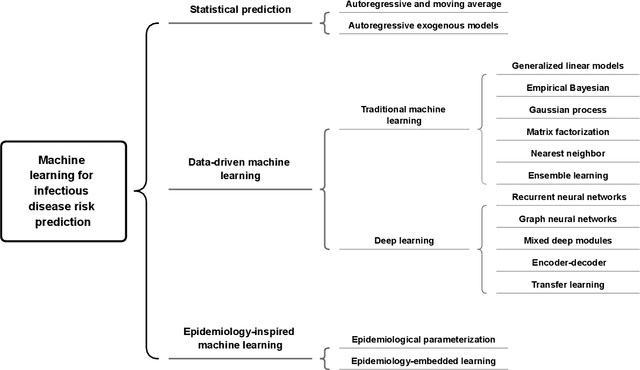
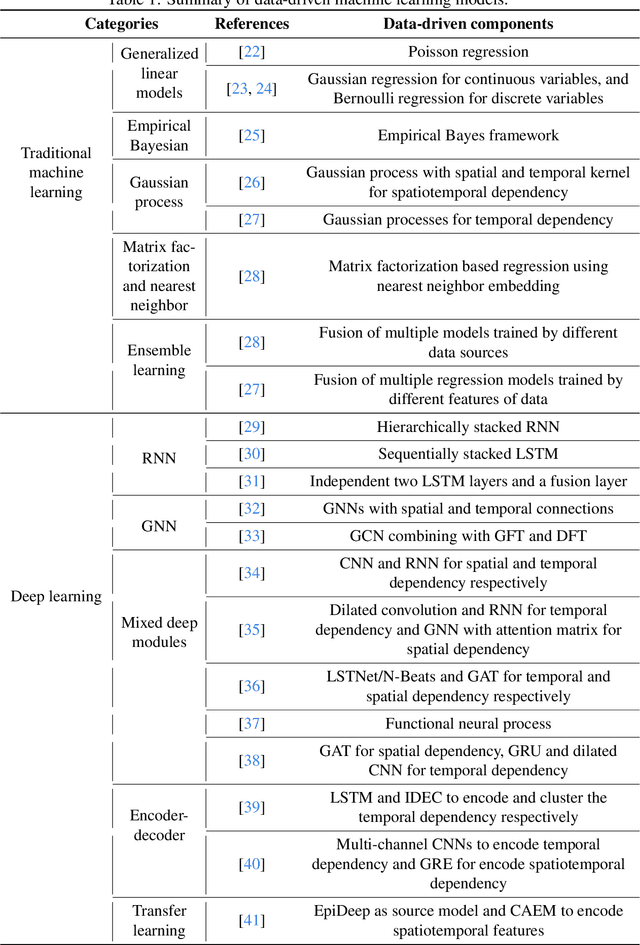
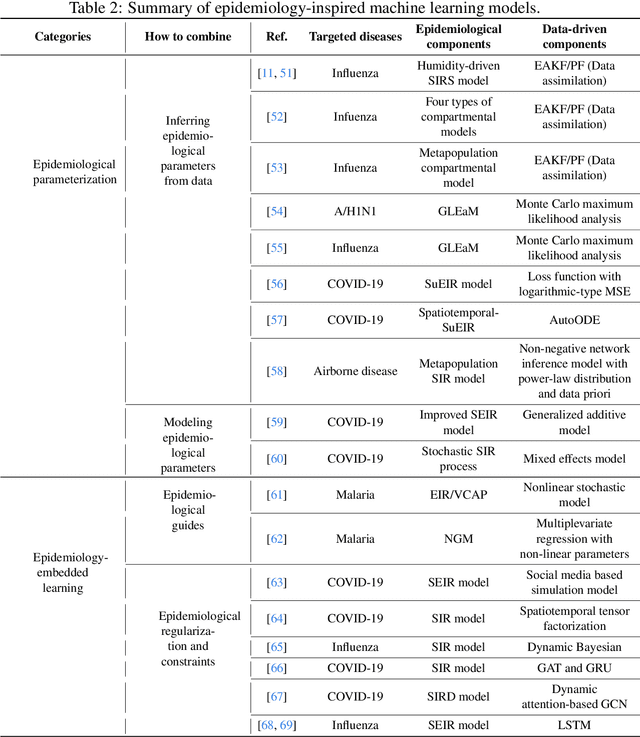
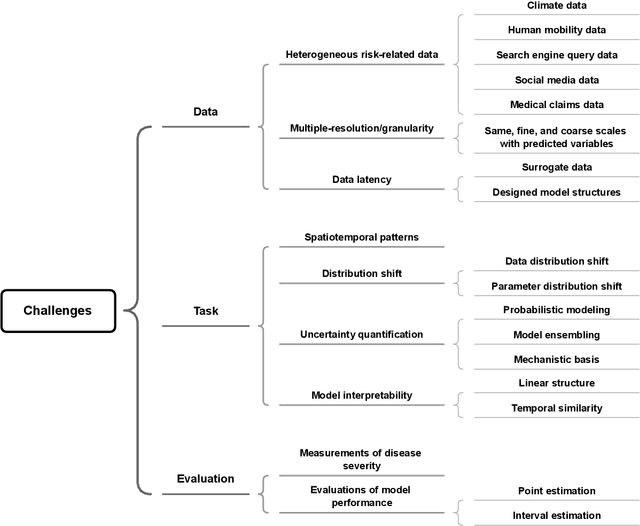
Infectious diseases, either emerging or long-lasting, place numerous people at risk and bring heavy public health burdens worldwide. In the process against infectious diseases, predicting the epidemic risk by modeling the disease transmission plays an essential role in assisting with preventing and controlling disease transmission in a more effective way. In this paper, we systematically describe how machine learning can play an essential role in quantitatively characterizing disease transmission patterns and accurately predicting infectious disease risks. First, we introduce the background and motivation of using machine learning for infectious disease risk prediction. Next, we describe the development and components of various machine learning models for infectious disease risk prediction. Specifically, existing models fall into three categories: Statistical prediction, data-driven machine learning, and epidemiology-inspired machine learning. Subsequently, we discuss challenges encountered when dealing with model inputs, designing task-oriented objectives, and conducting performance evaluation. Finally, we conclude with a discussion of open questions and future directions.