 Add to Chrome
 Add to Firefox
 Add to Edge
Leveraging LLMs and Heterogeneous Knowledge Graphs for Persona-Driven Session-Based Recommendation
Apr 08, 2026
Session-based recommendation systems (SBRS) aim to capture user's short-term intent from interaction sequences. However, the common assumption of anonymous sessions limits personalization, particularly under sparse or cold-start conditions. Recent advances in LLM-augmented recommendation have shown that LLMs can generate rich item representations, but modeling user personas with LLMs remains challenging due to anonymous sessions. In this work, we propose a persona-driven SBRS framework that explicitly models latent user personas inferred from a heterogeneous knowledge graph (KG) and integrates them into a data-driven recommendation pipeline.Our framework adopts a two-stage architecture consisting of personalized information extraction and personalized information utilization, inspired by recent chain-of-thought recommendation approaches. In the personalized information extraction stage, we construct a heterogeneous KG that integrates time-independent user-item, item-item, item-feature association, and metadata from DBpedia. We then learn latent user personas in an unsupervised manner using a Heterogeneous Deep Graph Infomax (HDGI) objective over a KG initialized with LLM-derived item embeddings. In the personalized information utilization stage, the learned persona representations together with LLM-derived item embeddings are incorporated into a modified architecture of data-driven SBRS to generate a candidate set of relevant items, followed by reranking using the base sequential model to emphasize short-term session intent. Unlike prior approaches that rely solely on sequence modeling or text-based user representations, our method grounds user persona modeling in structured relational signals derived from a KG. Experiments on Amazon Books and Amazon Movies & TV demonstrate that our approach consistently improves over sequential models with user embeddings derived using session history.

Guided Diffusion-based Counterfactual Augmentation for Robust Session-based Recommendation
Oct 29, 2024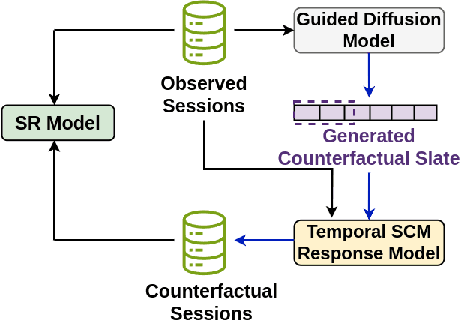
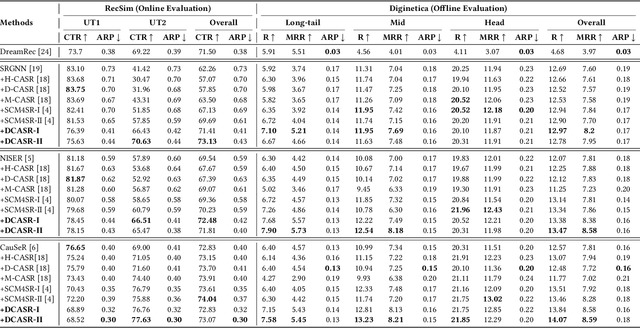
Session-based recommendation (SR) models aim to recommend top-K items to a user, based on the user's behaviour during the current session. Several SR models are proposed in the literature, however,concerns have been raised about their susceptibility to inherent biases in the training data (observed data) such as popularity bias. SR models when trained on the biased training data may encounter performance challenges on out-of-distribution data in real-world scenarios. One way to mitigate popularity bias is counterfactual data augmentation. Compared to prior works that rely on generating data using SR models, we focus on utilizing the capabilities of state-of-the art diffusion models for generating counterfactual data. We propose a guided diffusion-based counterfactual augmentation framework for SR. Through a combination of offline and online experiments on a real-world and simulated dataset, respectively, we show that our approach performs significantly better than the baseline SR models and other state-of-the art augmentation frameworks. More importantly, our framework shows significant improvement on less popular target items, by achieving up to 20% gain in Recall and 13% gain in CTR on real-world and simulated datasets,respectively.