 Add to Chrome
 Add to Firefox
 Add to Edge
Trust the Batch, On- or Off-Policy: Adaptive Policy Optimization for RL Post-Training
May 12, 2026
Reinforcement learning is structurally harder than supervised learning because the policy changes the data distribution it learns from. The resulting fragility is especially visible in large-model training, where the training and rollout systems differ in numerical precision, sampling, and other implementation details. Existing methods manage this fragility by adding hyper-parameters to the training objective, which makes the algorithm more sensitive to its configuration and requires retuning whenever the task, model scale, or distribution mismatch changes. This fragility traces to two concerns that current objectives entangle through hyper-parameters set before training begins: a trust-region concern, that updates should not move the policy too far from its current value, and an off-policy concern, that data from older or different behavior policies should influence the update only to the extent that it remains reliable. Neither concern is a constant to set in advance, and their severity is reflected in the policy-ratio distribution of the current batch. We present a simple yet effective batch-adaptive objective that replaces fixed clipping with the normalized effective sample size of the policy ratios. The same statistic caps the score-function weight and sets the strength of an off-policy regularizer, so the update stays close to the usual on-policy score-function update when ratios are nearly uniform, and tightens automatically when stale or mismatched data cause ratio concentration, while retaining a nonzero learning signal on high-ratio tokens. Experiments across a wide range of settings show that our method matches or exceeds tuned baselines, introducing no new objective hyper-parameters and removing several existing ones. The code is available at https://github.com/FeynRL-project/FeynRL.

Transformer Alignment in Large Language Models
Jul 10, 2024

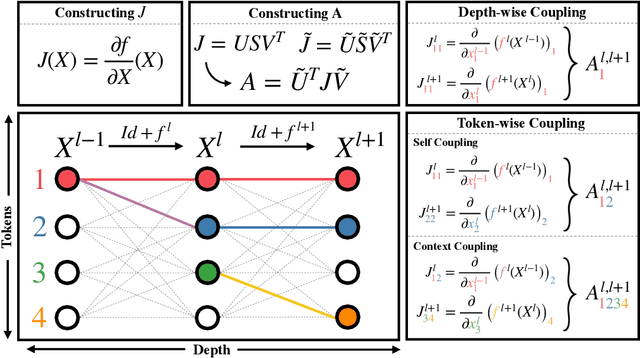

Large Language Models (LLMs) have made significant strides in natural language processing, and a precise understanding of the internal mechanisms driving their success is essential. We regard LLMs as transforming embeddings via a discrete, coupled, nonlinear, dynamical system in high dimensions. This perspective motivates tracing the trajectories of individual tokens as they pass through transformer blocks, and linearizing the system along these trajectories through their Jacobian matrices. In our analysis of 38 openly available LLMs, we uncover the alignment of top left and right singular vectors of Residual Jacobians, as well as the emergence of linearity and layer-wise exponential growth. Notably, we discover that increased alignment $\textit{positively correlates}$ with model performance. Metrics evaluated post-training show significant improvement in comparison to measurements made with randomly initialized weights, highlighting the significant effects of training in transformers. These findings reveal a remarkable level of regularity that has previously been overlooked, reinforcing the dynamical interpretation and paving the way for deeper understanding and optimization of LLM architectures.