 Add to Chrome
 Add to Firefox
 Add to Edge
Gradient Smoothing: Coupling Layer-wise Updates for Improved Optimization
Jun 29, 2026
Deep neural networks with repeated architectural blocks, such as transformers, often exhibit structured relationships across layers that emerge during training. Motivated by this observation, we introduce \emph{Depth-wise Gradient Augmentation}, a general optimization paradigm in which the update applied to each layer is obtained by transforming the collection of block-wise optimizer updates along the depth dimension. Within this framework, we study \emph{Gradient Smoothing}, a family of depth-wise smoothing methods, and instantiate it with a simple local \emph{Window Smoothing} operator. The resulting method operates directly on block-wise updates produced by arbitrary base optimizers (e.g., SGD, Adam, Muon), incurs minimal computational overhead, and is compatible with existing optimization pipelines. We evaluate Gradient Smoothing across a diverse set of architectures and training regimes, including language model pretraining, RL post-training of LLMs for reasoning, diffusion modeling, and image classification with Vision Transformers. Across these settings, Gradient Smoothing consistently improves optimization and generalization performance without modifying model architectures or training objectives. We further show that it promotes more structured representation evolution across depth, consistent with its interpretation as a structured depth-wise preconditioning method. Together, these results establish Depth-wise Gradient Augmentation as a promising framework for exploiting cross-depth structure in optimization and demonstrate Gradient Smoothing as a simple and broadly applicable instantiation.

Transformer Alignment in Large Language Models
Jul 10, 2024

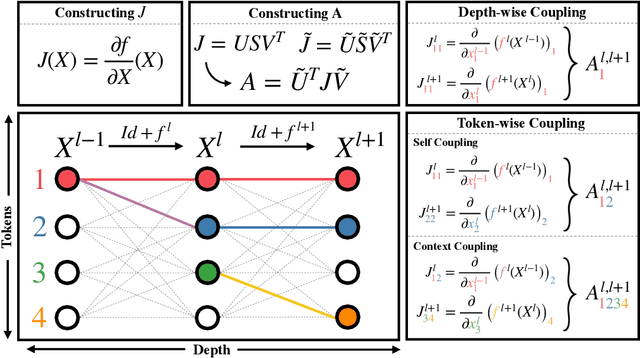

Large Language Models (LLMs) have made significant strides in natural language processing, and a precise understanding of the internal mechanisms driving their success is essential. We regard LLMs as transforming embeddings via a discrete, coupled, nonlinear, dynamical system in high dimensions. This perspective motivates tracing the trajectories of individual tokens as they pass through transformer blocks, and linearizing the system along these trajectories through their Jacobian matrices. In our analysis of 38 openly available LLMs, we uncover the alignment of top left and right singular vectors of Residual Jacobians, as well as the emergence of linearity and layer-wise exponential growth. Notably, we discover that increased alignment $\textit{positively correlates}$ with model performance. Metrics evaluated post-training show significant improvement in comparison to measurements made with randomly initialized weights, highlighting the significant effects of training in transformers. These findings reveal a remarkable level of regularity that has previously been overlooked, reinforcing the dynamical interpretation and paving the way for deeper understanding and optimization of LLM architectures.