 Add to Chrome
 Add to Firefox
 Add to Edge
Einstein World Models
Jun 25, 2026
Does intelligence require the ability to reason about phenomena beyond direct experience? It is natural to suspect that some complex thought cannot be captured through language alone. However, of particular concern to this work, is whether visualising counterfactual events can complement language as a mechanism for complex thought. We ask whether LLMs can be trained to utilise such visualisation mechanisms, in a way that benefits their reasoning abilities. Motivated by this question, we propose Einstein World Models. EWMs are a blueprint for LLM-based reasoning systems that place visual-temporal rollouts inside the reasoning trace, allowing them to reason in ways that text alone may not support well. In an EWM, the LLM calls a world-module (not to be confused with a world model), to produce short rollouts of scenes under consideration. The returned rollout is treated not as the answer, but as an inspectable hypothesis that can support later reasoning. Einstein World Models extend the capability of LLMs for tool calling (such as web search or code execution), into the domain of visual thought experiments.

Measuring AI Reasoning: A Guide for Researchers
May 04, 2026In this paper, we offer a guide for researchers on evaluating reasoning in language models, building the case that reasoning should be assessed through evidence of adaptive, multi-step search rather than final-answer accuracy alone. Under an evaluation-oriented definition, reasoning requires selecting intermediate steps and halting according to input-dependent conditions, which we formalize as a search-like procedure. We show that single forward passes in scalable architectures are structurally limited in their ability to realize such variable-depth computation, motivating intermediate decoding and externalized reasoning traces as appropriate evaluation interfaces. Central to our argument is that final-answer accuracy alone is an insufficient measure of reasoning, because it provides little ability to diagnose or debug the underlying processes that produce individual solutions in frontier models. We therefore argue for a shift toward process-based evaluation, in which reasoning is assessed through the faithfulness and validity of intermediate reasoning traces as first-class evaluation targets.
The AI Data Scientist
Aug 25, 2025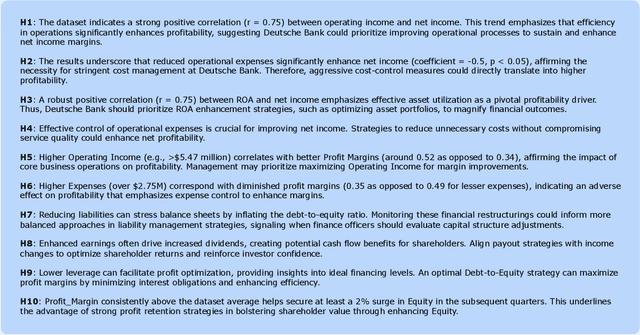
Imagine decision-makers uploading data and, within minutes, receiving clear, actionable insights delivered straight to their fingertips. That is the promise of the AI Data Scientist, an autonomous Agent powered by large language models (LLMs) that closes the gap between evidence and action. Rather than simply writing code or responding to prompts, it reasons through questions, tests ideas, and delivers end-to-end insights at a pace far beyond traditional workflows. Guided by the scientific tenet of the hypothesis, this Agent uncovers explanatory patterns in data, evaluates their statistical significance, and uses them to inform predictive modeling. It then translates these results into recommendations that are both rigorous and accessible. At the core of the AI Data Scientist is a team of specialized LLM Subagents, each responsible for a distinct task such as data cleaning, statistical testing, validation, and plain-language communication. These Subagents write their own code, reason about causality, and identify when additional data is needed to support sound conclusions. Together, they achieve in minutes what might otherwise take days or weeks, enabling a new kind of interaction that makes deep data science both accessible and actionable.