 Add to Chrome
 Add to Firefox
 Add to Edge
Scrouting: Cost-Aware Routing of Coding Agents by Scouting the Repository First
Aug 05, 2026
Frontier language models can resolve repository-level software issues, but each attempt is expensive, and existing routers select a model from the issue text alone. We present SuperScout, which routes after scouting the repository: a 7B searcher, SuperScout-7B, first explores the repository and produces a structured handoff whose reproduction claims are sandbox-verified, with false claims stripped before delivery. The searcher's hidden states, together with the task text, then feed a resume-based router that dispatches the task to one of four frontier fixers. Adding a new fixer requires no retraining. On the full Python slice of SWE-bench Pro (266 tasks) under the benchmark's official capped budget tier, SuperScout matches the best single model's solve rate (159 of 266 for SuperScout, 158 for the best model) at about a fifth of the total cost per solve, and the reported configuration sits above the random traffic-splitting baseline. A no-router ablation, always the cheapest fixer with the handoff, ties the routed system on this benchmark, so the handoff rather than the routing decision carries the result. A paired calibration study points to the mechanism: the handoff appears to redistribute rather than add solving ability, lifting the three cheaper fixers while slightly hurting the strongest, though at $N=99$ the per-fixer effects are directional only; the searcher's hidden states improve cost routing on the calibration labels while the handoff's own text does not. The searcher's compute adds less than half a cent of GPU time per task.

Code Isn't Memory: A Structural Codebase Index Inside a Coding Agent
Jun 21, 2026Coding agents now interleave LLMs with retrieval over the working repository, and retrieval implementations vary widely across deployed harnesses. Inside a fixed coding-agent harness on a fixed model, does adding a structural codebase index actually change cost or resolve? We ran three arms (the harness with the index, the same harness without it, and an agentic-grep comparator) on SWE-PolyBench Verified and SWE-bench Pro with Claude Opus 4.7 held fixed throughout, across three seeds, inside a leak-audited per-task sandbox. The within-harness ablation produces a large localization gain and a statistically separated resolve gain, with no cost penalty per cell and lower cost per solve. The cross-harness check shows that the index does not regress against an agentic-grep baseline on resolve or localization, again at no cost penalty. We release the per-cell exclusion ledger, the leak-audit script, the localization extractor, and the results database. The deployment question for a structural codebase index is thus not whether it is too expensive to run (across seeds, the index lands at a lower $/solved than agentic grep) but whether the workload includes multi-file changes where structural ranking pays off.
SuperCoder2.0: Technical Report on Exploring the feasibility of LLMs as Autonomous Programmer
Sep 17, 2024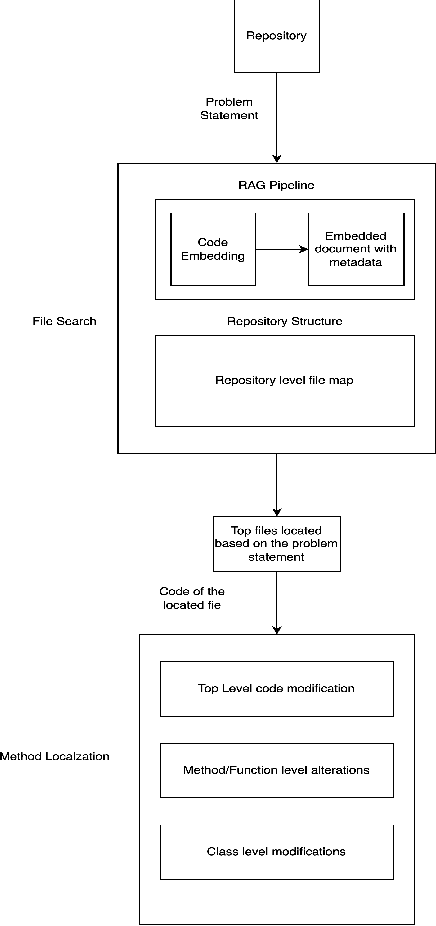
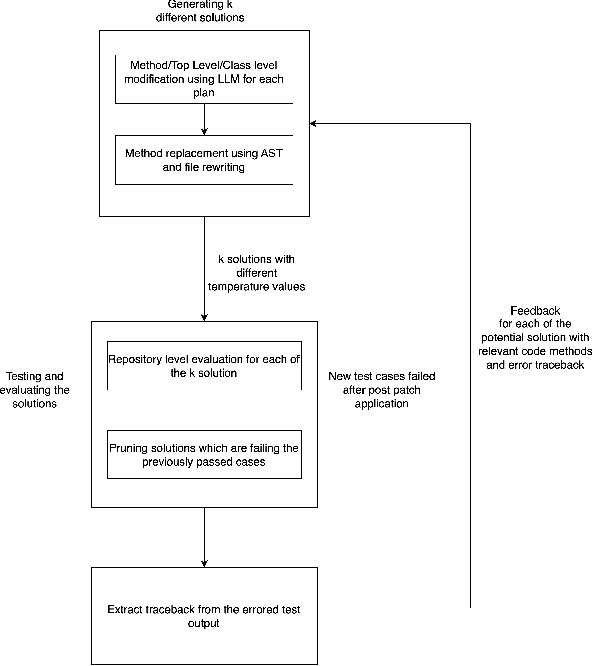
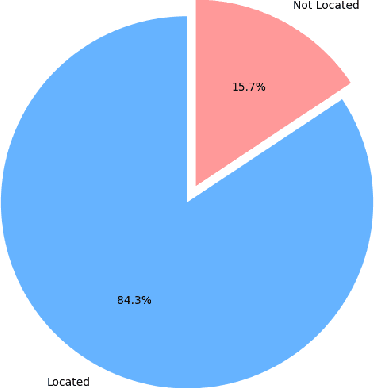
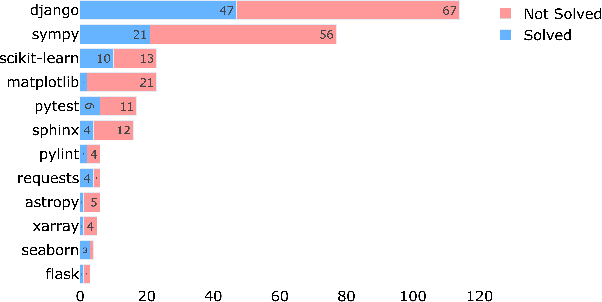
We present SuperCoder2.0, an advanced autonomous system designed to enhance software development through artificial intelligence. The system combines an AI-native development approach with intelligent agents to enable fully autonomous coding. Key focus areas include a retry mechanism with error output traceback, comprehensive code rewriting and replacement using Abstract Syntax Tree (ast) parsing to minimize linting issues, code embedding technique for retrieval-augmented generation, and a focus on localizing methods for problem-solving rather than identifying specific line numbers. The methodology employs a three-step hierarchical search space reduction approach for code base navigation and bug localization:utilizing Retrieval Augmented Generation (RAG) and a Repository File Level Map to identify candidate files, (2) narrowing down to the most relevant files using a File Level Schematic Map, and (3) extracting 'relevant locations' within these files. Code editing is performed through a two-part module comprising CodeGeneration and CodeEditing, which generates multiple solutions at different temperature values and replaces entire methods or classes to maintain code integrity. A feedback loop executes repository-level test cases to validate and refine solutions. Experiments conducted on the SWE-bench Lite dataset demonstrate SuperCoder2.0's effectiveness, achieving correct file localization in 84.33% of cases within the top 5 candidates and successfully resolving 34% of test instances. This performance places SuperCoder2.0 fourth globally on the SWE-bench leaderboard. The system's ability to handle diverse repositories and problem types highlights its potential as a versatile tool for autonomous software development. Future work will focus on refining the code editing process and exploring advanced embedding models for improved natural language to code mapping.
V-Zen: Efficient GUI Understanding and Precise Grounding With A Novel Multimodal LLM
May 24, 2024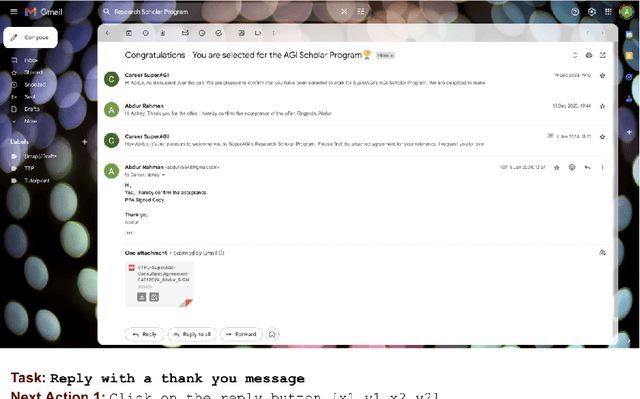
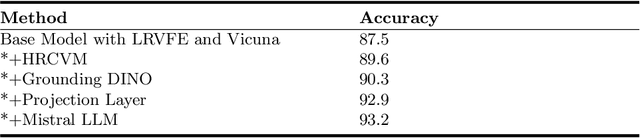

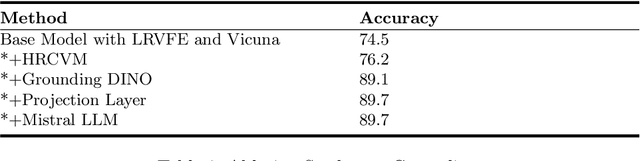
In the rapidly evolving landscape of AI research and application, Multimodal Large Language Models (MLLMs) have emerged as a transformative force, adept at interpreting and integrating information from diverse modalities such as text, images, and Graphical User Interfaces (GUIs). Despite these advancements, the nuanced interaction and understanding of GUIs pose a significant challenge, limiting the potential of existing models to enhance automation levels. To bridge this gap, this paper presents V-Zen, an innovative Multimodal Large Language Model (MLLM) meticulously crafted to revolutionise the domain of GUI understanding and grounding. Equipped with dual-resolution image encoders, V-Zen establishes new benchmarks in efficient grounding and next-action prediction, thereby laying the groundwork for self-operating computer systems. Complementing V-Zen is the GUIDE dataset, an extensive collection of real-world GUI elements and task-based sequences, serving as a catalyst for specialised fine-tuning. The successful integration of V-Zen and GUIDE marks the dawn of a new era in multimodal AI research, opening the door to intelligent, autonomous computing experiences. This paper extends an invitation to the research community to join this exciting journey, shaping the future of GUI automation. In the spirit of open science, our code, data, and model will be made publicly available, paving the way for multimodal dialogue scenarios with intricate and precise interactions.