 Add to Chrome
 Add to Firefox
 Add to Edge
Ultralytics YOLO26: Unified Real-Time End-to-End Vision Models
Jun 02, 2026
Real-time vision demands models that are accurate, efficient, and simple to deploy across diverse hardware. The YOLO family has become widely deployed for this reason, yet most YOLO detectors still rely on non-maximum suppression at inference, carry heavy detection heads due to Distribution Focal Loss, require long training schedules, and can leave the smallest objects without positive label assignments. We present Ultralytics YOLO26, a unified real-time vision model family that addresses these limitations through coordinated architecture and training advances. YOLO26 uses a dual-head design for native NMS-free end-to-end inference and removes DFL entirely, yielding a lighter head with unconstrained regression range. Its training pipeline combines MuSGD, a hybrid Muon-SGD optimizer adapted from large language model training; Progressive Loss, which shifts supervision toward the inference-time head; and STAL, a label assignment strategy that guarantees positive coverage for small objects. Beyond detection, YOLO26 introduces task-specific head and loss designs for instance segmentation, pose estimation, and oriented detection, producing consistent gains across tasks and scales. The family spans five scales (n/s/m/l/x) and supports detection, instance segmentation, pose estimation, classification, and oriented detection in a single pipeline, with an open-vocabulary extension, YOLOE-26, for text-, visual-, and prompt-free inference. Across all scales, YOLO26 achieves 40.9-57.5 mAP on COCO at 1.7-11.8 ms T4 TensorRT latency, advancing the accuracy-latency Pareto front over prior real-time detectors, while YOLOE-26x reaches 40.6 AP on LVIS minival under text prompting. Code and models are available at https://github.com/ultralytics/ultralytics.

TopoMaskV3: 3D Mask Head with Dense Offset and Height Predictions for Road Topology Understanding
Mar 02, 2026Mask-based paradigms for road topology understanding, such as TopoMaskV2, offer a complementary alternative to query-based methods by generating centerlines via a dense rasterized intermediate representation. However, prior work was limited to 2D predictions and suffered from severe discretization artifacts, necessitating fusion with parametric heads. We introduce TopoMaskV3, which advances this pipeline into a robust, standalone 3D predictor via two novel dense prediction heads: a dense offset field for sub-grid discretization correction within the existing BEV resolution, and a dense height map for direct 3D estimation. Beyond the architecture, we are the first to address geographic data leakage in road topology evaluation by introducing (1) geographically distinct splits to prevent memorization and ensure fair generalization, and (2) a long-range (+/-100 m) benchmark. TopoMaskV3 achieves state-of-the-art 28.5 OLS on this geographically disjoint benchmark, surpassing all prior methods. Our analysis shows that the mask representation is more robust to geographic overfitting than Bezier, while LiDAR fusion is most beneficial at long range and exhibits larger relative gains on the overlapping original split, suggesting overlap-induced memorization effects.
TopoBDA: Towards Bezier Deformable Attention for Road Topology Understanding
Dec 25, 2024


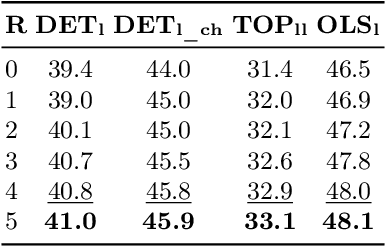
Understanding road topology is crucial for autonomous driving. This paper introduces TopoBDA (Topology with Bezier Deformable Attention), a novel approach that enhances road topology understanding by leveraging Bezier Deformable Attention (BDA). BDA utilizes Bezier control points to drive the deformable attention mechanism, significantly improving the detection and representation of elongated and thin polyline structures, such as lane centerlines. TopoBDA processes multi-camera 360-degree imagery to generate Bird's Eye View (BEV) features, which are refined through a transformer decoder employing BDA. This method enhances computational efficiency while maintaining high accuracy in centerline prediction. Additionally, TopoBDA incorporates an instance mask formulation and an auxiliary one-to-many set prediction loss strategy to further refine centerline detection and improve road topology understanding. Experimental evaluations on the OpenLane-V2 dataset demonstrate that TopoBDA outperforms existing methods, achieving state-of-the-art results in centerline detection and topology reasoning. The integration of multi-modal data, including lidar and radar, specifically for road topology understanding, further enhances the model's performance, underscoring its importance in autonomous driving applications.