 Add to Chrome
 Add to Firefox
 Add to Edge
Learning to Correct: Calibrated Reinforcement Learning for Multi-Attempt Chain-of-Thought
Apr 20, 2026
State-of-the-art reasoning models utilize long chain-of-thought (CoT) to solve increasingly complex problems using more test-time computation. In this work, we explore a long CoT setting where the model makes up to K successive attempts at solving a problem, in which each attempt is allowed to build on earlier ones after the model receives a hard verifier feedback. This motivates RL methods that can harness per-attempt rewards by carefully weighting individual attempts. We study optimizing the Verification@K reward (the model succeeds by the K-th attempt) and show that naively weighing the attempts by their pass/fail results in biased gradients. We introduce Calibrated Attempt-Level (CAL) GRPO by devising a weighing strategy to obtain unbiased gradients while maintaining small variance. Our theory reveals how incorporating per-attempt rewards influence the training and the eventual Verification@K performance. Experiments, baselines, and ablations on synthetic and real data corroborate our theory and the benefits of CAL-GRPO over vanilla GRPO as well as naive weighting.

Retrieval Augmented Time Series Forecasting
Nov 12, 2024
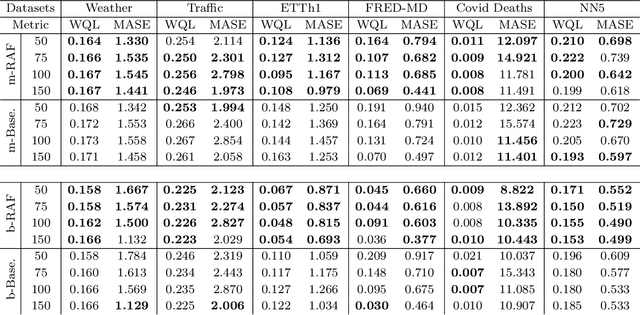

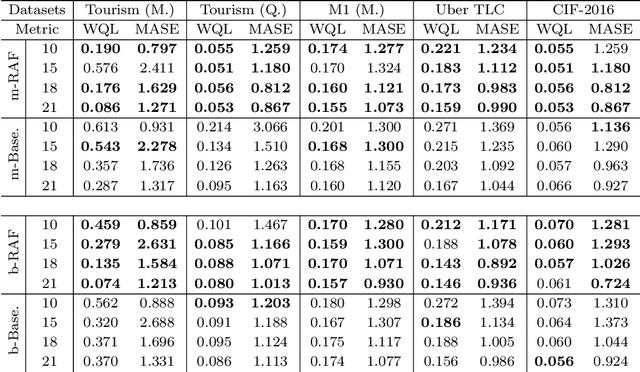
Retrieval-augmented generation (RAG) is a central component of modern LLM systems, particularly in scenarios where up-to-date information is crucial for accurately responding to user queries or when queries exceed the scope of the training data. The advent of time-series foundation models (TSFM), such as Chronos, and the need for effective zero-shot forecasting performance across various time-series domains motivates the question: Do benefits of RAG similarly carry over to time series forecasting? In this paper, we advocate that the dynamic and event-driven nature of time-series data makes RAG a crucial component of TSFMs and introduce a principled RAG framework for time-series forecasting, called Retrieval Augmented Forecasting (RAF). Within RAF, we develop efficient strategies for retrieving related time-series examples and incorporating them into forecast. Through experiments and mechanistic studies, we demonstrate that RAF indeed improves the forecasting accuracy across diverse time series domains and the improvement is more significant for larger TSFM sizes.