 Add to Chrome
 Add to Firefox
 Add to Edge
Covariance-Aware Transformers for Quadratic Programming and Decision Making
Feb 16, 2026
We explore the use of transformers for solving quadratic programs and how this capability benefits decision-making problems that involve covariance matrices. We first show that the linear attention mechanism can provably solve unconstrained QPs by tokenizing the matrix variables (e.g.~$A$ of the objective $\frac{1}{2}x^\top Ax+b^\top x$) row-by-row and emulating gradient descent iterations. Furthermore, by incorporating MLPs, a transformer block can solve (i) $\ell_1$-penalized QPs by emulating iterative soft-thresholding and (ii) $\ell_1$-constrained QPs when equipped with an additional feedback loop. Our theory motivates us to introduce Time2Decide: a generic method that enhances a time series foundation model (TSFM) by explicitly feeding the covariance matrix between the variates. We empirically find that Time2Decide uniformly outperforms the base TSFM model for the classical portfolio optimization problem that admits an $\ell_1$-constrained QP formulation. Remarkably, Time2Decide also outperforms the classical "Predict-then-Optimize (PtO)" procedure, where we first forecast the returns and then explicitly solve a constrained QP, in suitable settings. Our results demonstrate that transformers benefit from explicit use of second-order statistics, and this can enable them to effectively solve complex decision-making problems, like portfolio construction, in one forward pass.

Retrieval Augmented Time Series Forecasting
Nov 12, 2024
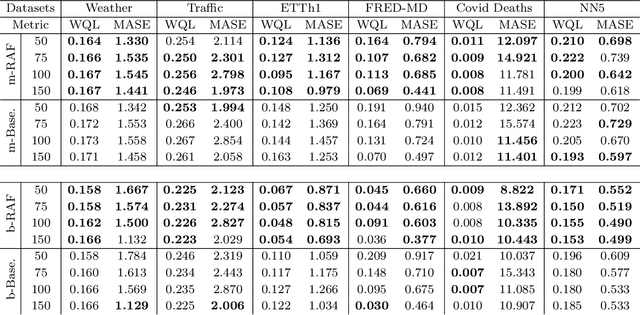

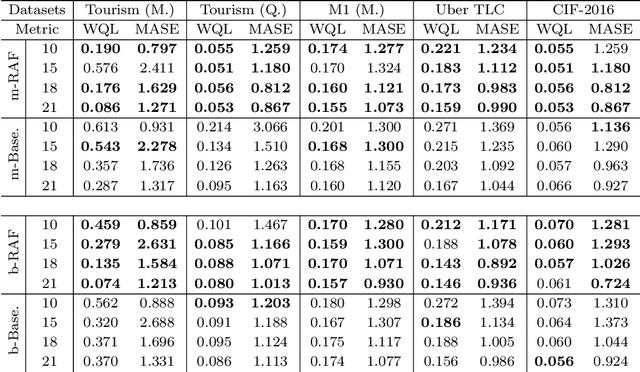
Retrieval-augmented generation (RAG) is a central component of modern LLM systems, particularly in scenarios where up-to-date information is crucial for accurately responding to user queries or when queries exceed the scope of the training data. The advent of time-series foundation models (TSFM), such as Chronos, and the need for effective zero-shot forecasting performance across various time-series domains motivates the question: Do benefits of RAG similarly carry over to time series forecasting? In this paper, we advocate that the dynamic and event-driven nature of time-series data makes RAG a crucial component of TSFMs and introduce a principled RAG framework for time-series forecasting, called Retrieval Augmented Forecasting (RAF). Within RAF, we develop efficient strategies for retrieving related time-series examples and incorporating them into forecast. Through experiments and mechanistic studies, we demonstrate that RAF indeed improves the forecasting accuracy across diverse time series domains and the improvement is more significant for larger TSFM sizes.