 Add to Chrome
 Add to Firefox
 Add to Edge
Enhancing Medical Data Analysis through AI-Enhanced Locally Linear Embedding: Applications in Medical Point Location and Imagery
Dec 19, 2025
The rapid evolution of Artificial intelligence in healthcare has opened avenues for enhancing various processes, including medical billing and transcription. This paper introduces an innovative approach by integrating AI with Locally Linear Embedding (LLE) to revolutionize the handling of high-dimensional medical data. This AI-enhanced LLE model is specifically tailored to improve the accuracy and efficiency of medical billing systems and transcription services. By automating these processes, the model aims to reduce human error and streamline operations, thereby facilitating faster and more accurate patient care documentation and financial transactions. This paper provides a comprehensive mathematical model of AI-enhanced LLE, demonstrating its application in real-world healthcare scenarios through a series of experiments. The results indicate a significant improvement in data processing accuracy and operational efficiency. This study not only underscores the potential of AI-enhanced LLE in medical data analysis but also sets a foundation for future research into broader healthcare applications.
* 5 pages, 3 figures. Accepted and published at 2024 19th International Conference on Emerging Technologies (ICET)

RIFT: A Scalable Methodology for LLM Accelerator Fault Assessment using Reinforcement Learning
Dec 10, 2025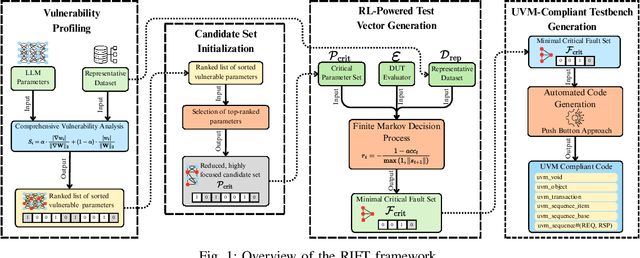
The massive scale of modern AI accelerators presents critical challenges to traditional fault assessment methodologies, which face prohibitive computational costs and provide poor coverage of critical failure modes. This paper introduces RIFT (Reinforcement Learning-guided Intelligent Fault Targeting), a scalable framework that automates the discovery of minimal, high-impact fault scenarios for efficient design-time fault assessment. RIFT transforms the complex search for worst-case faults into a sequential decision-making problem, combining hybrid sensitivity analysis for search space pruning with reinforcement learning to intelligently generate minimal, high-impact test suites. Evaluated on billion-parameter Large Language Model (LLM) workloads using NVIDIA A100 GPUs, RIFT achieves a \textbf{2.2$\times$} fault assessment speedup over evolutionary methods and reduces the required test vector volume by over \textbf{99\%} compared to random fault injection, all while achieving \textbf{superior fault coverage}. The proposed framework also provides actionable data to enable intelligent hardware protection strategies, demonstrating that RIFT-guided selective error correction code provides a \textbf{12.8$\times$} improvement in \textbf{cost-effectiveness} (coverage per unit area) compared to uniform triple modular redundancy protection. RIFT automatically generates UVM-compliant verification artifacts, ensuring its findings are directly actionable and integrable into commercial RTL verification workflows.