 Add to Chrome
 Add to Firefox
 Add to Edge
Deadline-Aware, Energy-Efficient Control of Domestic Immersion Hot Water Heaters
Jan 26, 2026
Typical domestic immersion water heater systems are often operated continuously during winter, heating quickly rather than efficiently and ignoring predictable demand windows and ambient losses. We study deadline-aware control, where the aim is to reach a target temperature at a specified time while minimising energy consumption. We introduce an efficient Gymnasium environment that models an immersion hot water heater with first-order thermal losses and discrete on and off actions of 0 W and 6000 W applied every 120 seconds. Methods include a time-optimal bang-bang baseline, a zero-shot Monte Carlo Tree Search planner, and a Proximal Policy Optimisation policy. We report total energy consumption in watt-hours under identical physical dynamics. Across sweeps of initial temperature from 10 to 30 degrees Celsius, deadline from 30 to 90 steps, and target temperature from 40 to 80 degrees Celsius, PPO achieves the most energy-efficient performance at a 60-step horizon of 2 hours, using 3.23 kilowatt-hours, compared to 4.37 to 10.45 kilowatt-hours for bang-bang control and 4.18 to 6.46 kilowatt-hours for MCTS. This corresponds to energy savings of 26 percent at 30 steps and 69 percent at 90 steps. In a representative trajectory with a 50 kg water mass, 20 degrees Celsius ambient temperature, and a 60 degrees Celsius target, PPO consumes 54 percent less energy than bang-bang control and 33 percent less than MCTS. These results show that learned deadline-aware control reduces energy consumption under identical physical assumptions, while planners provide partial savings without training and learned policies offer near-zero inference cost once trained.

Design of a six wheel suspension and a three-axis linear actuation mechanism for a laser weeding robot
Dec 11, 2025Mobile robots are increasingly utilized in agriculture to automate labor-intensive tasks such as weeding, sowing, harvesting and soil analysis. Recently, agricultural robots have been developed to detect and remove weeds using mechanical tools or precise herbicide sprays. Mechanical weeding is inefficient over large fields, and herbicides harm the soil ecosystem. Laser weeding with mobile robots has emerged as a sustainable alternative in precision farming. In this paper, we present an autonomous weeding robot that uses controlled exposure to a low energy laser beam for weed removal. The proposed robot is six-wheeled with a novel double four-bar suspension for higher stability. The laser is guided towards the detected weeds by a three-dimensional linear actuation mechanism. Field tests have demonstrated the robot's capability to navigate agricultural terrains effectively by overcoming obstacles up to 15 cm in height. At an optimal speed of 42.5 cm/s, the robot achieves a weed detection rate of 86.2\% and operating time of 87 seconds per meter. The laser actuation mechanism maintains a minimal mean positional error of 1.54 mm, combined with a high hit rate of 97\%, ensuring effective and accurate weed removal. This combination of speed, accuracy, and efficiency highlights the robot's potential for significantly enhancing precision farming practices.
Learning from Less: SINDy Surrogates in RL
Apr 25, 2025
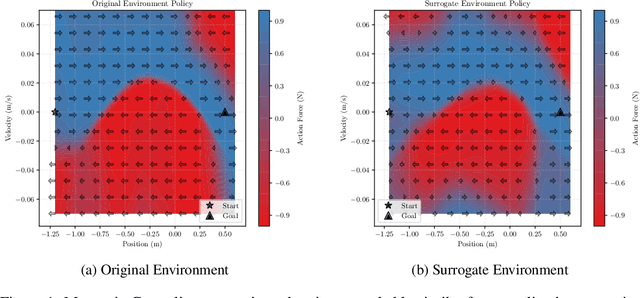
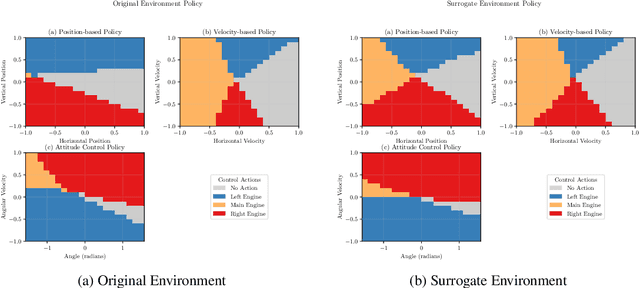
This paper introduces an approach for developing surrogate environments in reinforcement learning (RL) using the Sparse Identification of Nonlinear Dynamics (SINDy) algorithm. We demonstrate the effectiveness of our approach through extensive experiments in OpenAI Gym environments, particularly Mountain Car and Lunar Lander. Our results show that SINDy-based surrogate models can accurately capture the underlying dynamics of these environments while reducing computational costs by 20-35%. With only 75 interactions for Mountain Car and 1000 for Lunar Lander, we achieve state-wise correlations exceeding 0.997, with mean squared errors as low as 3.11e-06 for Mountain Car velocity and 1.42e-06 for LunarLander position. RL agents trained in these surrogate environments require fewer total steps (65,075 vs. 100,000 for Mountain Car and 801,000 vs. 1,000,000 for Lunar Lander) while achieving comparable performance to those trained in the original environments, exhibiting similar convergence patterns and final performance metrics. This work contributes to the field of model-based RL by providing an efficient method for generating accurate, interpretable surrogate environments.