 Add to Chrome
 Add to Firefox
 Add to Edge
Covariance-Guided Resource Adaptive Learning for Efficient Edge Inference
Mar 15, 2026
For deep learning inference on edge devices, hardware configurations achieving the same throughput can differ by 2$\times$ in power consumption, yet operators often struggle to find the efficient ones without exhaustive profiling. Existing approaches often rely on inefficient static presets or require expensive offline profiling that must be repeated for each new model or device. To address this problem, we present CORAL, an online optimization method that discovers near-optimal configurations without offline profiling. CORAL leverages distance covariance to statistically capture the non-linear dependencies between hardware settings, e.g., DVFS and concurrency levels, and performance metrics. Unlike prior work, we explicitly formulate the challenge as a throughput-power co-optimization problem to satisfy power budgets and throughput targets simultaneously. We evaluate CORAL on two NVIDIA Jetson devices across three object detection models ranging from lightweight to heavyweight. In single-target scenarios, CORAL achieves 96% $\unicode{x2013}$ 100% of the optimal performance found by exhaustive search. In strict dual-constraint scenarios where baselines fail or exceed power budgets, CORAL consistently finds proper configurations online with minimal exploration.

NAPER: Fault Protection for Real-Time Resource-Constrained Deep Neural Networks
Apr 09, 2025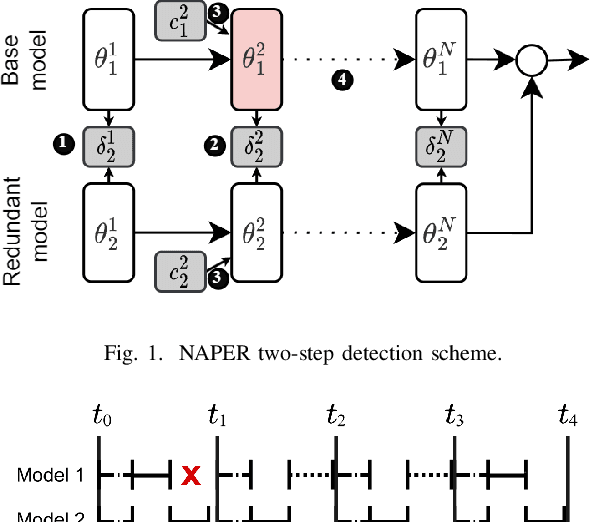
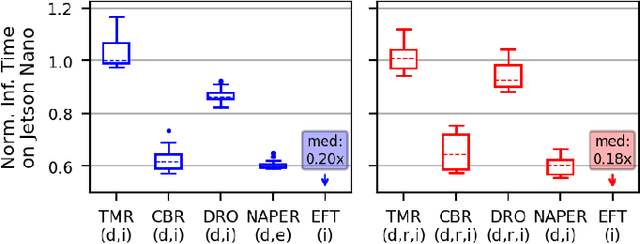
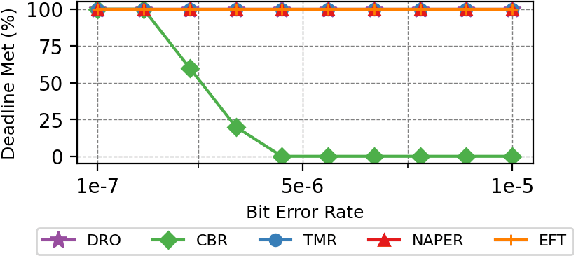
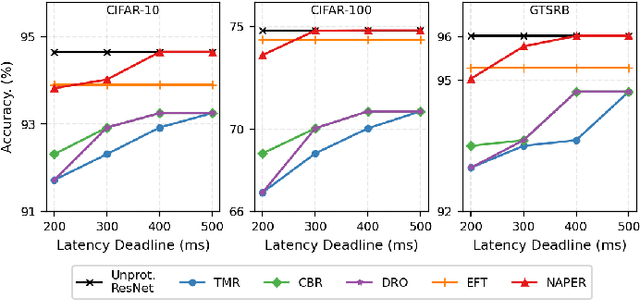
Fault tolerance in Deep Neural Networks (DNNs) deployed on resource-constrained systems presents unique challenges for high-accuracy applications with strict timing requirements. Memory bit-flips can severely degrade DNN accuracy, while traditional protection approaches like Triple Modular Redundancy (TMR) often sacrifice accuracy to maintain reliability, creating a three-way dilemma between reliability, accuracy, and timeliness. We introduce NAPER, a novel protection approach that addresses this challenge through ensemble learning. Unlike conventional redundancy methods, NAPER employs heterogeneous model redundancy, where diverse models collectively achieve higher accuracy than any individual model. This is complemented by an efficient fault detection mechanism and a real-time scheduler that prioritizes meeting deadlines by intelligently scheduling recovery operations without interrupting inference. Our evaluations demonstrate NAPER's superiority: 40% faster inference in both normal and fault conditions, maintained accuracy 4.2% higher than TMR-based strategies, and guaranteed uninterrupted operation even during fault recovery. NAPER effectively balances the competing demands of accuracy, reliability, and timeliness in real-time DNN applications