 Add to Chrome
 Add to Firefox
 Add to Edge
From Bit-Position Sensitivity to Unequal Error Protection for DNN Inference Memory
Jul 21, 2026
We characterize per-bit-position fault sensitivity in ML inference across 16 workloads -- spanning transformer-based models and attention-free CNNs -- and across three floating-point formats. Our central empirical finding is a sharp bit-sensitivity transition: flipping any of the least-significant fraction bits up to a data-type-specific threshold, Xsafe, degrades task metrics by less than 1% under deterministic single-bit stress tests. Sensitivity rises through the upper fraction bits and spikes at the exponent-mantissa boundary, where a single-bit flip causes catastrophic collapse. Because low-order bits are largely inconsequential while high-order and exponent bits are critical, uniform SECDED protection -- which guards every bit equally at 12.5% storage overhead -- is unnecessarily conservative. We derive per-data-type Xsafe floors (FP16: 6, BF16: 4, FP32: 15) and workload-aware tiers that widen the unprotected region for resilient model classes, raising ECC savings to 37.5-62.5% without retraining. Text-conditioned diffusion models dictate the conservative floor; vision encoders, NLU models, and resilient LLMs tolerate wider bypass regions. These floors and tiers drive an Unequal Error Protection (UEP) codec with per-cacheline data-type tags and a dual-partition SRAM architecture for ML accelerators. Validation across 870+ fault-injection runs confirms selective protection holds under contiguous 2- and 3-bit upsets. The codec reduces ECC area by 27.8% relative to uniform SECDED; dual-voltage operation of the non-critical partition lowers gross BF16 read energy by about 17%, with a roughly 4% dual-partition macro-area overhead.

Hardware Acceleration of Neural Graphics
Mar 16, 2023
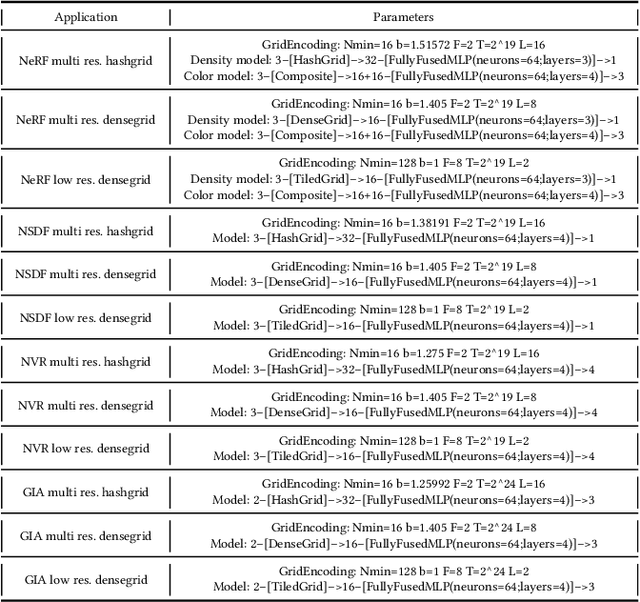

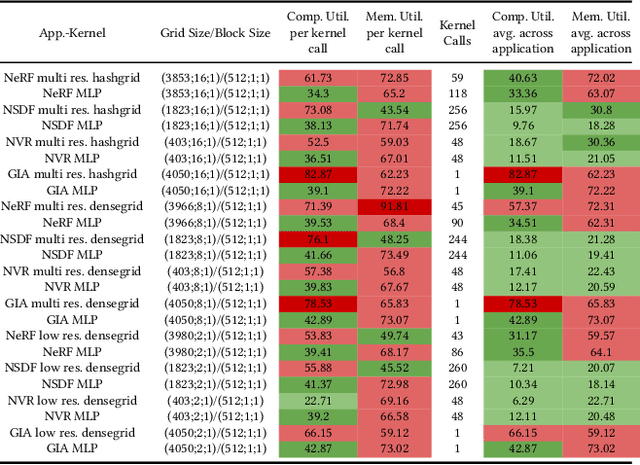
Rendering and inverse-rendering algorithms that drive conventional computer graphics have recently been superseded by neural representations (NR). NRs have recently been used to learn the geometric and the material properties of the scenes and use the information to synthesize photorealistic imagery, thereby promising a replacement for traditional rendering algorithms with scalable quality and predictable performance. In this work we ask the question: Does neural graphics (NG) need hardware support? We studied representative NG applications showing that, if we want to render 4k res. at 60FPS there is a gap of 1.5X-55X in the desired performance on current GPUs. For AR/VR applications, there is an even larger gap of 2-4 OOM between the desired performance and the required system power. We identify that the input encoding and the MLP kernels are the performance bottlenecks, consuming 72%,60% and 59% of application time for multi res. hashgrid, multi res. densegrid and low res. densegrid encodings, respectively. We propose a NG processing cluster, a scalable and flexible hardware architecture that directly accelerates the input encoding and MLP kernels through dedicated engines and supports a wide range of NG applications. We also accelerate the rest of the kernels by fusing them together in Vulkan, which leads to 9.94X kernel-level performance improvement compared to un-fused implementation of the pre-processing and the post-processing kernels. Our results show that, NGPC gives up to 58X end-to-end application-level performance improvement, for multi res. hashgrid encoding on average across the four NG applications, the performance benefits are 12X,20X,33X and 39X for the scaling factor of 8,16,32 and 64, respectively. Our results show that with multi res. hashgrid encoding, NGPC enables the rendering of 4k res. at 30FPS for NeRF and 8k res. at 120FPS for all our other NG applications.