 Add to Chrome
 Add to Firefox
 Add to Edge
PHY Authentication for Ambient IoTs in Near-Field XL-MIMO Backscatter Communication Systems
Jul 24, 2026
This letter exploits near-field (NF) spherical wavefronts to derive geometry-dependent physical signatures for backscatter device (BD) authentication in extremely large-scale multiple-input multiple-output (XL-MIMO) backscatter communication systems. We propose a binary element-wise delay shift keying (EW-DSK) modulation scheme based on a multi-antenna BD architecture. The proposed scheme introduces a deterministic, bit-dependent delay that shifts the power delay profile (PDP) while preserving the aperture-dependent curvature induced by NF propagation. Using the dominant PDP component extracted across the receive antennas, we develop a compact delay-curvature signature extractor and a corresponding authentication test to mitigate BD impersonation attacks. Simulation results evaluate the proposed scheme in terms of curvature extraction accuracy, authentication accuracy, and spoofing success probability under different spoofer distances, signal-to-noise ratios, and effective bandwidths.

Scalable Multi-BD Access for OFDM-Based Symbiotic Backscatter Communications
Jul 14, 2026We propose an interference-free multi-backscatter device (BD) access scheme for orthogonal frequency division multiplexing (OFDM)-based symbiotic backscatter communication (SBC). Specifically, we introduce an orthogonal frequency-code spread (OFC) scheme in which the transmitter reserves empty subcarriers for BDs to incorporate their information through frequency shifting, which effectively suppresses direct-link interference (DLI). Since enabling simultaneous access over shared subcarriers introduces inter-backscatter device interference (IBDI), a blockwise orthogonal code-spread is applied to assign each BD to a unique codeword, thereby mitigating IBDI with orthogonal transmissions of all BD signals in the code domain. We develop a non-coherent energy detector whose performance is analyzed in terms of average probability of missed detection (PMD) and sum-rate under Rayleigh fading. The simulation results validate the OFC scheme and demonstrate low PMD values and high spectral efficiency compared to conventional code-assisted multiple-BD access schemes.
Chirp-Based Multi-Device Ambient Backscatter Communication and Sensing Enabled by OFDM-AFDM Symbiotic Radio
Mar 09, 2026This paper presents a novel symbiotic radio system for integrated sensing and backscatter communication (ISABC) technique that enables signal-domain interference-free coexistence of the primary communication signal and the backscatter communication (BC) signal within the same spectrum. The proposed system design allows simultaneous backscatter devices (BDs) sensing and data transmission without mutual interference by exploiting waveform-domain orthogonality between orthogonal frequency division multiplexing (OFDM) and affine frequency domain multiplexing (AFDM) signals. Specifically, a chirp-based AFDM waveform is adopted due to its inherent processing gain, which enhances the detectability and reliability of the weak backscatter signal while simultaneously supporting high-resolution sensing. Unlike conventional methods that attempt to suppress direct-link interference (DLI), this approach embeds the backscatter transmission within the affine domain while maintaining reliable OFDM-based primary communication. Furthermore, by assigning distinct affine-domain shifts to each backscatter device, the proposed framework inherently suppresses inter-backscatter device interference (IBDI). Comprehensive simulation results demonstrate that the proposed coexistence scheme effectively mitigates interference without affecting the error rate of the primary link and improves the miss-detection probability performance of the BC, making it a promising candidate for future low-power and interferenceresilient systems.
Simultaneous Intrusion Detection and Localization Using ISAC Network
May 12, 2025The rapid increase in utilization of smart home technologies has introduced new paradigms to ensure the security and privacy of inhabitants. In this study, we propose a novel approach to detect and localize physical intrusions in indoor environments. The proposed method leverages signals from access points (APs) and an anchor node (AN) to achieve accurate intrusion detection and localization. We evaluate its performance through simulations under different intruder scenarios. The proposed method achieved a high accuracy of 92% for both intrusion detection and localization. Our simulations demonstrated a low false positive rate of less than 5% and a false negative rate of around 3%, highlighting the reliability of our approach in identifying security threats while minimizing unnecessary alerts. This performance underscores the effectiveness of integrating Wi-Fi sensing with advanced signal processing techniques for enhanced smart home security.
Interference Mitigation and Spectral Efficiency Enhancement in a Multi-BD Symbiotic Radio
Apr 09, 2025This study presents a framework designed to mitigate direct-link interference (DLI) and inter-backscatter device interference (IBDI) in multi-backscatter orthogonal frequency division multiplexing (OFDM)-based symbiotic radio (SR) systems. The framework employs OFDM signal designs with strategic allocation of null subcarriers and incorporates two backscatter modulation techniques: on-off frequency shift keying (OFSK) and multiple frequency shift keying (MFSK) for symbiotic backscatter communication (SBC). Additionally, we propose Fully-Orthogonal and Semi-Orthogonal multiple access schemes to facilitate SBC alongside primary communication. The Fully-Orthogonal scheme maintains orthogonality between direct link and SBC signals, thereby ensuring interference-free SBC, albeit at a reduced spectral efficiency. In contrast, the Semi-Orthogonal schemes eliminate IBDI but permit partial DLI, striking a balance between reliability and spectral efficiency. To address the partial DLI inherent in Semi-Orthogonal schemes, successive interference cancellation (SIC) is employed at the receiver, enhancing SBC reliability. To tackle channel estimation challenges in SBC within the SR system, we implement non-coherent detection techniques at the receiver. The performance of the proposed system is evaluated based on average bit error rate (BER) and sum-rate metrics, demonstrating the effectiveness of our schemes. We provide analytical results for the system's detection performance under both proposed modulation techniques and multiple access schemes, which are subsequently validated through extensive simulations. These simulations indicate a notable error-rate reduction of up to $10^{-3}$ at $20$ dB with the Fully-Orthogonal scheme with MFSK.
Interference-Free Backscatter Communications for OFDM-Based Symbiotic Radio
Aug 17, 2024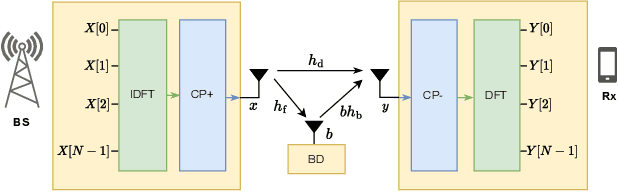
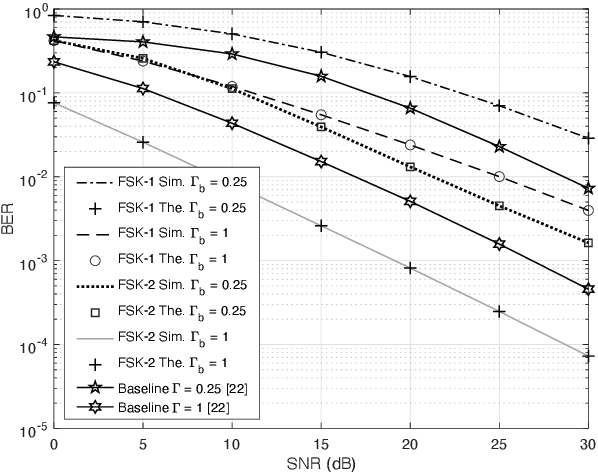
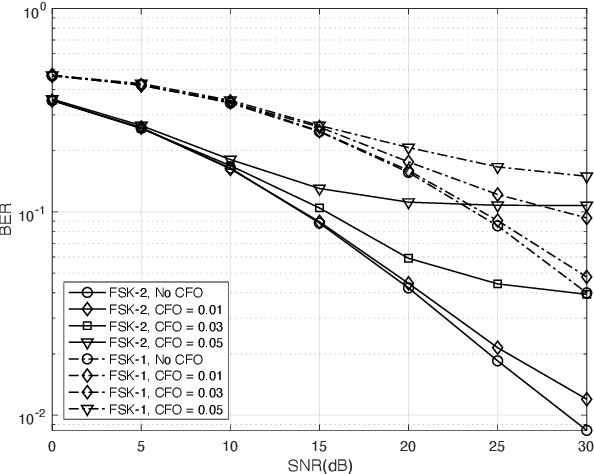
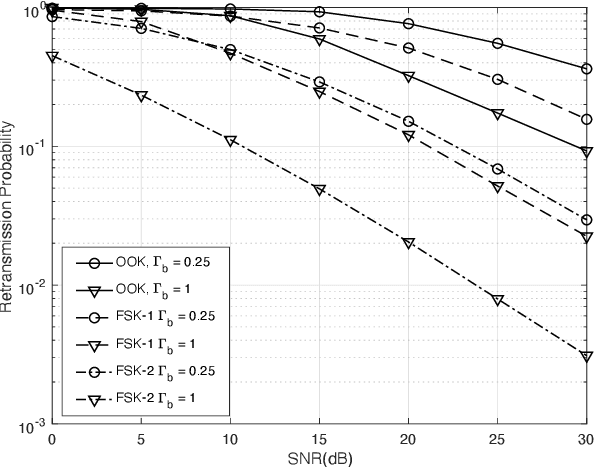
This study proposes an orthogonal frequency division multiplexing (OFDM) based scheme to achieve interference-free backscatter communications (BC) in a symbiotic radio system. In specific, we propose three frequency shift keying (FSK) based backscatter modulation schemes to shift the primary signal, i.e., the OFDM symbols transmitted from a base station (BS), in the frequency domain to transmit its information. Symbiotically, the BS empties specific subcarriers within the band so that the received frequency-shifted signals from the backscatter device and the primary signal are always orthogonal. The first scheme relies on the combination of on-off keying (OOK) within the FSK modulation while the second and the third schemes are based on the conventional FSK modulation with different in-band null-subcarrier allocation. These schemes allow the use of non-coherent detection at the receiver which addresses the channel estimation challenge for the signals arriving from a backscatter device. We derive the bit-error rate performance of the detector theoretically. The comprehensive simulations show that the proposed approach achieves a lower bit-error rate up to 10-4 at 30 dB with BC by eliminating direct link interference.
Survey on Symbiotic Radio: A Paradigm Shift in Spectrum Sharing and Coexistence
Nov 17, 2021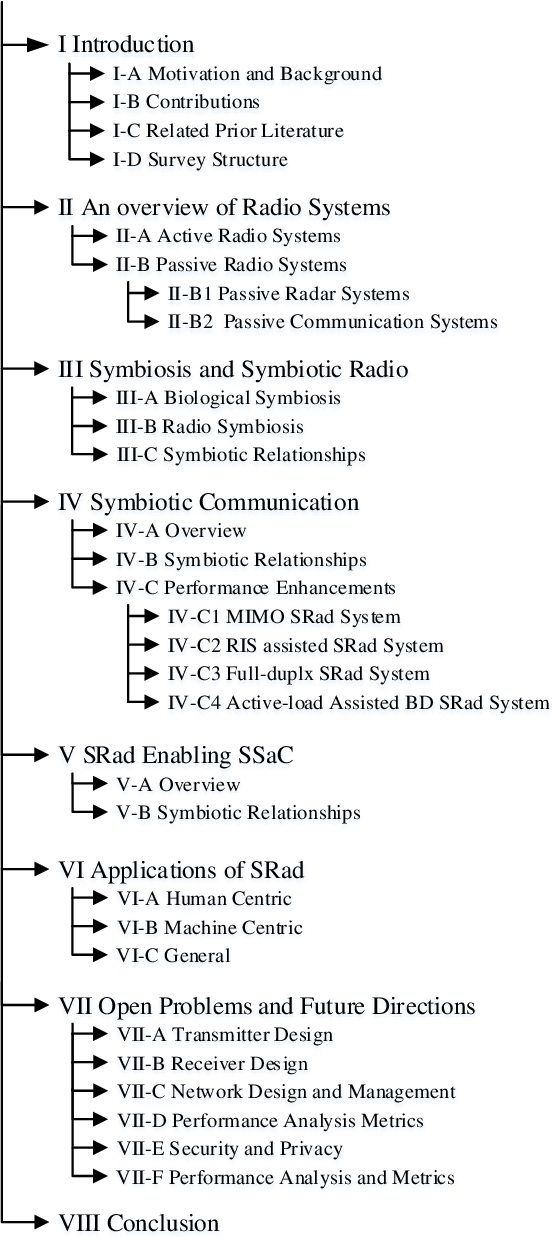
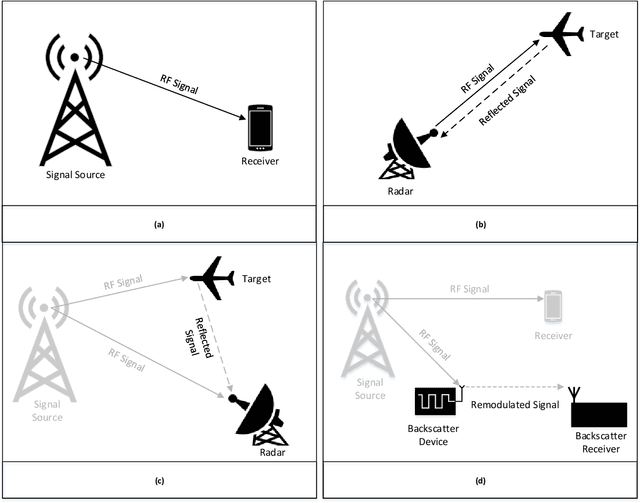
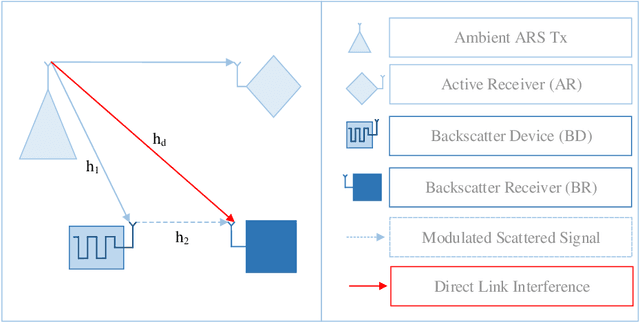
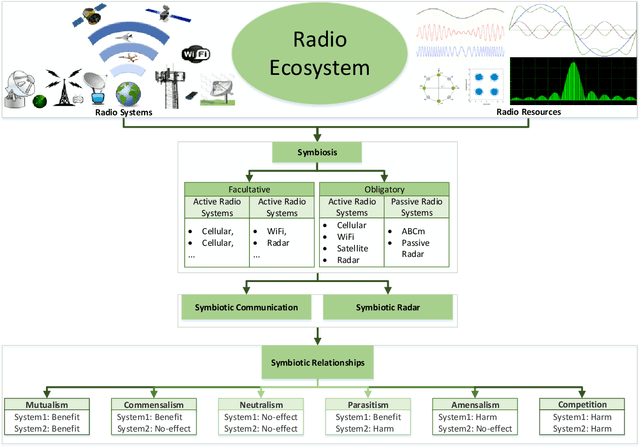
Sixth-generation (6G) of mobile communication aims to connect this world digitally through green communication networks that provide secure, ubiquitous, and unlimited connectivity in an attempt to improve the overall quality of life.The driving force behind the development of these networks is the rapid evolution of Internet-of-Things (IoT), which has stimulated the proliferation of wireless applications in health,education, agriculture, utilities, etc. However, these applications are accompanied by the deployment of a massive number of IoT devices that require a significant radio spectrum for wireless connectivity. IoT devices usually have low data rate requirements and limited power provision but desirably a long life.Recently, the development of passive radio systems has opened new paradigms of spectrum sharing and coexistence. These systems utilize the radio resources and infrastructure of the active radio systems to perform their functionalities. By enabling the dependent coexistence, a new technology named symbiotic radio (SRad) enables the symbiotic relationships between the different radio systems ranging from mutual benefits or competition in terms of sharing the resources, in particular for IoT devices. This survey first provides the motivation for dependent coexistence and background of spectrum sharing through coexistence along with existing literature. Then, it describes the active and passive radio systems definition and a brief overview. Afterward, the history of symbiosis and the role of SRad technology in spectrum sharing and coexistence are defined while focusing on symbiotic communication. Lastly, we discuss research challenges, future directions, and applications scenarios.