 Add to Chrome
 Add to Firefox
 Add to Edge
DS-SAC: Density Search for Sample Consensus
Jul 04, 2026
Robust geometric model estimation is a fundamental problem in computer vision. RANSAC and its variants remain widely used for this task; however, they rely on stochastic minimal sampling. In this article, we propose Density Search Sample Consensus (DS-SAC), a deterministic robust estimation framework, that avoids repeated random sampling by searching dense regions. Starting from an initial model estimated from the available points, the method performs local exploration via forward and backward search. To facilitate global exploration, DS-SAC recursively partitions the point set using signed residuals and searches each valid partition for high-consensus models. We show that DS-SAC has polynomial complexity with respect to the number of points, making it an efficient alternative to stochastic consensus-based methods. Experiments on large-scale real-world datasets for homography, fundamental matrix, and essential matrix estimation show that DS-SAC achieves higher AUC scores, competitive or lower median pose errors, and faster runtime compared with widely used robust estimators, including RANSAC, MAGSAC, LO-RANSAC, and GC-RANSAC.

Deep Morphological Hit-or-Miss Transform Neural Network
Dec 04, 2019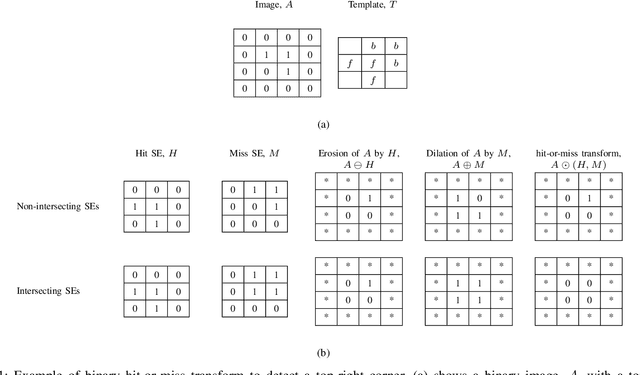
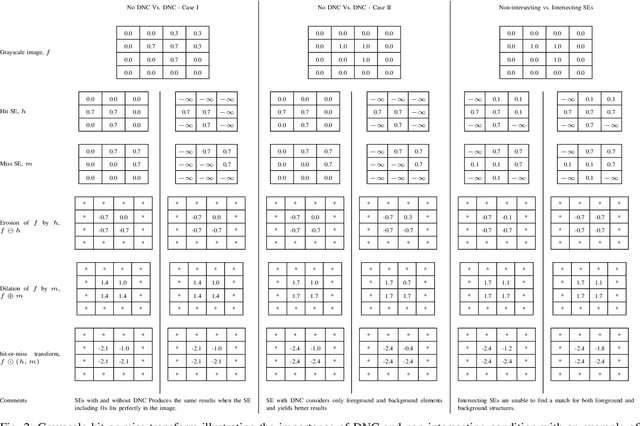
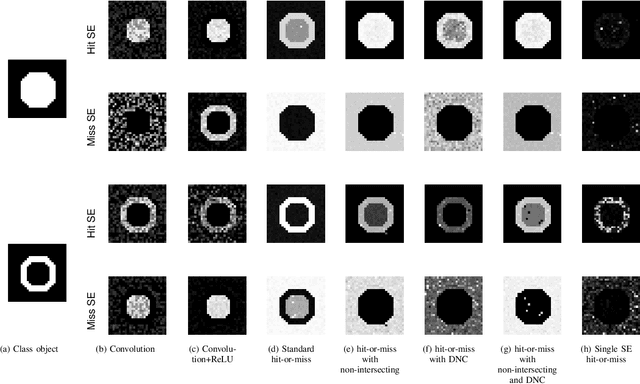
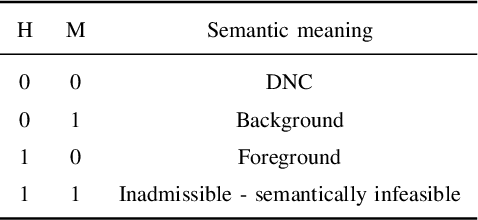
Neural networks have demonstrated breakthrough results in numerous application domains. While most architectures are built on the premise of convolution, alternative foundations like morphology are being explored for reasons like interpretability and its connection to the analysis and processing of geometric structures. Herein, we investigate new deep networks based on the morphological hit-or-miss transform. The hit-or-miss takes into account both foreground and background when measuring the fitness of a target shape in an image. We identify limitations of current hit-or-miss definitions, and we formulate an optimization problem to learn the transform. Our analysis shows that convolution, in fact, acts like a hit-miss transform through semantic interpretation of its filter differences. Analogous to the generalized hit-or-miss transform, we also introduce an extension of convolution and show that it outperforms conventional convolution on benchmark data sets. We conducted experiments on synthetic and benchmark data sets, and we show that the direct encoding hit-or-miss transform provides better interpretability on learned shapes consistent with objects whereas our morphologically inspired generalized convolution yields higher classification accuracy.
Fusion of heterogeneous bands and kernels in hyperspectral image processing
May 22, 2019Hyperspectral imaging is a powerful technology that is plagued by large dimensionality. Herein, we explore a way to combat that hindrance via non-contiguous and contiguous (simpler to realize sensor) band grouping for dimensionality reduction. Our approach is different in the respect that it is flexible and it follows a well-studied process of visual clustering in high-dimensional spaces. Specifically, we extend the improved visual assessment of cluster tendency and clustering in ordered dissimilarity data unsupervised clustering algorithms for supervised hyperspectral learning. In addition, we propose a way to extract diverse features via the use of different proximity metrics (ways to measure the similarity between bands) and kernel functions. The discovered features are fused with $l_{\infty}$-norm multiple kernel learning. Experiments are conducted on two benchmark datasets and our results are compared to related work. These datasets indicate that contiguous or not is application specific, but heterogeneous features and kernels usually lead to performance gain.
Enabling Explainable Fusion in Deep Learning with Fuzzy Integral Neural Networks
May 10, 2019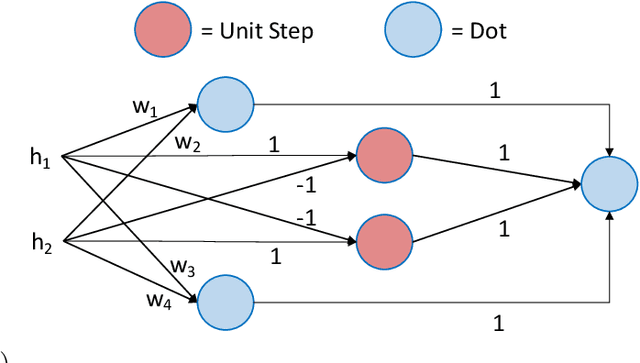
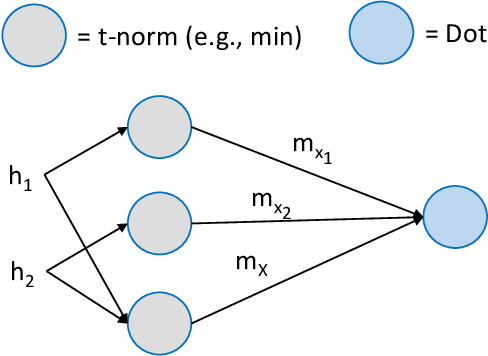
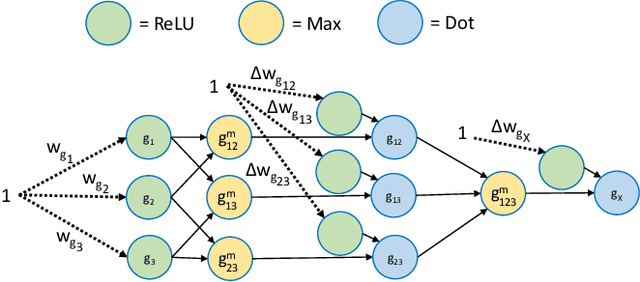
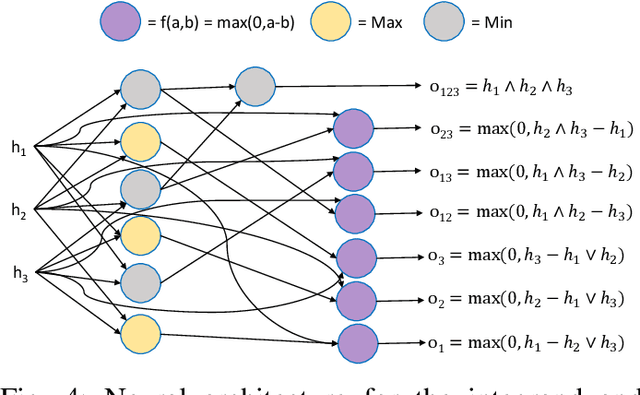
Information fusion is an essential part of numerous engineering systems and biological functions, e.g., human cognition. Fusion occurs at many levels, ranging from the low-level combination of signals to the high-level aggregation of heterogeneous decision-making processes. While the last decade has witnessed an explosion of research in deep learning, fusion in neural networks has not observed the same revolution. Specifically, most neural fusion approaches are ad hoc, are not understood, are distributed versus localized, and/or explainability is low (if present at all). Herein, we prove that the fuzzy Choquet integral (ChI), a powerful nonlinear aggregation function, can be represented as a multi-layer network, referred to hereafter as ChIMP. We also put forth an improved ChIMP (iChIMP) that leads to a stochastic gradient descent-based optimization in light of the exponential number of ChI inequality constraints. An additional benefit of ChIMP/iChIMP is that it enables eXplainable AI (XAI). Synthetic validation experiments are provided and iChIMP is applied to the fusion of a set of heterogeneous architecture deep models in remote sensing. We show an improvement in model accuracy and our previously established XAI indices shed light on the quality of our data, model, and its decisions.