 Add to Chrome
 Add to Firefox
 Add to Edge
Clinical Term Extraction using Open-Source Small Language Models
Jun 19, 2026
Clinical information for amyotrophic lateral sclerosis (ALS) care documented in unstructured clinical notes limits downstream analysis without extraction into structured formats. Open-source small language models with few-shot prompting for detecting the presence of ALS-relevant clinical terms in patient documentation were evaluated without task-specific training data. The detection task targeted 17 categories spanning functional scores, respiratory measures, medications, and related clinical and non-clinical attributes. Clinical note content was normalized from JSON-encoded discharge summaries and processed with a prompt template having structured JSON outputs. We compared 26 open-source models using aggregate, label-level, and manual-validation multilabel classification metrics. Manual validation showed that a regex rule baseline had higher overall micro-F1 and lower Hamming loss than any single SLM or TF-IDF baseline, while Qwen3-4B-Instruct-2507 was the highest-performing SLM by micro-F1. Model rankings varied by metric and label category, with the TF-IDF baseline showing high recall but low precision, some SLMs showing higher precision but lower recall, and Hammer2.1-7b showing strong performance for ALSFRS-R subscore detection. These findings support targeted hybrid extraction workflows rather than replacement of existing rule-based methods.

Heartbeat Detection from Ballistocardiogram using Transformer Network
Dec 18, 2024Longitudinal monitoring of heart rate (HR) and heart rate variability (HRV) can aid in tracking cardiovascular diseases (CVDs), sleep quality, sleep disorders, and reflect autonomic nervous system activity, stress levels, and overall well-being. These metrics are valuable in both clinical and everyday settings. In this paper, we present a transformer network aimed primarily at detecting the precise timing of heart beats from predicted electrocardiogram (ECG), derived from input Ballistocardiogram (BCG). We compared the performance of segment and subject models across three datasets: a lab dataset with 46 young subjects, an elder dataset with 28 elderly adults, and a combined dataset. The segment model demonstrated superior performance, with correlation coefficients of 0.97 for HR and mean heart beat interval (MHBI) when compared to ground truth. This non-invasive method offers significant potential for long-term, in-home HR and HRV monitoring, aiding in the early indication and prevention of cardiovascular issues.
Deep Morphological Hit-or-Miss Transform Neural Network
Dec 04, 2019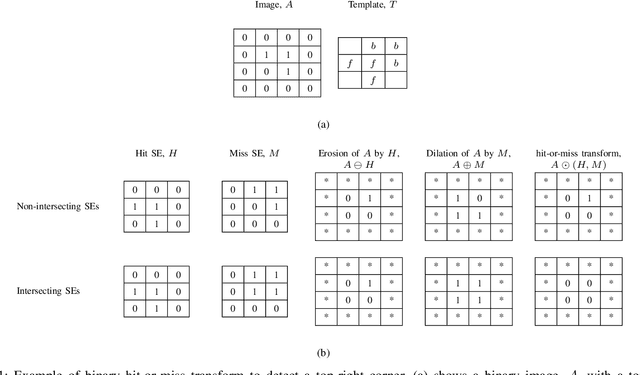
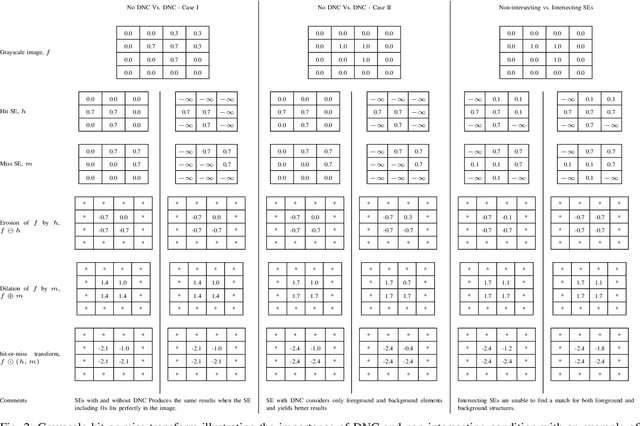
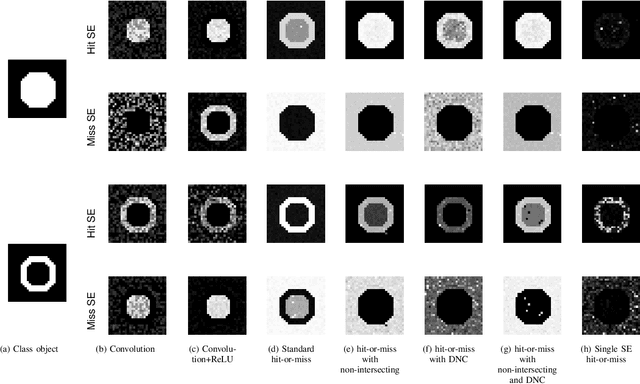
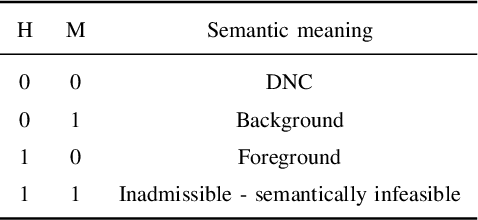
Neural networks have demonstrated breakthrough results in numerous application domains. While most architectures are built on the premise of convolution, alternative foundations like morphology are being explored for reasons like interpretability and its connection to the analysis and processing of geometric structures. Herein, we investigate new deep networks based on the morphological hit-or-miss transform. The hit-or-miss takes into account both foreground and background when measuring the fitness of a target shape in an image. We identify limitations of current hit-or-miss definitions, and we formulate an optimization problem to learn the transform. Our analysis shows that convolution, in fact, acts like a hit-miss transform through semantic interpretation of its filter differences. Analogous to the generalized hit-or-miss transform, we also introduce an extension of convolution and show that it outperforms conventional convolution on benchmark data sets. We conducted experiments on synthetic and benchmark data sets, and we show that the direct encoding hit-or-miss transform provides better interpretability on learned shapes consistent with objects whereas our morphologically inspired generalized convolution yields higher classification accuracy.