 Add to Chrome
 Add to Firefox
 Add to Edge
ORPA: Online Residual Policy Adaptation for Robot Manipulation Control with Human Feedback
Aug 18, 2026
Robotic manipulation policies trained via imitation learning, such as Action Chunking with Transformers (ACT), can achieve strong performance under ideal conditions but often remain sensitive to small execution errors and distribution shifts. Correcting these failures typically requires dataset aggregation and full-policy retraining, which is computationally expensive and unsuitable for real-time deployment. In this work, we propose Online Residual Policy Adaptation (ORPA), a framework that enables immediate, feedback-driven correction of robot actions without modifying the underlying policy parameters. ORPA augments a pretrained control policy with a lightweight, feedback-conditioned module that predicts residual adjustments directly in joint space, allowing the system to adapt its behavior at runtime. We evaluate ORPA on a set of precision-sensitive manipulation tasks using the ALOHA platform, demonstrating improvements in success rate and recovery from small perturbations compared to baseline control policies and rule-based inverse kinematics corrections.

Visual Prompting for Robotic Manipulation with Annotation-Guided Pick-and-Place Using ACT
Aug 12, 2025Robotic pick-and-place tasks in convenience stores pose challenges due to dense object arrangements, occlusions, and variations in object properties such as color, shape, size, and texture. These factors complicate trajectory planning and grasping. This paper introduces a perception-action pipeline leveraging annotation-guided visual prompting, where bounding box annotations identify both pickable objects and placement locations, providing structured spatial guidance. Instead of traditional step-by-step planning, we employ Action Chunking with Transformers (ACT) as an imitation learning algorithm, enabling the robotic arm to predict chunked action sequences from human demonstrations. This facilitates smooth, adaptive, and data-driven pick-and-place operations. We evaluate our system based on success rate and visual analysis of grasping behavior, demonstrating improved grasp accuracy and adaptability in retail environments.
Attention-Guided Integration of CLIP and SAM for Precise Object Masking in Robotic Manipulation
Feb 26, 2025This paper introduces a novel pipeline to enhance the precision of object masking for robotic manipulation within the specific domain of masking products in convenience stores. The approach integrates two advanced AI models, CLIP and SAM, focusing on their synergistic combination and the effective use of multimodal data (image and text). Emphasis is placed on utilizing gradient-based attention mechanisms and customized datasets to fine-tune performance. While CLIP, SAM, and Grad- CAM are established components, their integration within this structured pipeline represents a significant contribution to the field. The resulting segmented masks, generated through this combined approach, can be effectively utilized as inputs for robotic systems, enabling more precise and adaptive object manipulation in the context of convenience store products.
Mobile Robots through Task-Based Human Instructions using Incremental Curriculum Learning
Dec 26, 2024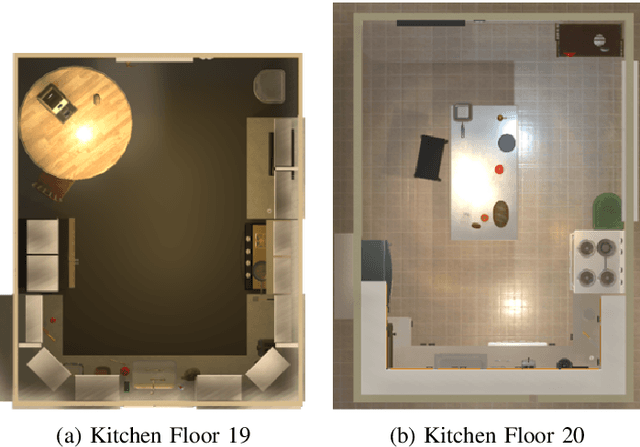
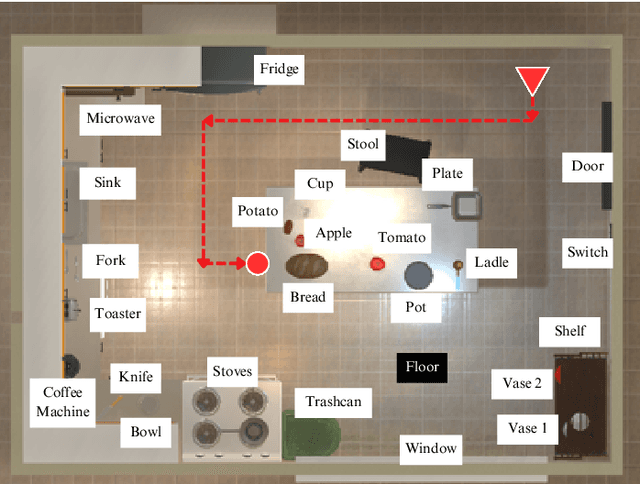
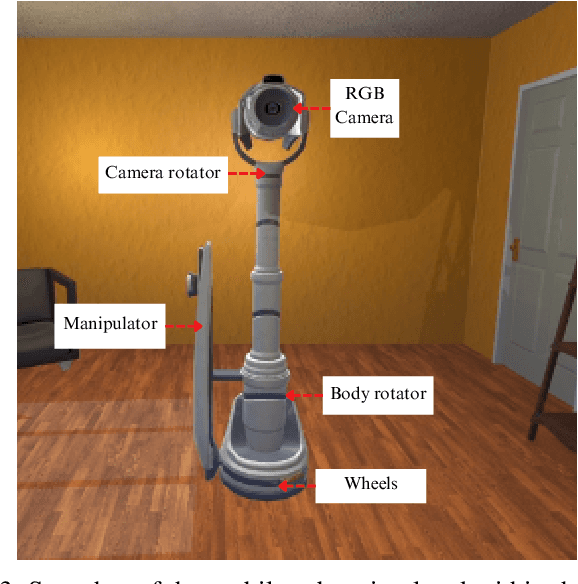
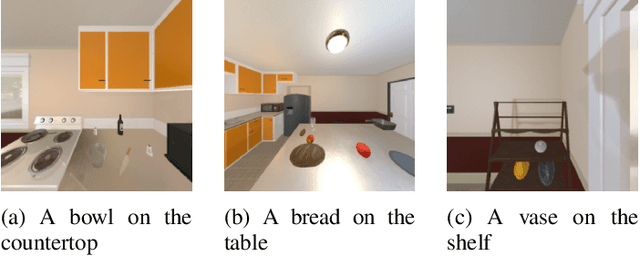
This paper explores the integration of incremental curriculum learning (ICL) with deep reinforcement learning (DRL) techniques to facilitate mobile robot navigation through task-based human instruction. By adopting a curriculum that mirrors the progressive complexity encountered in human learning, our approach systematically enhances robots' ability to interpret and execute complex instructions over time. We explore the principles of DRL and its synergy with ICL, demonstrating how this combination not only improves training efficiency but also equips mobile robots with the generalization capability required for navigating through dynamic indoor environments. Empirical results indicate that robots trained with our ICL-enhanced DRL framework outperform those trained without curriculum learning, highlighting the benefits of structured learning progressions in robotic training.
Precision and Adaptability of YOLOv5 and YOLOv8 in Dynamic Robotic Environments
Jun 01, 2024Recent advancements in real-time object detection frameworks have spurred extensive research into their application in robotic systems. This study provides a comparative analysis of YOLOv5 and YOLOv8 models, challenging the prevailing assumption of the latter's superiority in performance metrics. Contrary to initial expectations, YOLOv5 models demonstrated comparable, and in some cases superior, precision in object detection tasks. Our analysis delves into the underlying factors contributing to these findings, examining aspects such as model architecture complexity, training dataset variances, and real-world applicability. Through rigorous testing and an ablation study, we present a nuanced understanding of each model's capabilities, offering insights into the selection and optimization of object detection frameworks for robotic applications. Implications of this research extend to the design of more efficient and contextually adaptive systems, emphasizing the necessity for a holistic approach to evaluating model performance.